
WO 121 covers soldiers discharged 1787–1813 and awarded Chelsea out-pensions. Learn why the paper is not a service file for every soldier. Start at the original repository’s guide and note its stated series coverage. See our affiliate disclosure before comparing paid record platforms.
Use the Discharge-and-Award Test Before Searching
WO 121 is not a roll of everyone who served in the British Army during the Napoleonic period. The National Archives describes it specifically as papers for soldiers discharged between 1787 and 1813 who were awarded a Chelsea out-pension. Both qualifications matter: relevant discharge dates and a pension outcome. A person known only from a battle narrative or a later family story may fall outside this surviving collection. Start with the man’s regiment, approximate age, enlistment context and possible discharge year.
Create two separate hypotheses: a soldier served in the army, and that soldier was discharged with an out-pension within the stated period. An enlistment citation or a regiment history may help the first, but it does not settle the second. Search names with initials, known variants and regimental clues. Do not merge a common-name pensioner with your target merely because a date of discharge looks plausible. Record what personal details the actual record provides before deciding that a candidate matches.
Know the Difference Between Out-Pensioner and Resident
Chelsea was a royal hospital associated with military pension administration. Many recipients of pensions were out-pensioners, meaning that they received payments without residing in the hospital. In-pensioners were a different residential group. Therefore “Chelsea pensioner” in a census, pension record or obituary does not establish that a soldier lived at the hospital. A document noting an out-pension is evidence of an administrative entitlement, not a household address or proof that dependants resided nearby.
If a family tradition says an ancestor lived at Chelsea, test that claim with a distinct residence record, pension admission category and dated census. Pension-related addresses can be where a claimant collected money or maintained correspondence. Enter the words in-pensioner and out-pensioner exactly as written, instead of replacing both with “veteran resident.” Where a later residence is found, do not project it backwards across the whole pension period. The status date matters just as much as the wording.
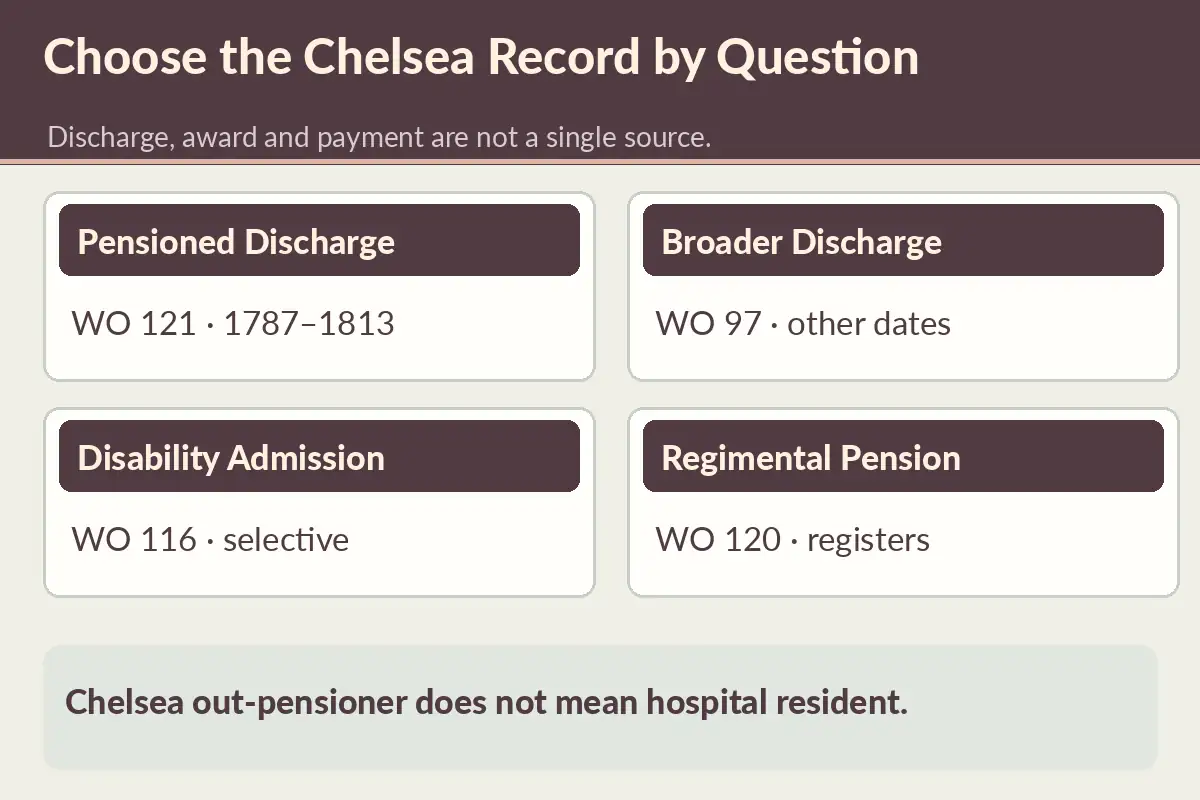
Distinguish WO 121 From WO 97 and Pension Books
The Archives’ Army guide separates different Chelsea-related holdings by their scope and date. WO 97 contains broader groups of discharge documents, WO 116 concerns certain admission and disability pension records, and WO 120 contains registers of admissions to pension arranged by regiment. WO 131 concerns later deferred pensions. They are different tools, not successive pages of one soldier’s dossier. If WO 121 yields no match, choose the next source according to date, reason for discharge and the evidence needed.
An out-pension record might document a named entitlement, a discharge date and service details; a later payment register answers a question about administration at another date. Compare one entry at a time, preserving source references and administrative purposes. Absence from an online WO 121 name index does not prove that a man never served, was never wounded or never received a different pension. Ask whether he was discharged by purchase, died in service, served in another formation or qualified outside the collection years.
Build a Regiment-Based Identity Test for Namesakes
Early nineteenth-century soldiers often shared names and moved among units. A list extracted from a website is rarely adequate to identify one as a particular ancestor. Compile candidate records with regiment, rank, approximate age, date of discharge, birthplace when reported and distinguishing family clues. Contemporary spellings of regimental titles may vary. A regiment name remembered by a later descendant can also refer to a unit under a different designation at the relevant date.
For each possible man, keep a separate worksheet. A match of name and rank alone receives only provisional status. A mismatch in regiment or discharge year may exclude a candidate, but consider recorded transfers or transcription errors before discarding original evidence. Link the successful candidate to an independent parish baptism, marriage, burial or locality clue rather than assuming that the pension biography is inherently genealogical proof. Citing both the source and the logic is essential.

Separate Admission, Award and Actual Payment
An administrative award and evidence of a later payment are not the same event. The Archives points to pension registers and payment returns in other War Office series for particular eras and locations. Even where WO 121 confirms that the soldier was awarded an out-pension, it may not reveal whether money was received continuously, changed amount or was paid overseas at a later date. Never calculate a lifetime income by multiplying one stated rate by presumed years of survival.
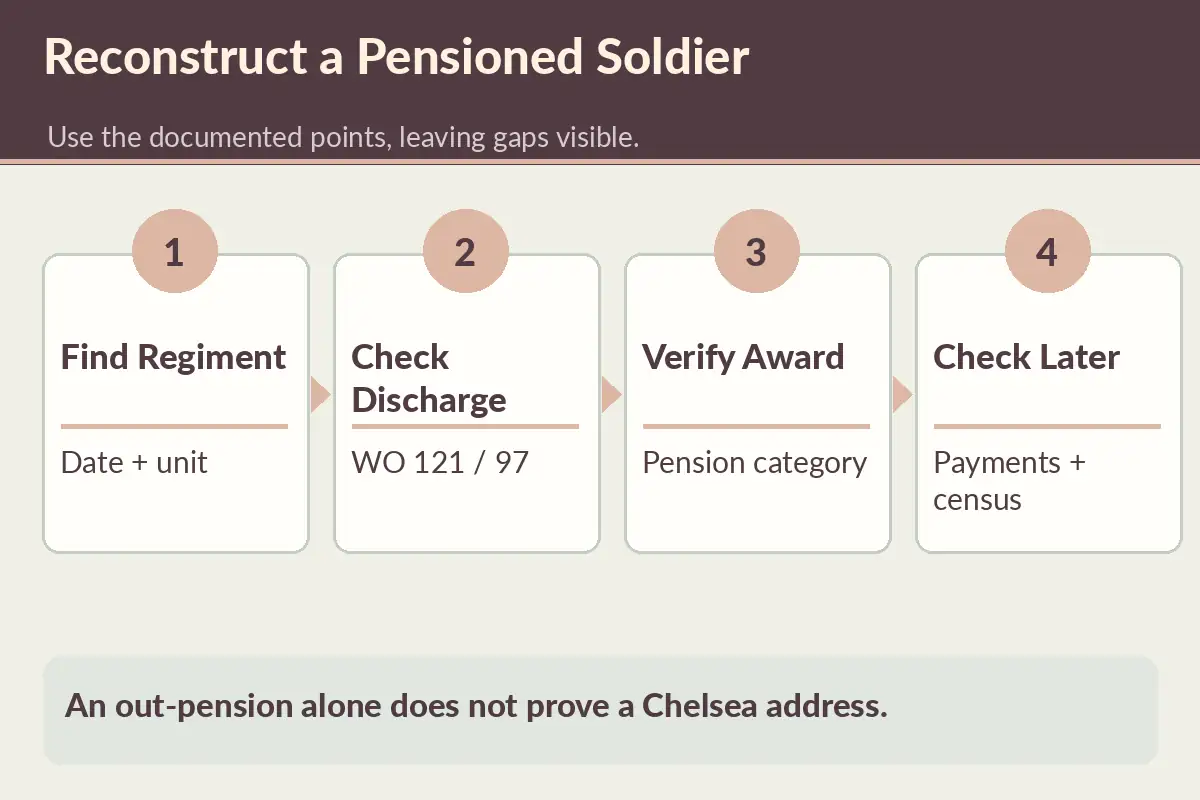
To examine the later history, first note the award or discharge date, regiment and any pension reference from WO 121. Select a register or payment series that actually covers the subsequent place and time. If no payment entry survives, state only what the award record proves. A pension can lapse, transfer, change form or be recorded under a different administrative arrangement. Your family tree should not treat pension eligibility as direct evidence of wealth, uninterrupted employment or residence.
Report a Discharge With Evidence Limits and Dates
Write a concise, documented military profile: the soldier’s name as recorded, regiment, approximate period of service, dated discharge and precise pension status. Add only fields actually read from the relevant document. If the paper contains a medical opinion or other assessment, attribute it to that source and period; avoid using historical terminology to diagnose a modern condition. When records conflict over age or place of birth, preserve the disagreement and search for independent civil or church sources.
A useful final research table has columns for document, claimed fact, date, independent support and a competing-name test. Record paid access limitations transparently; the National Archives indicates that partner access to some pre-1915 Army images is chargeable. An incomplete or unindexed record group should produce a bounded research conclusion, not an assertion that an ancestor was never a pensioner. Separating discharge from later pension administration is the central safeguard against an invented continuous career.
How We Research This Archival Record Class
We first establish why an office created the record, the years and people actually covered, and its current custody and access status. A searchable catalogue description is not the original document, and a provider index may omit names or normalize dates. We record a positive finding exactly as written and distinguish it from inferences about identity, residence, family relationship or legal outcome. Every plausible namesake gets a separate comparison based on contemporary identifiers. Negative searches include what series, piece, years and spelling variants were really checked. A claim is accepted only when the evidence supports that narrow wording; gaps remain visible.
More Records and Archives Guides
Official Research Sources and Evidence Limits
The custodian’s collection guide confirms States that WO 121 covers discharged British Army soldiers 1787–1813 who were awarded Chelsea out-pensions, alongside distinct WO 97/131/122 paths.. Additional archive guidance confirms Identifies digitized pre-1915 British Army and militia records including WO 121, and paid provider access.. These describe surviving series, not an individual ancestor’s case. Check the actual Discovery entry for piece-by-piece access and current closure information, and cite the original page where possible rather than copying a later index entry without inspection.
No. It concerns soldiers in the specified period who were awarded a Chelsea out-pension.
Not necessarily. Out-pensioners received pensions without being resident in the hospital.
The series have different discharge and pension-linked coverage; consult each guide.
No. Later pension returns are needed to test actual payments.
No. Test eligibility, survival, name variants and other military series.