
Use a Regiment-First Chelsea Pension Search
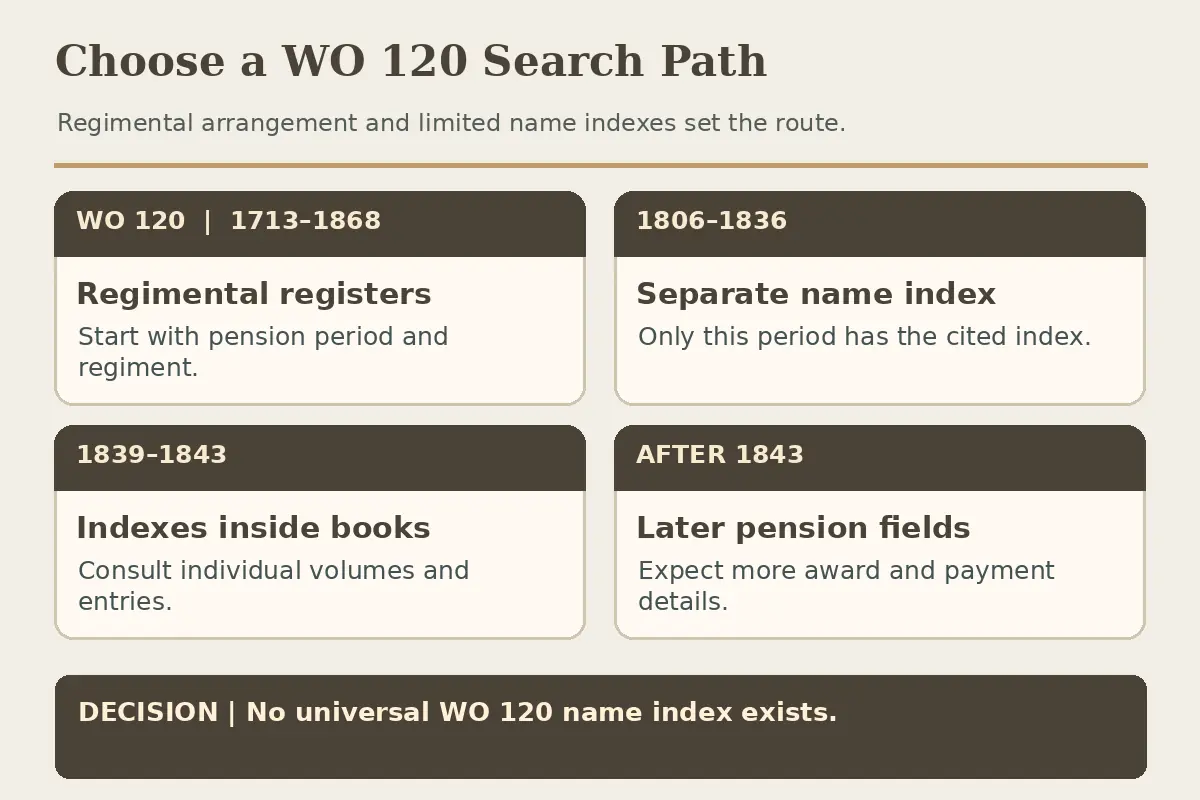
WO 120 contains Royal Hospital Chelsea regimental registers of pension admissions, with records in a broad 1713–1868 span. An entry can help identify a retired soldier or a pension award, but it should not be mistaken for a complete enlistment-to-discharge file. The registers are arranged by regiment. If you start with a common surname but no unit, the catalogue search may be less useful than an independently documented regimental connection.
The National Archives guide to soldiers before 1913 specifies a name index for 1806–1836 only and indexes included within the volumes for 1839–1843. These are limited finding aids, not a universal name index for WO 120. Write the exact range searched. A name absent from the 1806–1836 index is not proof that no pension admission appears elsewhere.
Before opening a volume, establish the soldier’s possible regiment, relevant dates and whether the evidence points toward Chelsea pension admission rather than the Royal Hospital Kilmainham series WO 118. Pension administration records were produced for different purposes; the word “pensioner” does not by itself identify one specific hospital, regiment or category of discharge.
Use 1843 as a Field-Content Warning
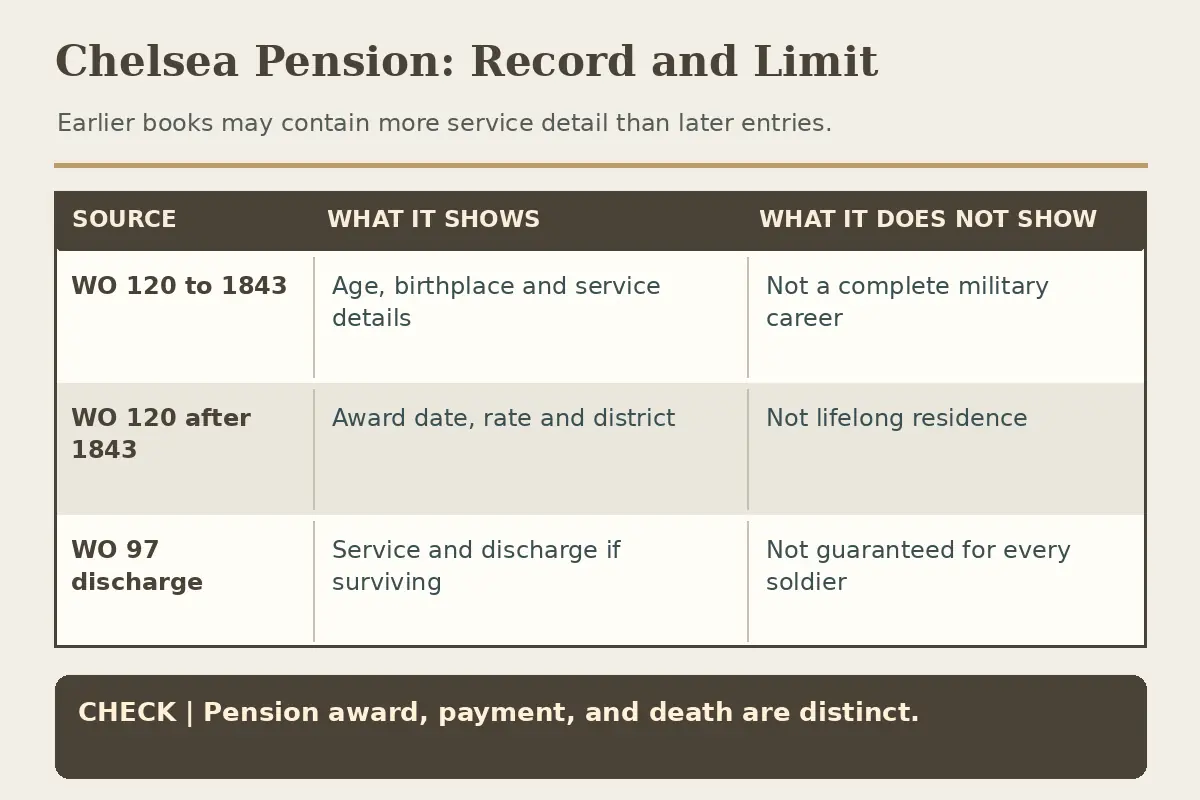
Library and Archives Canada’s official War Office research guide describes WO 120 as seven overlapping sets of regimental pension registers. Earlier registers, up to 1843, can include age, birthplace, service and discharge detail. Later entries usually emphasize the pension award date, rate and district of payment. A researcher cannot expect the same columns in every volume across a century and a half.
A district where a pension was received does not prove an ancestor lived there for the entire award period. Some entries may include death dates after about 1812, but that information is not a universal death-register field. Likewise birthplace reported at the end of military service may reflect the informant’s knowledge or a historical spelling. Preserve the original place form before connecting it to a modern parish or county.
Use a two-stage evidence chart: first ask which date band and volume applies, then inventory actual columns in that volume. Do not copy an online summary’s generalized list of possible fields as if they are all present on your ancestor’s page. If the writing is abbreviated, expand the term cautiously and record the literal reading in your research notes.
Separate Pension Admission From Army Service
Record the admission date, named regiment, any recorded number or unit, service statement, pension rate and district separately. If an entry gives “years of service,” check whether it includes special allowances or a rounded calculation; do not convert it straight into an exact enlistment date without verifying the record’s wording. A pension admission is an administrative event distinct from an enlistment, discharge or medical finding.
The National Archives distinguishes WO 120 from WO 116 disability out-pension awards and WO 97 soldiers’ discharge papers. Those alternatives can answer different questions and their survival patterns vary. A record in a pay series such as WO 22 shows a payment or administrative event, not necessarily proof of the original pension decision. The diagram below places each record beside its proper evidentiary limit.
If a regimental designation changed, consult the unit’s date-specific history rather than simply assuming a modern successor had the same identity. Namesakes can serve in different units over the same decade. Match age, birthplace, regiment, admission date and any discharge or attestation record. Describe an uncertain identification as a candidate rather than adding unsupported military campaigns to a family narrative.
Trace a Pension Recipient Without Assuming Death
Follow an award with a separate dated pension payment, register notation, civil death certificate, burial record or other applicable event record. A stop in a payment run can reflect movement, transfer, an administrative interval or death; do not automatically choose the last explanation. Later WO 120 entries provide districts and rates useful as leads, but these are not continuous residential addresses.
A service or disability question may call for original discharge or medical documents rather than a pension-admission entry. Compare the full dates on the sources. If a Chelsea register records an administrative award and a later separate register reports a different amount, preserve the interval between them. Do not put both amounts in a single fictional “initial pension” row.
If an earlier book appears to name an overseas birthplace or a district with several spelling variants, cross-check local jurisdiction and the soldier’s other sources. Library and Archives Canada highlights the relevance of some WO 120 volumes for pensioners abroad, but a Canadian settlement cannot be assumed merely because a surname appears in a volume used by researchers there.
More Records and Archives Guides
How We Research Chelsea Pension Evidence
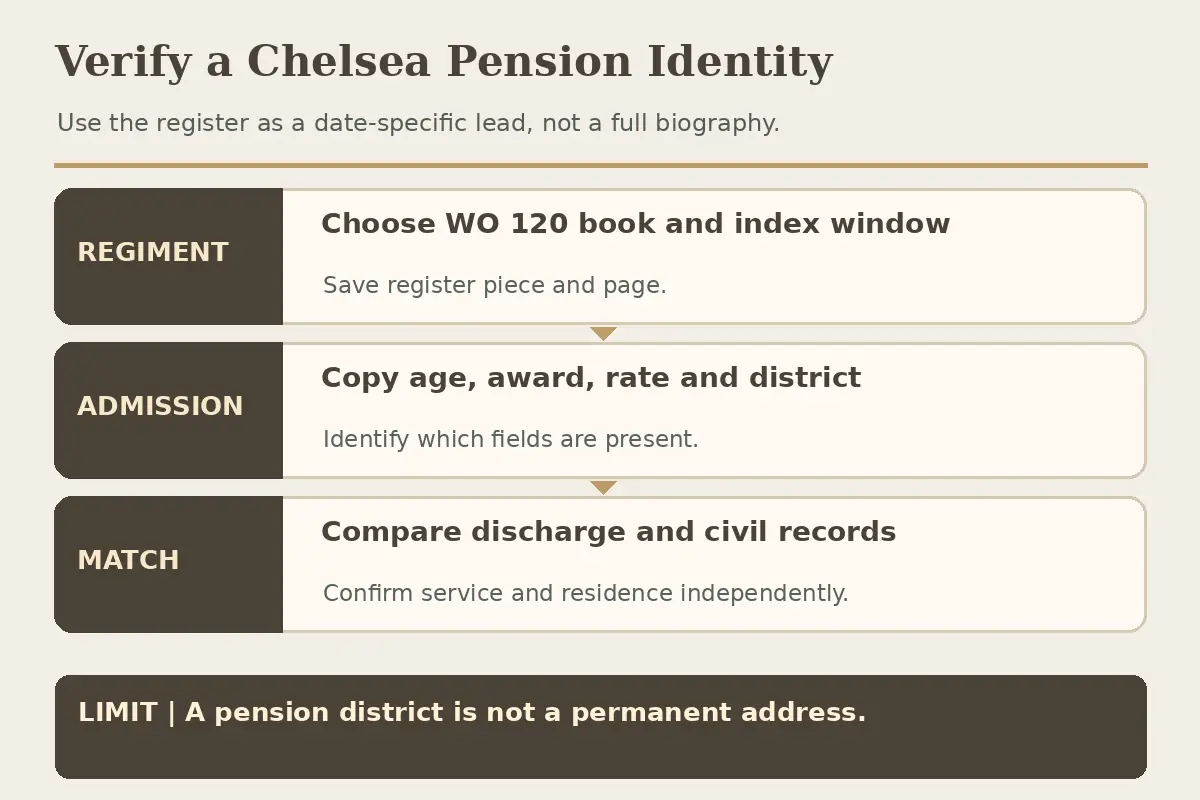
We start with the regiment and exact date span, use only the indexes that actually cover it, then read the complete WO 120 entry. Our first scheme separates index windows; the second distinguishes pension, service and place evidence; the third requires an independent person-level record before making biographical claims. None of the illustrations represents an original soldier’s pension certificate.
A full reference identifies WO 120, piece, page or folio, regiment, entry date and the image or reading-room source. Note uncertainty in dates and numbers, especially where a handwritten abbreviation could be mistaken for a unit code. Current Discovery descriptions and access arrangements should always be rechecked before ordering a piece or relying on a website’s index.
Our affiliate disclosure records the site’s commercial transparency. The purpose of the method is to verify a precisely dated pension event without transforming a useful administrative entry into unsupported campaign service, permanent residence or an undocumented date of death.
A series of regimental registers of admissions to pensions from the Royal Hospital Chelsea.
No. A name index covers 1806–1836, and the 1839–1843 volumes contain their own indexes.
Earlier and later registers commonly contain different kinds of personal and pension information.
Not by itself. It identifies an administrative district and needs independent residence evidence.
Some entries contain death information, but it is not universal and should be independently checked.