
BT 124 records certificates of service issued to certain masters and mates in the British Merchant Navy’s foreign trade. It is not a ship’s logbook and not a comprehensive chronological list of every voyage a mariner made. A certificate-of-service entry can document that an officer received a specified recognition on a stated date. It cannot alone prove that the officer sailed aboard a named ship on an arbitrary later day or passed a certificate-of-competency examination.
The National Archives’ Merchant Navy officers guide explains the crucial route: find the certificate number in the relevant index, particularly BT 127, and use the number and type to select a register series. For foreign-trade service certificates, consult BT 124; competency certificates or home-trade service credentials are elsewhere. Keeping those paths separate prevents a genuine certificate match from being misrepresented as a complete sailing career.
Distinguish service certificates from competency awards
Historical certificates of service could recognize experienced officers, while certificates of competency reflected a qualifying examination process. Both are legitimate but they support different claims. The National Archives gives number bands for BT 124: 35,000–54,999 for foreign-trade masters, 55,000–69,999 for mates, 70,000–78,999 for a further set of masters, and 79,000–80,999 for mates. These bands are a navigation aid, not a guarantee that every number refers to a surviving or fully completed personal record.
If a researcher finds a number outside those categories, do not force it into BT 124. BT 122 covers certain foreign-trade competency awards; BT 125 and BT 126 concern home-trade qualifications or service, and other grades have different series. The guide also notes colonial certificates with letter prefixes in BT 128. Record the actual grade, trade, certificate kind and number before choosing any register; “captain” in a family story is not a sufficient series selector.

Use the name index to reach the right register
Begin with a full name, possible birth year, known port, and any previous rank or ship. Consult the index in BT 127, noting alternative initials, spelling variants, and the guide’s warning that Mc or Mac surnames may be alphabetized under the letter following the prefix. When a plausible index entry supplies a certificate number, capture the index reference before opening the corresponding BT 124 register volume. This chain makes a match checkable by a second researcher.
A name index is a finding aid rather than the original certification evidence. A number or surname can be copied incorrectly, especially across handwritten registers. Confirm the officer’s birthplace, birth year, grade, place and date of certification, where shown. If two men share the same name, do not treat a nearby certificate number as a reliable identity clue. Keep candidates separate until personal details or another independent record distinguishes them.
Interpret dates in an officer’s register
The National Archives notes that registers may record certificate issue and, for certain older certificates, information about voyages. Importantly, dates relating to voyages in certificates issued up to 1888 can be the dates records were filed, not necessarily departure or arrival. Some paperwork was filed after a sequence of voyages. Do not turn a registry date into a precise sea passage or immigration event without a separate voyage source.
A later entry or replacement certificate may bear a new number if an earlier document was lost. The sequence does not automatically indicate a promotion or a new ship. Copy any explanatory annotations, cross-references, and differing dates exactly. For post-1888 certificates a death date may sometimes be noted, but its absence is not evidence that an officer was alive at a later date. Treat each field according to the function of the register rather than the story you hope it tells.
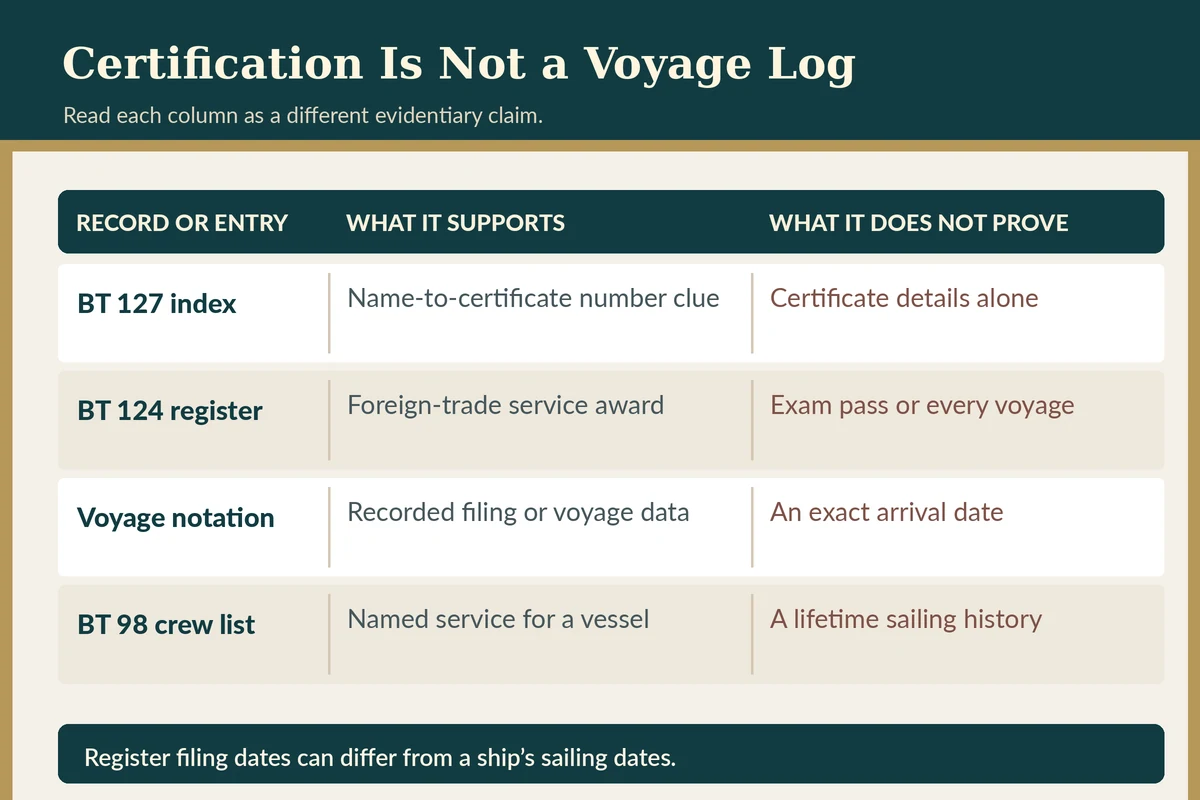
Keep certification and ship service in different columns
Make a ledger listing index name, BT 127 reference, certificate number, BT 124 volume, certification grade and trade, issue details, recorded birth information, and any separate voyage notation. Next add another column for the specific claim being tested: “qualified as mate by this date,” “served as master on a named ship,” or “arrived at a specified port.” A single certification entry supports some of these much more directly than others.
When a family narrative identifies a particular voyage, search crew lists such as BT 98 as directed by the officer research guide. Compare vessel name, official number where applicable, officer capacity, and engagement or discharge details. Lloyd’s Lists and other maritime publications may assist with ship movements, but movement evidence for a vessel is not proof that an individual officer was aboard on the same trip. Explain the difference in the written conclusion.
Handle gaps and misleading index matches
Not every service record survives in identical detail or has been digitized as a searchable name record. The National Archives lists some material within its digital microfilm guide, but the presence of a series in an online resource does not mean every page can be reliably searched by every personal name. Search adjacent index spellings, note the index’s alphabetization rules, and check the actual register rather than counting a search snippet as a citation.
Also consider the officer’s trade and era. A home-trade mate may properly appear in BT 126 rather than BT 124. A steam certificate, an engineer, or a fishing officer belongs on another route, even if a family source generically says “ship officer.” Do not combine two different certificates simply because the surname matches. An unlocated BT 124 entry may indicate that the research question selected the wrong kind of qualification rather than that the person was never an officer.

More Records and Archives Guides
How We Research Merchant Officer Certificates
Our starting point is a certificate-number audit: name index, number, rank and trade, then the original series. We transcribe the recorded issue and identity fields before using them in a biography. A separate voyage proof table cites crew agreements or other person-level evidence. This prevents the common mistake of reading administrative filing dates as if they were departure and arrival events. The archival guides provide the system rules, while the register supplies the individual evidence.
The final note identifies the minimum defensible claim and one next verification. For example, a BT 124 entry might establish that a named man received a foreign-trade mate service certificate at a particular place and date. It would not alone demonstrate a voyage to the Americas. Preserve references for both the index and the register, and state what independent crew or ship source would be needed to make the larger statement.
For information about external links and editorial transparency, see the GenHis affiliate disclosure. These archival references are independent research citations, not a claim of affiliation or endorsement.
Not necessarily. A certificate of service recognized qualifying prior experience; examination-based competency certificates follow other series.
Look up the officer and certificate number in a suitable index such as BT 127, then use the number and type to select the register.
No. Some registers have limited voyage-related information, and dates may show filing rather than actual sailing or arrival.
Check the appropriate home-trade certificate series, including BT 125 or BT 126, instead of assuming BT 124 applies.
Seek person-level crew lists or agreements for the vessel and dates; a certificate demonstrates qualification rather than every subsequent assignment.