
C 145 is a medieval Chancery series of miscellaneous inquisitions, not a convenient surname index of convicted outlaws. Its files can contain findings about land, goods, or feudal services and the circumstances of a particular inquiry. An inquisition reports what an inquiry was commissioned to establish; the resulting finding is evidence of what was recorded, not automatically proof of every accusation that brought investigators to the property.
The National Archives’ outlawry guide dates C 145 from 1218 to 1485 and warns that its catalogue lacks searchable item descriptions. The files are summarized in published Calendars of Inquisitions Miscellaneous. The medieval soldiers guide also notes scutage, serjeanties, and returns linked to Simon de Montfort’s rebellion. Start from the historical problem and the calendar, then read the underlying file before attaching a legal label to a named person.
Choose the inquiry type before searching C 145
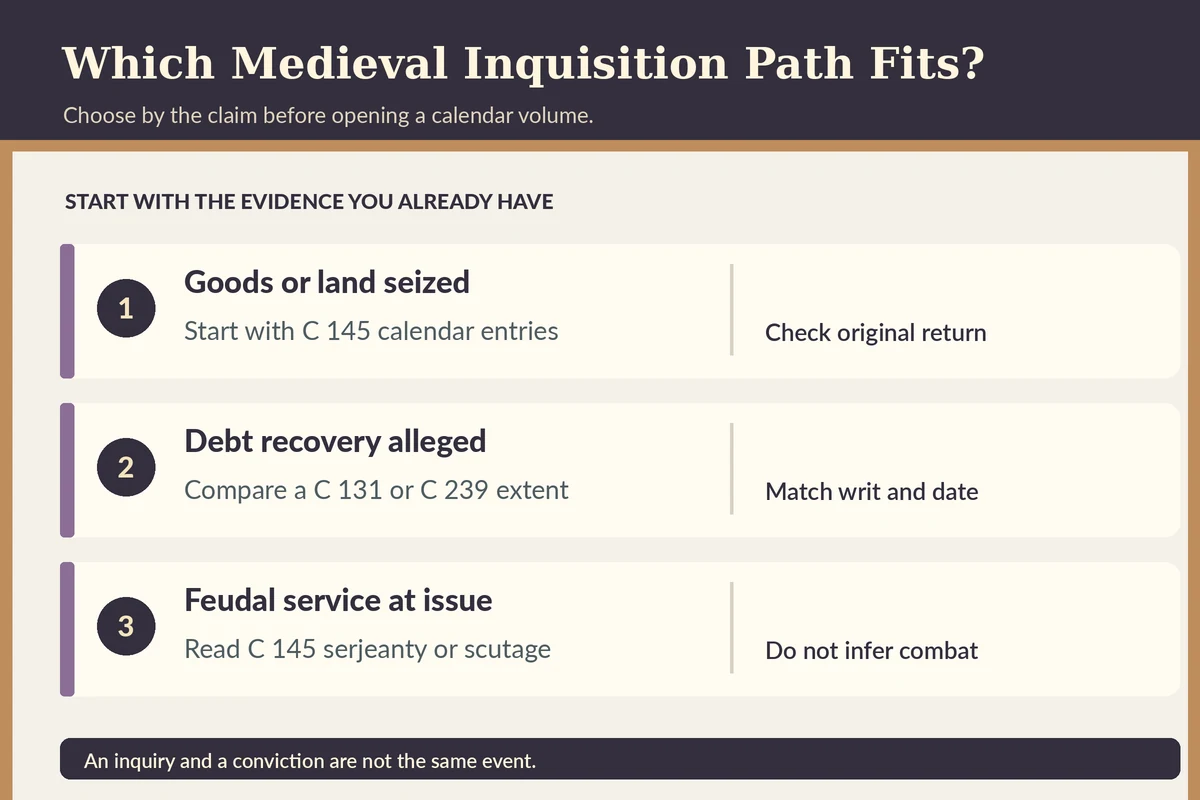
First decide what the family or property question actually alleges. Was land seized for a debt, was someone described as an outlaw, was service due from a holding, or was a person listed among possessions associated with rebellion? These are related but distinct legal and administrative contexts. Transcribe the source of the allegation, including its date and historical jurisdiction. A modern summary saying “the king confiscated the estate” may collapse several acts that occurred at different times.
Use the printed calendar headings and indexes to search names, counties, and technical subjects. The same surname may refer to a juror, landholder, petitioner, debtor, or an official receiving a return. Do not begin by deciding that everyone named in a seizure-related entry was an accused person. Keep the office, legal capacity, and property description with the name in the notes. The calendar may abbreviate language that changes the meaning.
Move from a calendar abstract to the original file
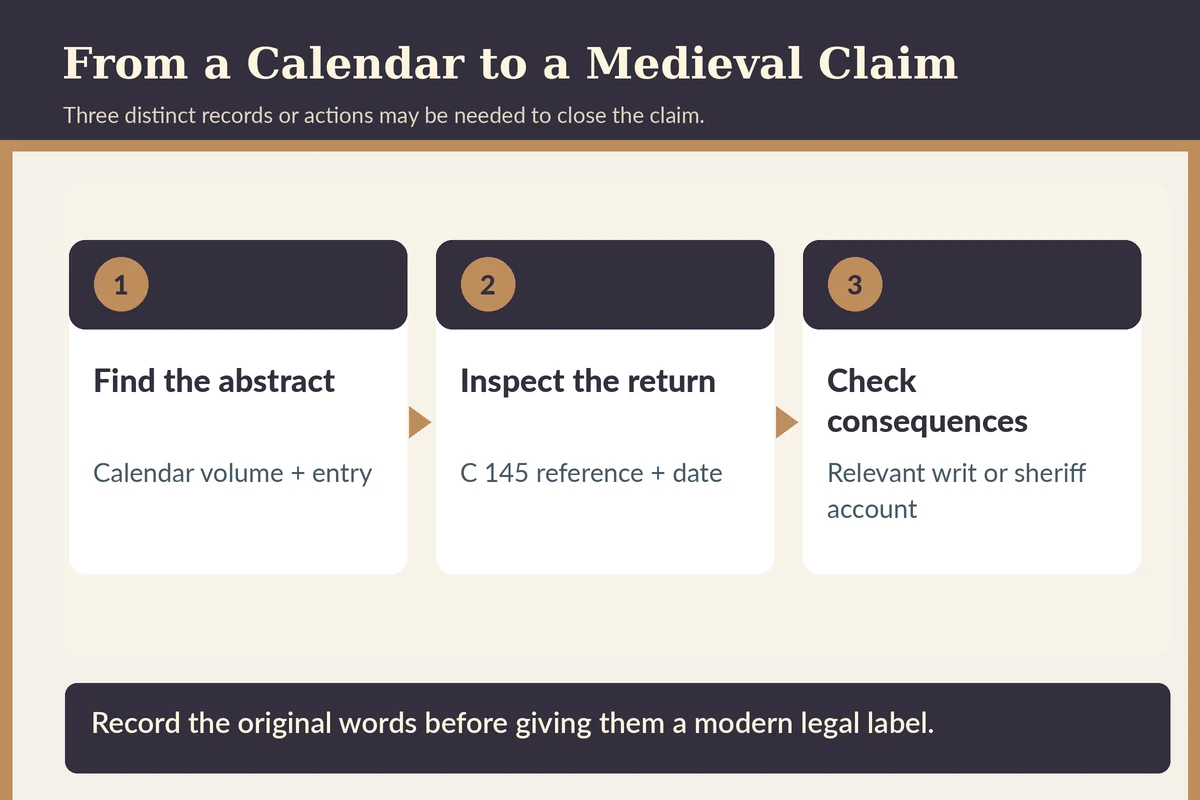
The published Calendars of Inquisitions Miscellaneous are finding and summary aids. Record the calendar volume, number or page, reign, year, and the quoted or paraphrased wording that led to the archival reference. Follow the reference to C 145 and check how the file is arranged. The National Archives says catalogue descriptions are chronological rather than item-level name indexes, so a blank online search for a person should not be treated as conclusive.
On the original document, look for the writ or authority for the inquiry, its return, the date and place, names of jurors or officials, and the clauses stating what was found. Mark any portions that are damaged or difficult to read. A calendar translator may standardize a place or name; preserve the original spelling when possible. If a later editor supplied a date or reconstructed a reading, distinguish that editorial note from the medieval record.
Separate allegations, findings and legal consequences
An entry valuing goods associated with an outlaw can be powerful evidence for an administrative seizure, but it does not automatically tell you why the person was legally outlawed or what happened after the inquiry. The return may distinguish goods, movable possessions, rents, and land interests. An inventory of assets associated with a person does not by itself establish modern ownership, continuous possession, or the identity of later heirs.
Consider who speaks in each document. A sheriff’s return, a local jury’s finding, and a later order could represent three stages of one matter but not the same evidentiary act. A person named as holding an interest at one date may have a tenant or under-tenant. A record concerning scutage or serjeanty can address feudal obligation without reporting battlefield participation. Treat a surname, holding name, and alleged offence as separate propositions until the source connects them.

Keep a medieval property and person ledger
Create an evidence table with calendar citation, C 145 reference, inquiry date, county, named individual, their capacity, property or service, recorded value, and the exact legal or administrative language. Add columns for whether you inspected the original and which words remain uncertain. If the same place appears in two returns, compare boundaries and lordships before concluding it is the same estate. Similar spellings in different counties are weak identity evidence by themselves.
Use an explicit claim scale. A return may directly show that a named person was mentioned and that a specified holding was investigated or valued. It may support a cautious inference about a medieval interest if the wording is precise. It cannot alone prove a modern parcel boundary, a complete pedigree, the final result of all litigation, or that every act alleged in a petition occurred. This prevents the calendar’s concise prose from doing more evidentiary work than it can support.
Follow related writs and sheriff accounts when needed
The National Archives guide on outlawry describes other routes: C 131 extents for debts; C 239 private-debt extents; E 199 sheriff accounts; and E 379 accounts of seizures, each with its own date scope and arrangement. These are potential comparison sources, not compulsory stages of one continuous file. Select one only where the C 145 entry creates a specific question about authority, execution, or payment. A file in one series does not imply a surviving counterpart in every other.
Look for evidence of the same person and estate by comparing unusual place details, lordships, dates and official names. An inquiry dated shortly after a writ may document part of the same process, but a shared surname and county are not enough. If a claimed judgement is central to the story, locate the court process or documented outcome before writing that someone was convicted, pardoned, or permanently dispossessed. Record missing years without replacing them with narrative certainty.
More Records and Archives Guides
How We Research Medieval Inquisition Claims
We use the published calendar to generate leads but cite the underlying C 145 manuscript where it can be examined. We keep the medieval vocabulary intact until its legal sense has been checked against the document and its context. That includes being careful with the distinction between holding an estate, owing a feudal service, being named in an inquiry, and being punished for an offence. The research guide confirms series organization, not a specific individual’s legal history.
The final work product is a short chain: the calendar entry used, the file consulted, the exact finding, one proposed interpretation, and the missing independent source required to establish the larger claim. When Latin, abbreviations, or regnal dating could affect meaning, we mark the reading as provisional instead of presenting a polished but unverified family story. Even a negative result should state which calendar volumes and file dates were actually examined.
For information about external links and editorial transparency, see the GenHis affiliate disclosure. These archival references are independent research citations, not a claim of affiliation or endorsement.
No. It is a miscellaneous inquisition series arranged chronologically; published calendars are often the practical starting point.
Not necessarily. The entry may be an inquiry into property, services, or a consequence of another process; establish the legal outcome separately.
The National Archives describes the series as covering 1218–1485, with content varying substantially by period and inquiry type.
It can locate and summarize a document, but abbreviated wording should be checked against the original before making a precise legal or kinship claim.
Depending on the issue and date, related writs or accounts may survive in C 131, C 239, E 199, or E 379; none is guaranteed.