
To identify a British Merchant Navy master or mate, look up the name in the BT 127 index, copy the certificate number, and use the grade, trade and number range to choose the corresponding register in BT 122–126 or related series. Do not treat a certificate date as the date of a voyage or presume a named officer served continuously on one ship. The National Archives separates Certificates of Competency from Certificates of Service and explains why a replacement document may bear a different number.
Identify an Officer Rather Than an Ordinary Crew Member
The officers guide covers masters, mates, engineers, fishing skippers and other ranks, but different officer types follow different registers. Begin by establishing that the person was described as a master or mate rather than merely serving aboard a merchant vessel.
Note the wording, approximate date, ship name and port in the independent source that gave you the occupation. A mariner may later become an officer, and one employment record cannot establish when a certificate was issued. For ordinary seamen, especially during the 1858–1913 register gap, crew lists and agreements may be more useful than officer certificate registers.
Search BT 127 and Allow for Unusual Surname Filing
The National Archives identifies BT 127 as the name index used for the masters and mates certificate registers. Search the correct historical spelling, initials and known variants before assuming no certificate exists. The official guide warns that names beginning Mc or Mac can be filed under the following letter rather than under M: a MacDonald may be under D.
Transcribe every possible index entry, including reference, name, initials, certificate number and distinguishing annotation. Do not select the first hit automatically. Similar officer names were common in seaports, and the name index was designed as navigation, not an independently verified biographical register.
Decode Competency Versus Service Certificates
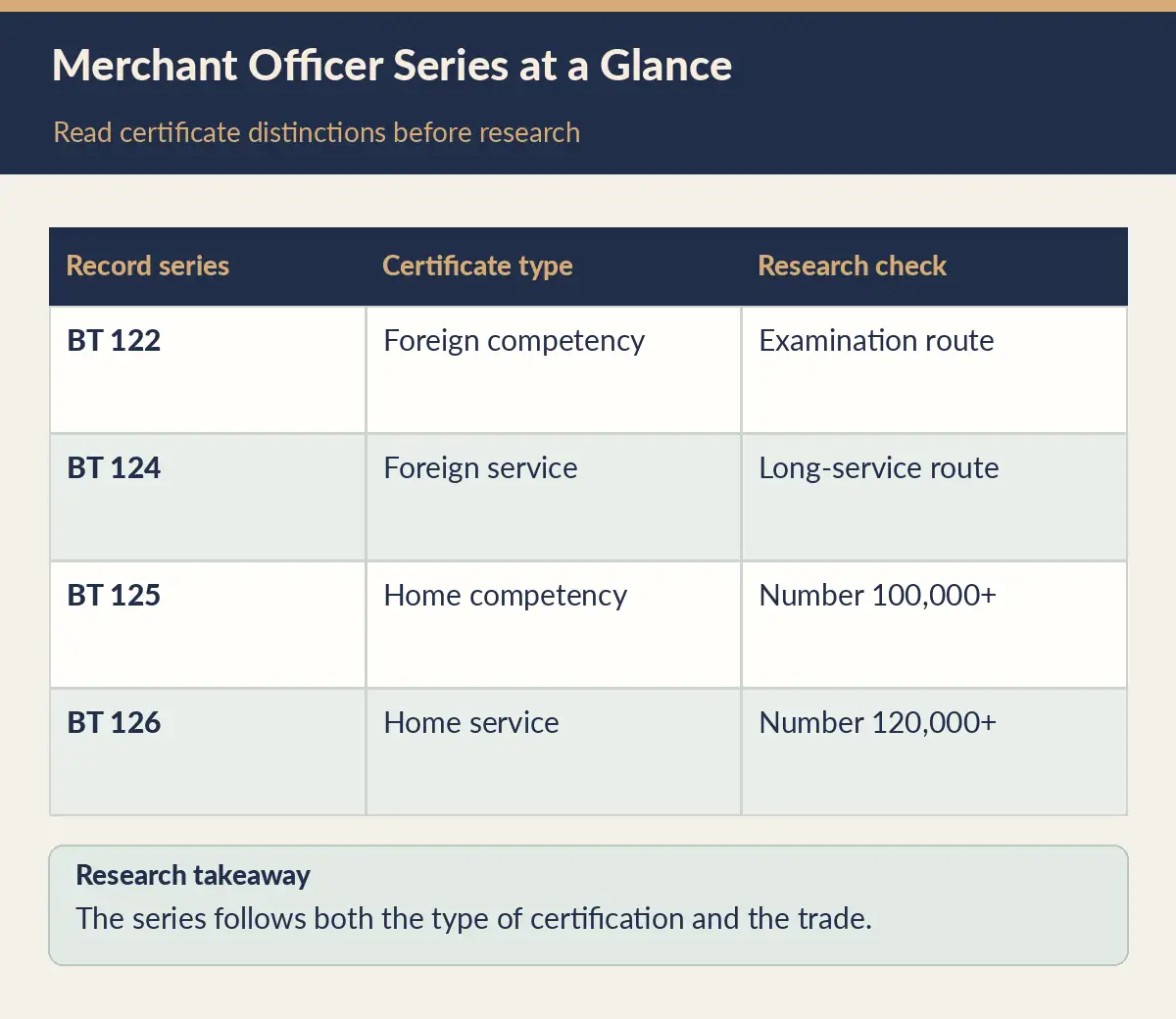
A Certificate of Competency generally followed an examination; a Certificate of Service recognized qualifying earlier experience. These document different routes to certification and should not be collapsed into the statement that someone passed a particular examination. The number ranges are essential.
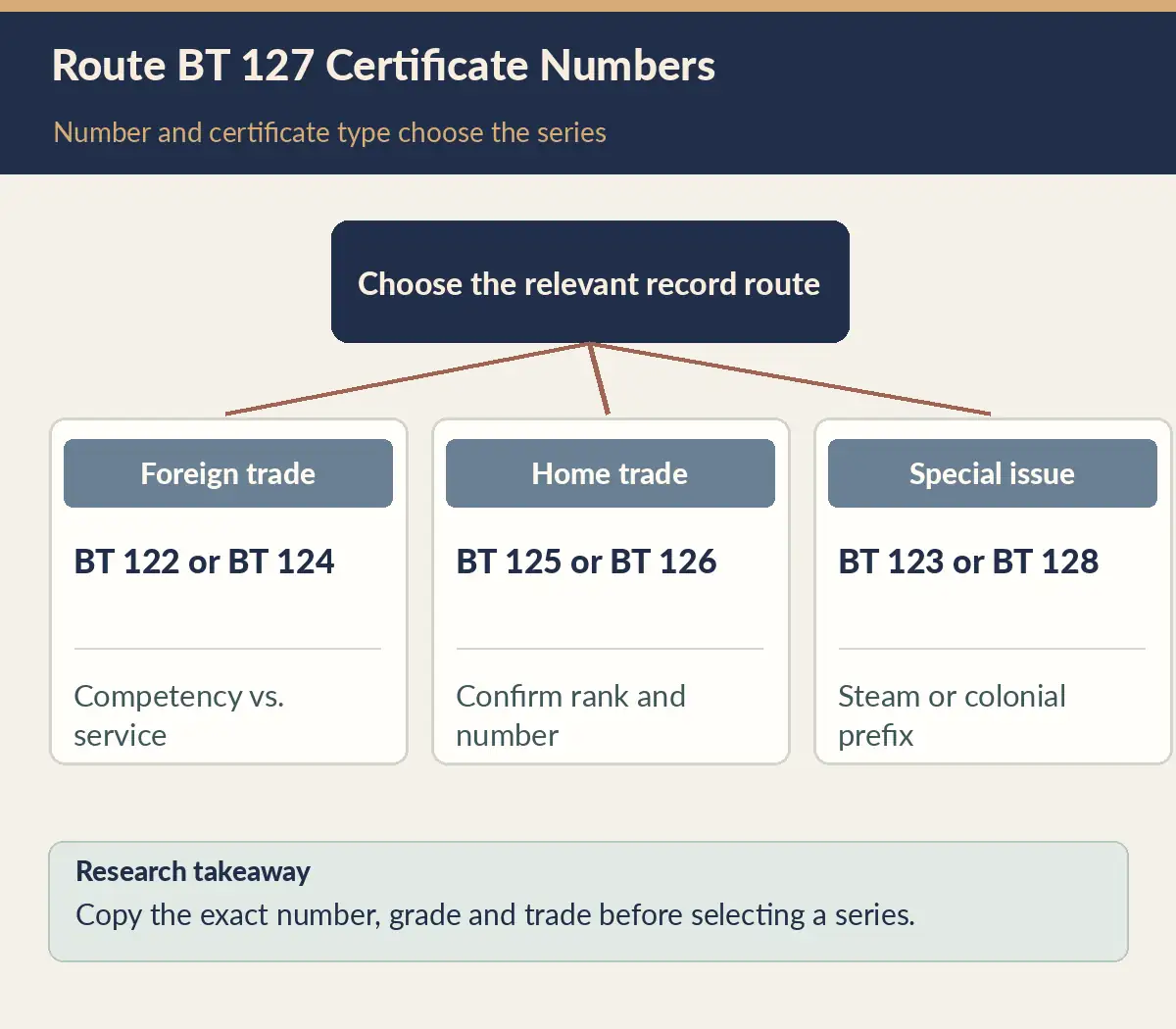
For example, the official table associates foreign-trade competency numbers 1–34,999 with BT 122 and foreign-trade service numbers 35,000–80,999 across sections of BT 124. A replacement can produce a further certificate number. Record the certificate type, rank, trade and number separately rather than inferring them from a family description such as captain or seaman.
Route Foreign and Home Trade Numbers to Correct Registers
The TNA table routes foreign competency to BT 122 and foreign service to BT 124; home-trade competency numbers 100,000–119,000 route to BT 125, and home service numbers 120,000–150,000 to BT 126. Later or specialized numbering can point to BT 123, BT 128 or other series.
Search the exact number range and start date rather than treating all BT volumes as one alphabetical sequence. If the entry has a colonial prefix such as NWS, consult the BT 128 guidance. A correct certificate number with the wrong trade or rank is a warning that the identification needs further checking.
Read the Numbered Register and Original Wording
Certificate registers may supply name, year and place of birth, certification date and place, certificate grade and number, and sometimes voyage or death annotations. Confirm all legible fields in the register image or archival copy. An index may omit a second given name or use an abbreviated birthplace; check whether the register supplies it.
The TNA guide cautions that recorded voyage dates can be filing dates and that date of death is only sometimes present in later certificates. Avoid converting uncertain written notes into exact arrival dates. Log uncertain characters, damaged entries and any continuation page.
Connect a Certificate to a Ship Only with Crew Evidence
The existence of a valid master’s or mate’s certificate does not identify every ship on which that officer worked. A crew agreement or ship log is a separate record that may show rank, age, birthplace and dates of joining or discharge.
TNA recommends searching the ship’s official number when possible and consulting BT 98 and other crew-list holdings. Create two citations: one for qualification and another for a particular voyage or appointment. A ship’s official number is not an officer’s certificate number; confusing them can send a search into entirely unrelated volumes.
Use Birthplace and Grade to Test Namesakes
Suppose two men named James Fraser appear in BT 127 within a decade. Read both register entries and compare stated birthplaces, approximate ages, grade, trade, certification dates and later crew-list roles.
If one is a foreign-trade mate and the other a home-trade master, keep their identities separate until you can explain a career progression with dated evidence. The same person can hold more than one qualification, so two certificate numbers alone do not prove two individuals. Create a compact identity table with independent corroboration, positive matches, conflicts and unanswered questions.
Plan for In-Person or Paid Record Access
The National Archives guide distinguishes online commercial indexes from documents requiring consultation at Kew or an ordered copy. Avoid promising free full images just because a name can be searched on a third-party website.
Note the exact BT series, piece and register number before a paid request, and assess whether a crew-list search might answer the actual family question more efficiently. Some series were continued elsewhere, including BT 352, and the precise path depends on certificate date. If a catalog result lists only a piece, do not invent an item-level image or a specific page.

How We Research a Merchant Officer Certificate
We identify the officer’s alleged rank and date from external evidence, search all plausible BT 127 name entries, and then check the National Archives certificate-number table. We open or request the actual register, record certificate number, grade and birthplace, and compare a separate dated crew agreement before claiming a voyage.
Unexplained replacement numbers and officers of identical names remain separate possibilities. The distinction between free finding aids and paid record access is stated plainly. Our affiliate disclosure is available for editorial transparency.
Cite the Index, Register and Crew List Individually
A reproducible index citation includes BT 127, the spelling searched, name entry and displayed number. For the underlying register add archive, BT series and piece, certificate number, grade, date, page or image where available, and access platform.
A crew-list reference should additionally name the ship, its official number, port and year. If you used a commercial transcript, identify it as a transcript rather than a witnessed original. Your conclusion may say that a named officer held a specified certificate; employment aboard a particular ship requires documentary evidence connecting that individual and the voyage.
More Records and Archives Guides
Turn the Finding Into a Narrow Next Question
Once the grade, certificate number and birthplace are secure, choose one follow-up: identify a specific ship in a target year, verify a hometown in a civil or church register, or establish when a mate later received master qualification. If a ship is known, check its crew agreement against certificate details; if no ship is known, research historical directories and maritime lists for a plausible vessel. Keep a chronology of actual document dates rather than arranging undated notes into an imagined continuous career. This focused approach is more useful than downloading several same-name certificates without a question they can answer.
Use BT 127 as the name index and copy the certificate number before choosing the register.
No. It is distinct from a Certificate of Competency, which usually followed examination.
No. Foreign versus home trade, certificate type, dates and number ranges route to different BT series.
No. The archival guide cautions that some voyage dates reflect filing rather than arrival.
Find a separately sourced crew agreement or log for the ship and the relevant date.