
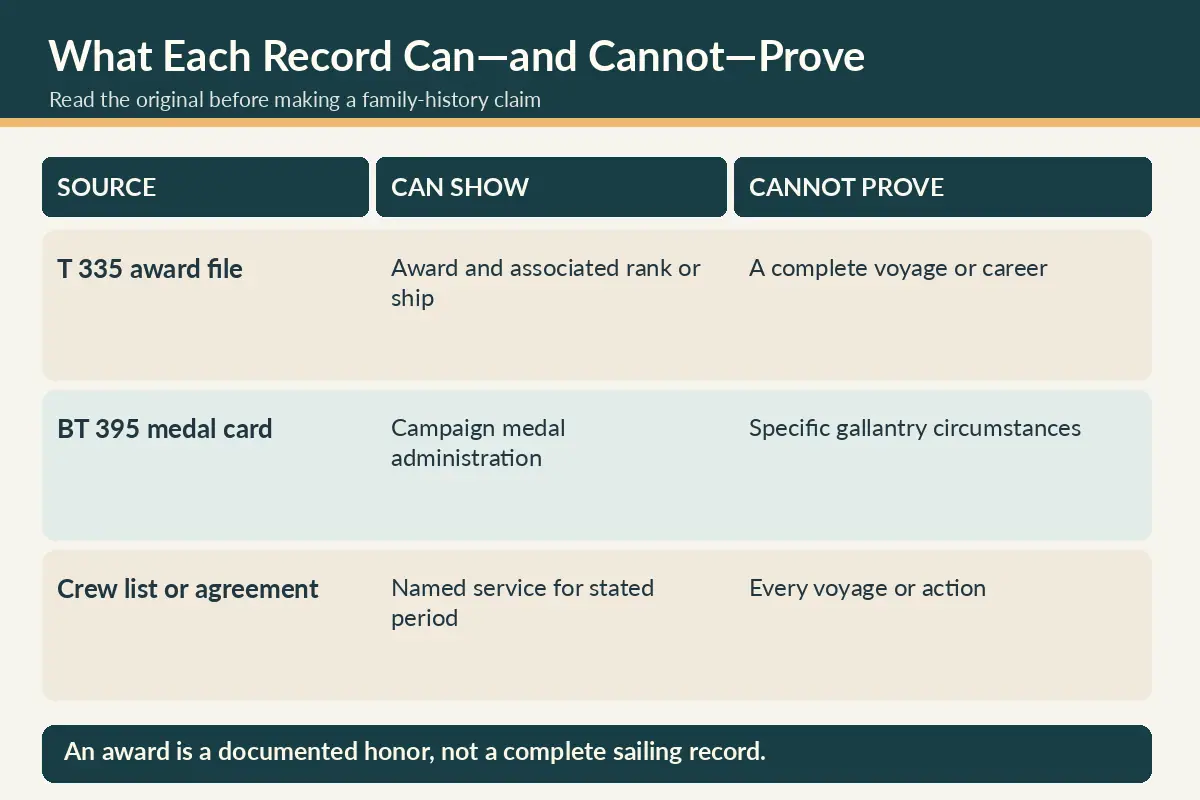
The National Archives places Second World War Merchant Navy award files dated 1939–1947 in T 335. Its guidance recommends searching by both recipient and ship, rather than relying on a surname alone. A useful result may identify an award, a rank and the ship associated with a person. It does not provide a universal log of voyages or prove that every individual of the same name sailed aboard the named vessel. See the official research guide for the archive series and its purpose.
A family story about wartime bravery should be divided into three questions: which honor was actually recorded, what circumstances the surviving file documents, and whether independent sources connect the right person to the ship at the relevant time. The last question is especially important where two merchant seamen had similar names or served on ships that were renamed.
Search T 335 with two independent identifiers
Start with the full name, then search a documented ship name in the relevant 1939–1947 window. The National Archives specifically advises this two-part search. Use quotation marks for multiword names and preserve variants in initials or spelling. The catalogue may summarize a file under a ship rather than under every crew member. Collect the complete reference before deciding that a result pertains to the ancestor.
A provisional match should include the reported rank or rating, vessel and date. Where these details do not all match the family account, record the discrepancy rather than smoothing it away. The person may have transferred ships, a report may have an error, or the record may concern another individual. A search result is a candidate lead, not a solved identity.

Separate gallantry awards from campaign medals
The National Archives names T 335 as award files and elsewhere describes Merchant Navy campaign medal records such as BT 395. These have different purposes. A campaign medal card documents administration of a medal and may contain issue marks; it does not automatically recount a particular rescue, attack or bravery incident. Conversely, a T 335 file cannot substitute for every medal that an individual may have received.
When compiling a biography, label each award exactly as the source does. Do not quietly promote a recommendation to a confirmed decoration or treat the file date as the day of the underlying action. If an announcement appears in an official gazette, compare the published wording to the administrative file, noting differences in dates or rank.
Read accounts of the action with source labels
A T 335 file may contain different stages of the recognition process. If a witness account exists, preserve who made the statement and when. A recommendation describes what someone proposed; a formal outcome identifies the action taken by the awarding authority. When the final outcome is unclear, do not write that the proposed honor was awarded. Quotes should remain limited and properly attributed.
The ship’s circumstances matter. A wartime incident can involve several vessels, survivors and rescue crews. Create an incident timeline using only events attested by particular documents. Separate enemy attack, vessel damage, subsequent rescue and award announcement. Neither a dramatic newspaper report nor a vessel photograph identifies the subject of the award unless the connection is independently evidenced.

Prove the right seaman and build a narrow career record
Use person-level Merchant Navy sources where they survive: a crew agreement, a service register or a surviving seaman’s pouch for the correct era. The archives warn that not every pouch survives and access to recent personal information can be restricted. Compare date of birth, rank, address, official ship number and voyage interval if those details actually appear. Do not infer a year-long appointment from a single named incident.
An evidence-based conclusion might establish that a specific person was named in one T 335 award file associated with one named vessel, with a separate source documenting service on that vessel. Other wartime voyages and postwar career stages require their own support. Record unsuccessful searches, especially when the records use different spellings or the ship changed ownership or name.
Distinguish ship identity from the award narrative
One ship could carry different masters and crew during the war, and names may be recycled. Maintain a vessel line with name, official number if known and the precise date of the incident; maintain a separate personal line for the proposed award recipient. Connect them only with a record that states the relationship. This prevents accidental transfer of one seaman’s gallantry account to another member of a large maritime family.
Treat the date of a recommendation, an award approval and its publication as potentially different. An award file may reveal how recognition was considered; it should not be stretched into a full wartime employment history. A clear conclusion says who was named, how the ship was identified, which administrative stage the record documents and what remains to be checked in service material.
More Records and Archives Guides
How We Research and Verify This Evidence
We begin with the relevant guide from The National Archives to confirm the purpose and limitations of the record series. We then use Discovery to identify the actual series, piece descriptions and holding institution. We record the historical spelling, archive reference and date of each statement; our diagrams are explanatory reconstructions, not facsimiles of archival documents. A catalogue summary is not presented as a transcription of a complete original.
When no item survives, the honest conclusion is that a documented search has not located evidence within the series examined. We do not infer that the person never served, the event never happened or the asserted relationship is necessarily false. For editorial and affiliate policies, read our affiliate disclosure. The research process described here does not depend on a paid partner or a promised download.
The National Archives identifies Second World War Merchant Navy award files from 1939–1947.
Yes. The archive recommends searching by both recipient and ship.
No. T 335 concerns award files; BT 395 is campaign-medal administration.
No. Confirm any asserted period of service from separate crew or personal records.
Report it as a recommendation and seek a final decision or official announcement.