
The Lord Steward’s department managed much of the domestic side of the British Royal Household. Its surviving wage and allowance records can provide unusually specific evidence about servants, but the evidence has a precise boundary. The National Archives identifies LS 13/154–167 as receipt books for 1761–1816. Many entries include a servant’s signature for boardwages and other allowances. A receipt confirms a documented payment or acknowledgment, not years of uninterrupted employment, an exact room in a palace, or a family relationship. See the official research guide for the archive series and its purpose.
Begin with a name, approximate date and likely post, then ask which administrative event you need to prove. Admission to an office, a signed receipt and a recorded leave of absence are three different events. Keeping them on separate lines makes it possible to assemble a plausible work history without quietly converting an occasional mention into a full biography.
Separate a signed receipt from a staff appointment
A named receipt book entry is strongest for the transaction it records. Note the title of the volume, the accounting interval, the amount, any office or departmental wording and whether a signature is visible. A signature may help distinguish two same-named employees, but similarity of handwriting is not a substitute for documented identity. If an extract names a servant but not their duty, do not infer they held the post mentioned on the neighboring line.
Check LS 13/197–204 when the question is about admission. The guide places these certificate books in 1672–1820 and says they include servants from the stables and chapels, among others. Their coverage and administrative purpose differ from payment acknowledgments. Record an admission separately from wages; an official admitted on one date might subsequently change role or receive different allowances.

Track approved absence and extraordinary duty
The National Archives points to LS 13/205–208 for special duties and leave of absence, 1766–1811. A leave entry may establish an administrative permission, but it cannot by itself place the individual at an ancestral home or prove where they traveled. Keep permission dates separate from confirmed departure or return dates. When the apparent absence conflicts with a receipt, investigate accounting practice before assuming the records refer to different people.
Use the chronological overlap with LS 13/154–167 cautiously: a duty record and a wage receipt from the same year may strengthen an identity claim if both include a distinctive office or signature. They are still two documents created for different administrative purposes. An apparent missing payment is a search problem until the relevant accounting books and their survival have been assessed.

Distinguish departments and similarly named servants
The Royal Household was not a single undifferentiated staff list. The Lord Steward’s domestic functions differed from the Lord Chamberlain’s department; records in LC relate to a different administrative structure. A name appearing in both must not be assumed to represent a transfer without specific supporting evidence. Record department, post, institution and year for every candidate, especially common names in large court establishments.
Also separate servants from creditors or suppliers. The guide identifies stable creditors and salary bills in LS 13/210–230 and other accounts elsewhere. A tradesman paid for supplies is not necessarily a salaried household servant. If an entry mentions a recipient of money, identify the type of book and the wording of the payment before writing ‘worked at the palace’ into a family tree.
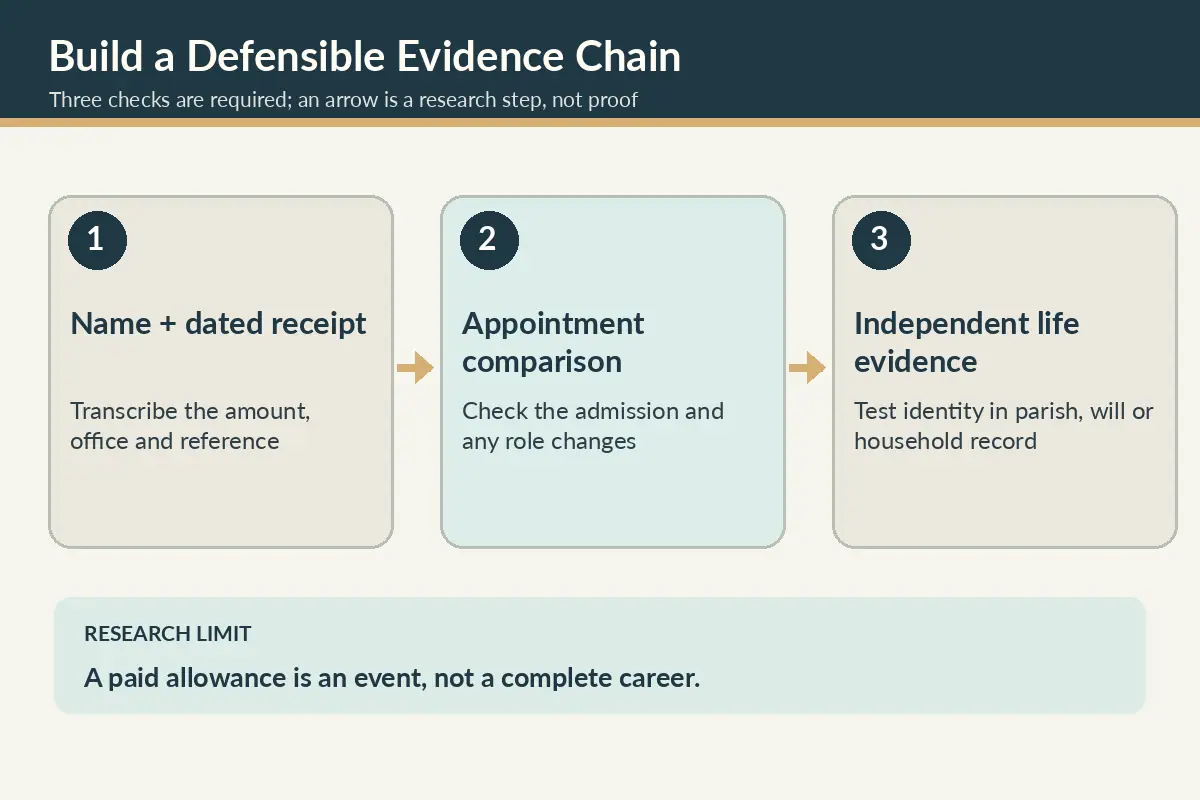
Build a defensible servant timeline
Create columns for document date, period paid for, person as written, office, transaction, repository reference and identity confidence. Put contradictory spellings side by side. Do not smooth an irregular series of receipts into a monthly payroll that you have not actually seen. A mark or signature can be copied separately for later comparison, while preserving the complete citation for the source volume.
For family history, pair the household sources with a parish register, a will or a contemporaneous address document only if each source can be traced. An association between two people in the same payment volume does not establish that they were spouses or siblings. A carefully worded finding might state that one signed receipt names a particular court servant in a specified accounting period, while residential and family details remain unverified.
Audit wages and admission dates as different timelines
A dated receipt should enter a payments chronology even if the admission date is unknown. If admission evidence survives, keep a second career chronology showing what the record names as an office. Their alignment may support a working hypothesis, but do not interpret silence as dismissal. Administrative records can be episodic, and money due for one interval might be acknowledged much later. When quoting an amount, preserve the historical denomination rather than converting it to a modern salary without a supported method.
The separate Lord Steward’s accounts can reveal a creditor, wage recipient or appointed household officer. Ask who created each volume and whether it concerns a payment authorization, an actual receipt or an accounting reconciliation. This makes a more careful answer possible than using a directory as a list of people certainly living at court. The office and the source’s exact period should travel with every name in your notes.
More Records and Archives Guides
How We Research and Verify This Evidence
We begin with the relevant guide from The National Archives to confirm the purpose and limitations of the record series. We then use Discovery to identify the actual series, piece descriptions and holding institution. We record the historical spelling, archive reference and date of each statement; our diagrams are explanatory reconstructions, not facsimiles of archival documents. A catalogue summary is not presented as a transcription of a complete original.
When no item survives, the honest conclusion is that a documented search has not located evidence within the series examined. We do not infer that the person never served, the event never happened or the asserted relationship is necessarily false. For editorial and affiliate policies, read our affiliate disclosure. The research process described here does not depend on a paid partner or a promised download.
No. It documents acknowledgment in an administrative receipt book; seek independent residence evidence.
The National Archives identifies admission certificates in LS 13/197–204 for 1672–1820.
Not from scattered receipts alone. Test gaps against other accounts and appointments.
No. They cover different parts of Royal Household administration and must be identified separately.
No. Demonstrate a relationship from independent person-level evidence.