
An invoice is not a receipt. LC 11 contains bill books and original bills presented to the Lord Chamberlain’s department by tradespeople, including some royal warrant holders. In this guide, the record is treated as an archival source with explicit proof limits: the catalogue can locate a document, while the original and an independent source establish what can responsibly be claimed. You can use the following worksheet-style route even if the person or building you are tracing has not yet been identified.
Start With the Bill, Not the Family Story
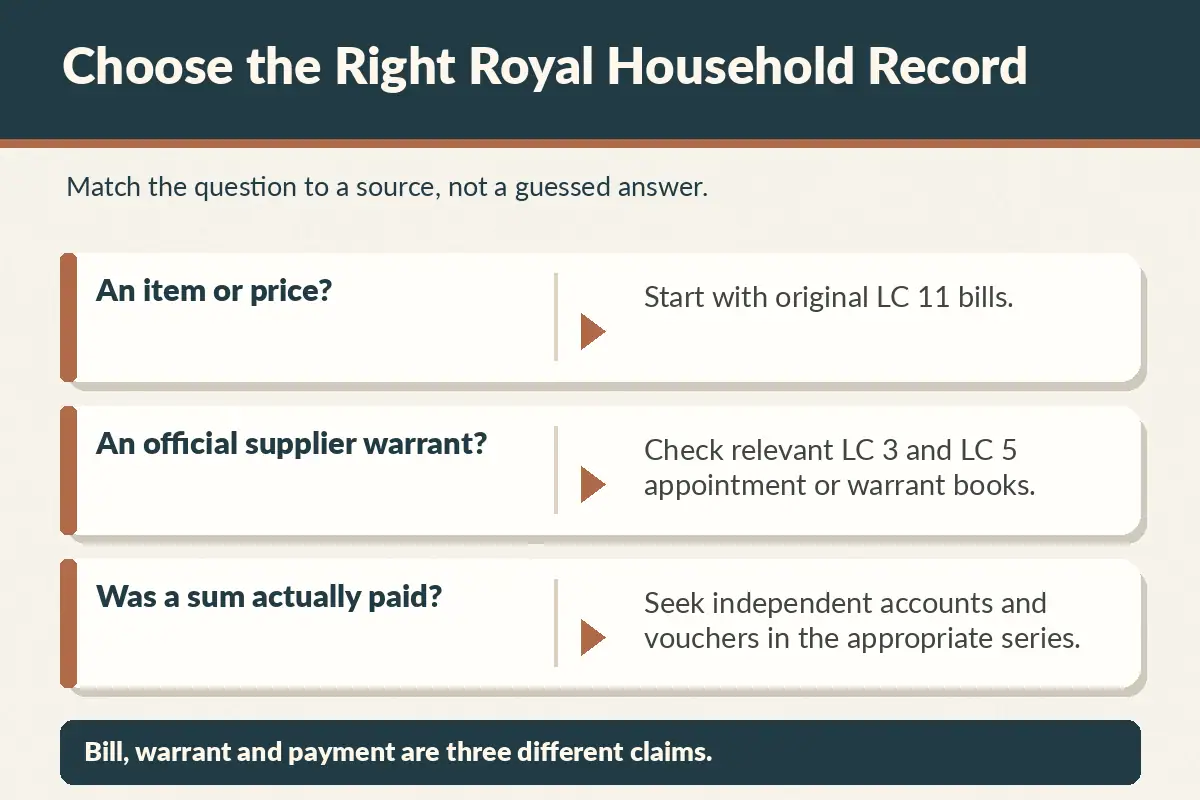
LC 11 contains bill books and original bills presented to the Lord Chamberlain’s department by tradespeople, including some royal warrant holders. For the nineteenth-century search, the record is best approached as an account of an item or service supplied to a royal office, not as a census of palace employees. The National Archives identifies LC 11 as a major supplier source, with bills appearing in the early 1800s and continuing into 1901. Whether a named bill exists for a particular year must be tested in the relevant piece.
Begin with three details: the supplier’s name, a plausible date or decade, and the goods or service associated with the trade. A tailor, engraver or furnishing supplier can be mentioned under a business style different from the personal surname remembered by descendants. Write variant firm names alongside the name, and distinguish a supplier’s trade address from any asserted private residence. Do not assume that appearing on an invoice means the individual personally visited a palace or served in its household establishment.
Separate Supplier Bills From Royal Warrants
The archival guide identifies appointment and warrant material in LC 3 and LC 5 as separate from invoices. Some tradespeople obtained royal warrants, while others supplied goods without one. A document in LC 11 may describe goods presented for payment; it does not by itself record the award of a warrant. Conversely, a royal warrant documents an official authorization or status and need not identify each transaction carried out by the business. Record these as two different historical propositions.
Create a working table with the date on the bill, name as written, business style, goods or work, recipient office, claimed amount, and any wording indicating receipt or payment. A number in a money column is not automatically evidence the sum was paid: it may be an amount charged, examined or entered for settlement. If a matching warrant is located in LC 3/61–70 or another appropriate series, cite its own date and reference rather than treating the bill and warrant as one document.
Read Prices and Goods Without Inventing a Contract
Original bills can be unusually vivid evidence of material culture. They may specify textiles, decorations, repairs, personal items or quantities which rarely appear in a pedigree. The same vividness is a trap: a billed object should not be placed in a named room, awarded to a particular royal person, or declared delivered unless the manuscript explicitly supports that identification. Some entries may represent grouped charges for a period rather than one discrete purchase. Respect the wording and inspect both the face and reverse of a document where available.
When a total appears, look for the accounting marks: annotations, signatures, examination notes, dates or cross-references. Explain what each mark literally says before interpreting it. A posted amount, crossed-out sum, or later marginal notation might change how a charge was treated, but ink alone is not a universal payment code. Compare any payment claim with a separate relevant account or voucher in LC 9, LC 10, or other identified volumes before asserting that money changed hands.
Follow a Supplier Across Successive Names
A supplier’s apparent continuity may conceal changes of proprietor, partnership or location. Two invoices bearing a surname a decade apart could be from a parent and child, unrelated namesakes, or a firm that retained its trade name. Make a dated identity grid recording trade, business address, handwriting or signature, and co-partners. If later records use “and Son,” do not fill in the son’s identity from the phrase alone. Contemporary trade directories and civil registration can help identify people behind the business name.
Keep separate columns for evidence from the royal department and evidence from outside it. A directory may identify a shop in the same street; a census may describe a household; a probate or partnership notice may clarify ownership. None is a substitute for showing a defensible match of names and dates. A surname coincidence plus a similar occupation is a lead rather than proof. For a family-history article, the most valuable result may be a narrower verified statement that a particular named firm submitted a bill in a specified year.

Search and Cite the Surviving Piece
Search Discovery with LC 11 as the series filter, then add a surname, trade, place or date. The catalogue may describe a volume at a broad level, so an absent person-name result is not a definitive negative search. The National Archives advises that Discovery generally searches catalogue descriptions, not all words inside manuscripts. If the catalogue cannot identify an individual invoice, plan for a piece-level inspection or enquire about copying and access based on the particular reference. Do not advertise universal digitization.
Capture a reproducible citation: The National Archives, LC 11 followed by the piece and any item or folio, the bill’s date, and the supplier’s name as written. Identify whether the document is an original bill, later book entry, catalogue description or your transcript. When the writing is uncertain, preserve the doubtful letters and note an alternative reading. If the invoice mentions a royal occasion, consult independent event and official account material rather than converting the bill’s mere existence into a confirmed attendance record.

More Records and Archives Guides
How We Research Original Documents and Their Limits
This research route relies on original institutional guidance, not an invented visit to an individual archive piece. The topical source is The National Archives research guide; record-finding limits are explained in Discovery search guidance; and the citation standard is described in The National Archives citation guidance. We have not inferred that a particular person or project appears in an unseen piece. The accompanying scenes and diagrams are newly composed explanatory illustrations, not reproduced historic documents.
Before citing a conclusion, keep separate the catalogue description, the original document as inspected, your literal transcription, and the independent evidence used to test identity or outcome. Record spelling variants and failed searches, including the date and scope of each attempt. Avoid assuming that everything in a surviving series is individually keyword indexed or digitally accessible. The site’s affiliate disclosure explains relationships and funding; these steps do not depend on an unverified commercial service or a fabricated referral.
No. It proves only what the particular bill and its annotations say. Seek a payment entry or other explicit settlement evidence.
No. The National Archives distinguishes warrant holders and other suppliers in its description of original bills.
Not ordinarily. Bill suppliers and household employees are different roles, though an individual could have multiple relationships.
The piece may be described at volume level rather than indexed by the names in every invoice.
A sourced identity chain using matching trade, address, time and independent family records, not the shared surname alone.