
PALA 6 is a route into records of discipline associated with the English royal household after 1623. It is not a national criminal register and a record of a complaint is not a finding of guilt. The household marshal exercised a special jurisdiction linked to the moving royal court, historically described in relation to a twelve-mile verge. The National Archives distinguishes earlier household discipline records in E 35 and E 37 from material after 1623 in PALA 6. Start with the date, the alleged act, the person’s stated role and the kind of court document actually preserved.
Choose the Court Series From the Date and Jurisdiction
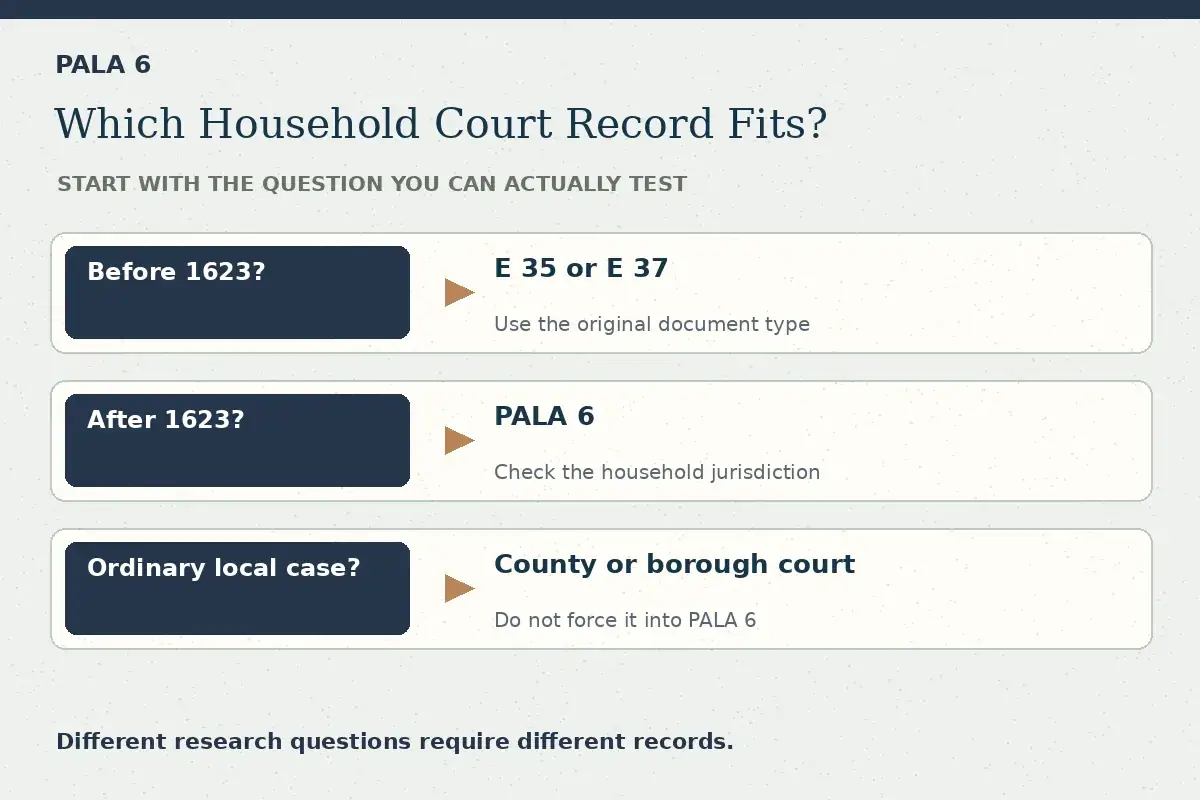
The royal household’s jurisdiction was not identical to the ordinary county or borough courts. Historical descriptions of the verge refer to the area around the royal household wherever it was situated; it was not a fixed circle permanently centered on one palace. A dispute that took place in London does not automatically fall within royal household discipline. Determine why the case might have belonged to the marshal’s authority before you select PALA 6.
The National Archives’ royal household guide gives a useful date gate: E 35 for certain marshalsea inquisitions from the Henry VI period, E 37 for pleas of the hall up to 1623, and PALA 6 for discipline after 1623. Those are leads to distinct kinds of surviving documents, not one continuous name-indexed series. A missing result in PALA 6 for an earlier case should prompt a review of record class, not the conclusion that no dispute occurred.
Write a jurisdiction worksheet with event date, royal household location if known, individual’s role, suspected court, document type and relevant series. Separate someone employed by the household from someone accused of an act near a royal residence; the two categories need not overlap. If the court named in a family story is uncertain, also check ordinary local judicial records before assigning the case to PALA 6.
Identify the Procedural Document, Not Just the Name
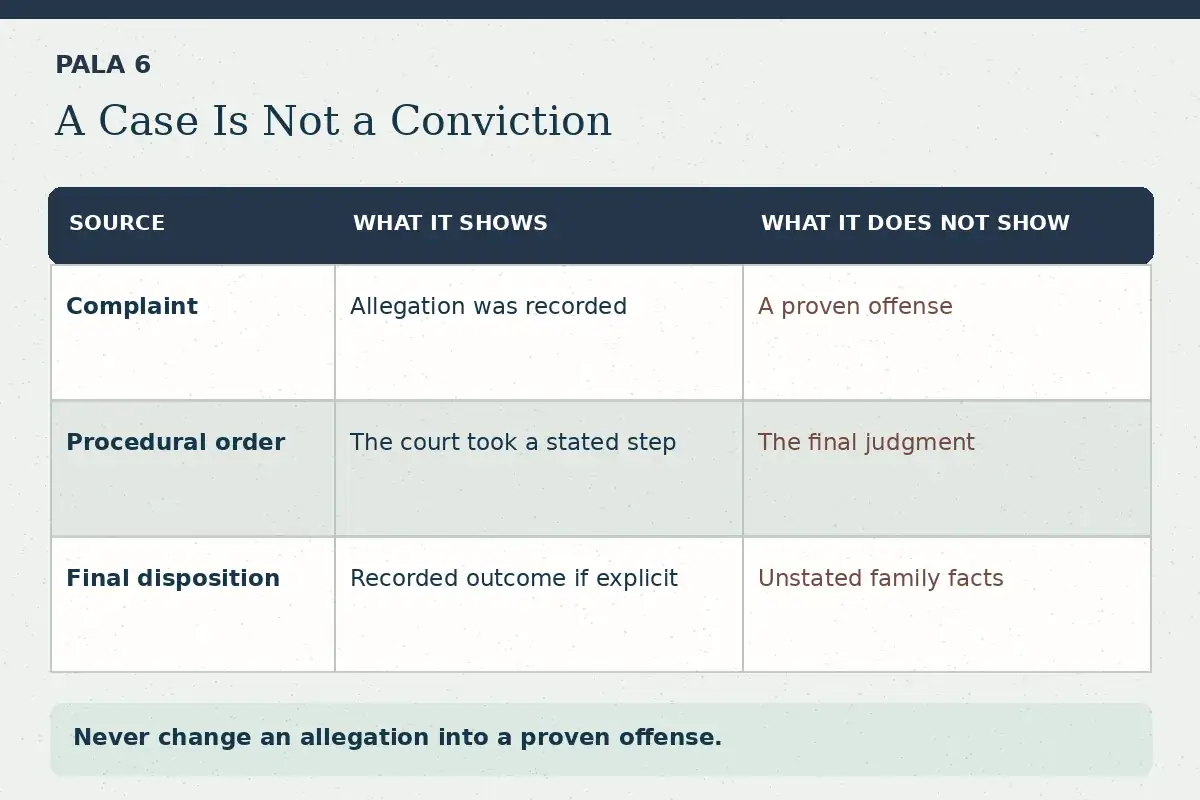
An archival item may be a pleading, deposition, order, minute or other record of a procedural step. Each answers a different question. A complaint records what someone asserted. A witness statement records testimony, not a judicial finding. An order may direct further proceedings rather than dispose of the issue. Read the language and date of the particular item before writing “tried,” “convicted,” “acquitted” or “punished.”
Use Discovery to find the PALA series description and narrow by the available date, person, place and court terms. Not every document is described at item level by every participant’s name, and early-modern spellings may vary. Record what you searched, including a known alias or office rather than just a surname. Where the description groups many proceedings, inspect the original or a reliable transcription before asserting that the named person appears inside.
When a personal name is present, transcribe the role exactly. A complainant, witness, defendant, officer and clerk are different participants. A name alone cannot resolve identity; the account may involve several men or women with the same name. Combine household office, parish, date, status and independent records. Avoid translating a generic role into a specific modern occupation or converting archaic legal vocabulary into an unqualified criminal label.
Separate Allegation, Court Action and Eventual Outcome
Build a case-stage ledger. Under allegation put what the complaint or indictment literally asserts. Under proceeding record dates, summonses, examinations or orders only where those appear. Under outcome write a result only if the record contains an explicit disposition or another authoritative judgment. A procedural line such as an adjournment may mean the case continued elsewhere. A gap at the end of a volume does not prove acquittal or conviction.
If a household officer is accused of taking a payment or violating a rule, the document could be evidence that an accusation was made. It is not automatically proof that money was taken, that the officer lost employment, or that a penalty was enforced. Seek related orders, accounts, employment records or later proceedings. Do not infer a public sentence from a private administrative dispute. Each claim should cite the exact document that supports it.
A hypothetical case can show the method without inventing history: one paper alleges misconduct by a servant; a second commands the parties to return; no final order has survived in the materials examined. The correct conclusion is “complaint and further process documented, result unresolved.” It is not “the servant was convicted.” Keep this wording even when a family narrative would be more dramatic with a definitive ending.
Preserve Household and Family Context With Restraint
Royal service was not in itself a guarantee that a person lived at a particular palace or traveled with the monarch. The household’s membership and movement could change. To link a named participant in PALA 6 to a family member, compare an independently dated appointment, wage or livery account with residence, parish or probate evidence. Be careful when the record uses only a title, first name, or an office that passed between successive holders.
A person may be named as witness because they were near an incident, not because they were employed or related to either party. Document the recorded relationship, not a reconstructed one. Similarly, a household disciplinary case can reflect the jurisdiction rather than the address of the litigant’s home. Record the place stated in the source separately from any modernized map location.

A complete research note should show the full archival reference, procedural category, source language, people and stated roles, and what could not be verified. If the original is inaccessible, describe the catalog result as a lead only. This prevents sensitive historical allegations becoming unsupported facts about an identifiable person, while allowing the surviving paperwork to illuminate household administration and court practice.
More Records and Archives Guides
How We Research Royal Household Court Papers
We use The National Archives guide to Royal Household and Wardrobe records for the pre- and post-1623 distinctions, and its court-record research guidance to classify judicial documents. A catalog title is treated as a finding aid; the Discovery guide explains the path to an original reference.
Our case-stage examples are hypothetical and intentionally do not accuse actual historical people. We do not claim a conviction unless surviving legal evidence supports it. Our affiliate disclosure describes relationships without implying an affiliation with the archive.
No. Court jurisdiction and survival must be checked; proximity to a royal building alone does not establish the correct court.
The National Archives identifies earlier household discipline records in E 35 and E 37; choose according to date and record type.
No. An allegation and a judgment are different sources; look for explicit disposition and any later proceedings.
Not by itself. Confirm residence, employment or household membership through independent contemporary evidence.
Compare roles, dates, locality and other identifiers with a separate source; record ambiguity where more than one candidate remains.