
The National Archives identifies LC 10/1–9 as the place to examine royal messengers’ traveling expenses between 1784 and 1838. These records can reveal the administration of journeys, payments and service, but an account is not automatically an itinerary showing where a person was at every moment. A cost claimed, charged or repaid should be read in its accounting context before being used as evidence of a completed trip or a continuous career.
A messenger’s surname may also occur in appointment, salary or correspondence records. The distinctive value of LC 10 is a journey-focused ledger: who incurred the expense, how the amount was described, what date the book uses and which independent document could show the actual dispatch or arrival. This prevents a financial entry from becoming an invented biography.
Find the correct messenger and accounting volume
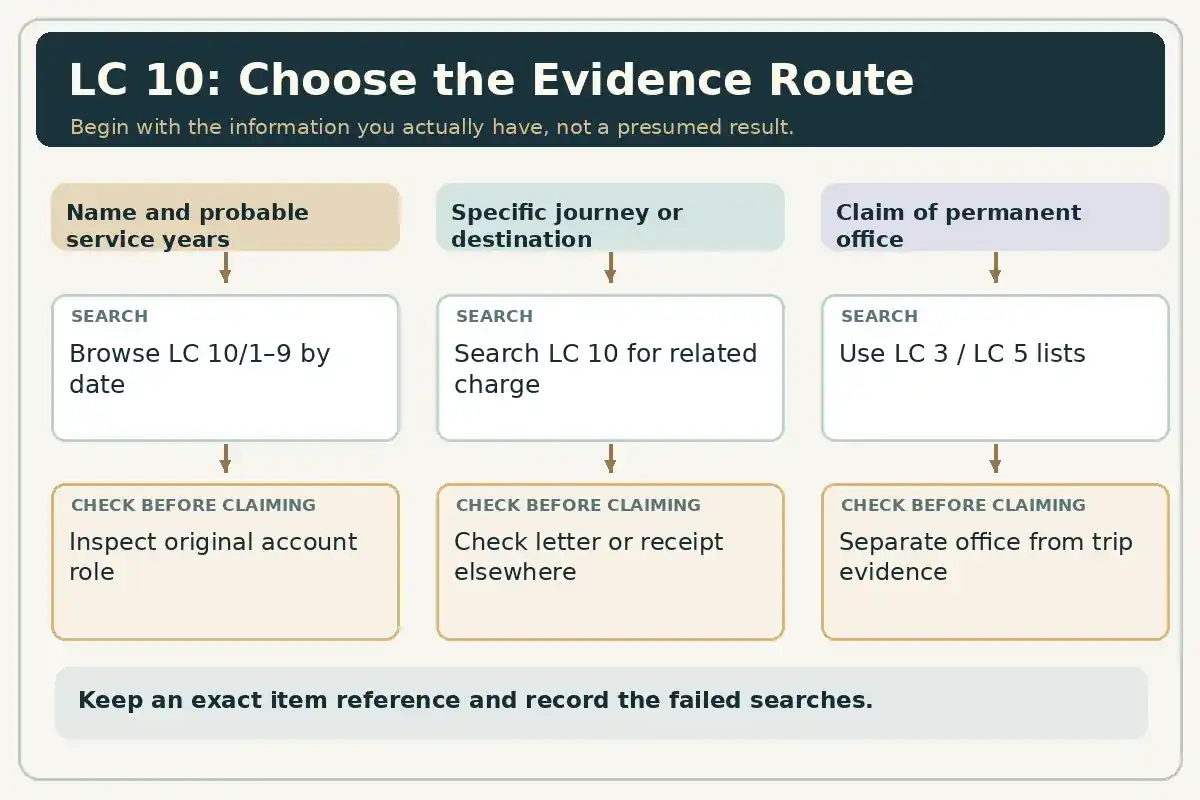
Start with the Lord Chamberlain’s department, not the Lord Steward’s general staff books. The National Archives Royal Household guide explicitly routes messenger travel expenses to LC 10/1–9 for 1784–1838. Search Discovery within the series using surname, role, route, palace or accounting period when available; descriptions may be at volume rather than person level. A missing name in a catalogue result therefore may reflect sparse item-level indexing instead of missing records.
Write a short identity card before opening a volume: exact name as known, dates of possible service, named royal residence, and any independently documented occupation. If a surname appears with different initials or the title “messenger,” do not merge the entries yet. A repeated clerk or payee might appear in the paperwork, so track the name’s role on the account and any signature, rather than assuming every name belongs to the traveler.
Separate the date of travel from the date of settlement
A financial book may describe a journey, the period billed or the later date an amount was entered or settled. Capture all identifiable dates in distinct columns. When an entry supplies only a month-end date, it should not be promoted into a precise departure or arrival day. Note whether a route is explicit, inferred from a destination heading, or absent. The most reliable first conclusion may be “this account concerns a charge associated with X” rather than “X reached Y on a stated date.”
Use the historical spelling of a place and retain any modern identification as a separate field. A messenger could serve duties across different royal residences, but a charge mentioning a palace does not prove it was the messenger’s home or permanent workplace. Likewise, the amount of mileage or subsistence claimed can help describe administration without proving the exact path, stops or duration of travel.
Read allowance, reimbursement, and employment as distinct facts
In the ledger, distinguish an authorized allowance from an account presented for payment and a receipt acknowledging money. Those record types have different evidentiary force. A sum written under a messenger’s name can also represent a departmental charge processed by another official. Record the wording for approvals, deductions, balances and signatures, if any, before translating the figure into a personal wage or reimbursed expense.
Do not compare one sum with another without noting currency, unit, number of days and any stated purpose. A larger claim may relate to distance, lodging or several errands rather than promotion. The separate appointment books of the Lord Chamberlain’s department, including LC 3 and LC 5, can help test a formal office; they are not identical to the LC 10 journey accounts. An expense statement is useful evidence about money even when the individual’s employment status remains uncertain.

Correlate with appointment and correspondence evidence
The National Archives lists establishment books, appointment books, salary books and correspondence across LC departments. Use them according to the question: appointment books for authorization to hold an office, correspondence for instructions or a specific mission, and LC 10 for expenses. Search the years around the expense entry rather than assuming the office began when the first surviving payment appears.
If a letter explicitly directs a messenger to carry a dispatch, its wording is evidence of an instruction. If LC 10 lists an associated charge, the two documents together strengthen an interpretation, but neither alone necessarily shows safe delivery or actual arrival. Look for a reply, receipt, destination office register or independently dated letter before asserting a completed transaction. Keep alternative explanations visible where names or dates fail to align.
Avoid confusing messengers with other palace servants
The royal household contained many departments and occupations, including watermen, housekeepers, artists and attendants. “Messenger” may be a formal occupational description or a functional role in a document. A person who transported a letter one time need not have been a salaried Royal Household messenger. Compare job title, supervisory office, recurring entries and tenure in establishment lists before building a career timeline.
A person could appear in LC 10 as a payee without appearing in a surviving name index. General civil-service guidance cautions that routine personnel files were not systematically preserved. Therefore, an absence of a personnel file should not negate a well-cited expense entry, and a name match to an unrelated civil servant must not be accepted without chronological and occupational links.

Publish a cautious journey chronology
A useful table has columns for source reference, name and role, stated place, period of service, charge or allowance, accounting date and corroboration. Assign a separate status to each itinerary claim: documented instruction, expense associated with movement, independently confirmed arrival, or unresolved. This structure makes it possible to tell a genuine sequence of movements from a series of transactions posted on different dates.
Preserve the full reference LC 10/piece and page or folio along with the exact image or document location. Note whether the information was read from a catalogue description, manuscript, transcript or later account. If two messengers share a surname, list their distinguishing details and reasons for exclusion. An accurate narrow conclusion — for example, that a named account charged an expense during one period — is preferable to a vivid unsupported travel story.
More Records and Archives Guides
How We Research and Verify These Records
This guide treats LC 10 royal messenger expenses as a source-specific question, not a promise that every historical person can be located. We first checked archival descriptions for coverage and record purpose, then compared the source routes with previous GenHis topics and searched for overlap in reader intent. For every suggested inference we asked what the record explicitly states, who supplied the information, whether an independent record survives and what contradictory explanation remains possible. A catalogue listing, a derivative transcript and an original document are cited as different objects.
Archive and repository guidance consulted for this topic includes The National Archives The National Archives. Each site is evidence about its own holdings or research method, not proof that a particular person appears in a specific record. Before requesting a copy, check the present catalogue entry, opening status, permitted use, charges if any and whether the repository holds the original or a transcript. Never assert that absence from a sampled or incompletely catalogued series proves the underlying event did not occur.
Our source practice is to preserve archival reference, image or folio, exact names and dates as written, and a separate field for any estimate or translation. We do not invent individuals or identify living people in examples. Links to outside repositories are informational; review the affiliate disclosure before using any commercial service mentioned elsewhere on the site.
Not automatically. It records travel-related expenses; arrival may require a dated reply, receipt or other independent evidence.
The National Archives Royal Household guide describes the messenger expense run as 1784–1838.
Do not assume so. Many historic volumes are described more broadly than at the personal-name level.
No. Use LC appointment or establishment records for an appointment claim and the expense record for its financial facts.
Label accounting, travel and payment dates separately and avoid inferring an exact departure day from a later entry.