
RAF Air Publications AIR 10 offers an evidence-based path to a specific historical question. First identify the right administrative series and original record, then separate a reported assertion, a dated decision and an unverified family inference. This article shows where to search, how to interpret the source, and what independent record should test the conclusion.
Ask What the Aircraft Could Do, Not Who Flew It
AIR 10 contains the Air Publications collection at The National Archives, including pilots’ notes, rigging diagrams, handbooks and maintenance instructions dating from 1913 onward. These sources describe equipment and procedures; they are not personal logbooks. A family account that a relative served in a particular RAF aircraft can be enriched by reading the correct manual, but the publication itself cannot place that relative in a cockpit.
Begin by identifying a documented aircraft type and, if known, mark or variant. Distinguish the standard type from a later conversion. Keep the crew member’s service number and unit in a separate evidence file; do not populate a personal timeline from performance figures or diagrams.
Choose the Exact Edition and Mark
Aircraft manuals often differ across a type’s development, and a technical page from one mark may not describe the machine used on a particular date. Search the AIR 10 series by aircraft name, type number, role and publication keywords. Inspect the catalogue description for an edition date and original piece reference rather than trusting search-snippet terminology.
When a family photograph shows an aircraft with an uncertain marking, compare dated photographs and formation or equipment histories before choosing a manual. If no exact edition can be located, label the guide as a contemporary comparison, not an exact reconstruction of the ancestor’s machine. Record all edition uncertainty next to any technical quotation.

Differentiate Pilot Notes, Maintenance and Rigging
The Archives lists several document classes under AIR 10. Pilots’ notes describe operation and limits for aircrew; maintenance instructions describe upkeep; rigging diagrams address assembly and alignment; handbooks may serve other technical roles. The type of publication determines what question it can answer, including why crews checked a system or how ground staff identified a component.
A rigging drawing is not a diagram of an operational flight. A pilot instruction is not a report that a particular pilot followed it. Note the intended audience, equipment variant, date of revision and any officially prescribed terminology. Avoid interpreting an illustrative operating limit as a measured outcome from a historical sortie.
Link AIR 10 to Operational Sources Carefully
To investigate a dated mission, turn to unit operations books, especially AIR 27 for squadrons; AIR 28 may contain station activity, and AIR 50 holds some Second World War combat reports. These sources answer different questions from AIR 10. A squadron diary might note a formation or operation, but it may not identify every crew member.
Build two parallel research lines: an equipment profile based on the correct AIR 10 publication, and an event chronology built from dated operational sources. Only join the lines once aircraft mark, unit and date align. Even a surviving squadron report is not a substitute for an individual service file or flight log where personal presence is disputed.

Use a Technical Illustration as Context
A technical drawing can make the machinery in a photograph understandable: which control, hatch or station was available on the model, and what task the instruction addressed. It does not identify the individual standing beside the aircraft. AIR 10 is also not a comprehensive source of detailed production drawings; The National Archives points to other AVIA, AIR and SUPP material for particular photographs and aircraft specifications.
Label a family-history illustration with the actual aircraft type and source edition. If a drawing is an original archive image, check reproduction rights before reuse. When creating a new explanatory sketch instead, state clearly that it is an editorial reconstruction, not a scan from the manual.
Watch for Training and Operational Variants
Training aircraft and frontline aircraft may share a name but differ in features and operational assumptions. Even within one squadron, equipment could change during a posting. The relevant question is not merely whether the RAF used the type at some point, but whether an independent dated record places that type with the unit during the timeframe being researched.
Prepare a variant checklist: type, mark, issue or revision date, unit, service dates, theatre and known photographs. If the evidence establishes only a squadron assignment, do not assert the officer flew the specific aircraft shown in a museum or modern restoration. Note gaps in the squadron equipment record as unresolved.
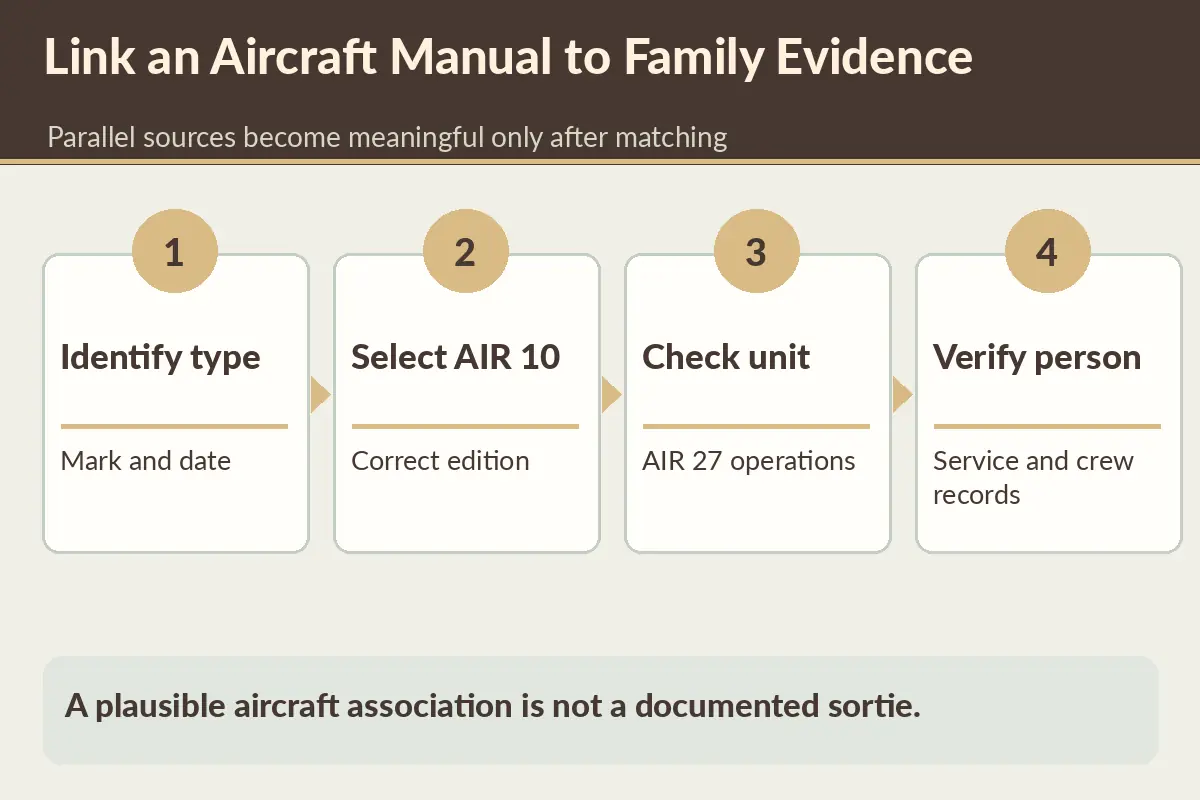
Verify Personal Service With Personnel Evidence
For an individual RAF airman, the Archives points to separate personnel records including AIR 79 for many pre-1939 airmen and AIR 84 for some later transferred service files; officers have different service series and commissions evidence. A service record can support a unit or period without documenting every sortie. Air publications should be cited alongside these records, not substituted for them.
Where family testimony describes an injury, sortie or crash, look for date-specific AIR 27, AIR 50, AIR 81 or relevant casualty material. The presence of an aircraft’s manual in a historical collection is not evidence that the person trained on it. Preserve the distinction between documented assignment, unit-level operation and individually proven flight.
Create a Reproducible Equipment-and-Event Note
A useful conclusion lists the AIR 10 piece and edition, technical claim, aircraft mark and related dated record supporting the family context. For each statement, mark whether it comes from a procedure, contemporary operation report, personal service record or later recollection. This four-way label makes the story readable without overstating certainty.
If only the manual is available, present the equipment as historical context. Say explicitly that no individual flight has been proved. A precise limited conclusion is stronger than reconstructing a dramatic sortie from a generic flight manual. Preserve a next search for squadron records or a personal service file where the actual person and date are central.
How We Research Historical Archive References
We checked the principal archival research guide and a second repository or related-source guide on 28 October 2026. We compared the dates and type of record, the intended purpose of each series, available finding aids, and the limits of individual identification. No fictional example is represented as a genuine historical person. The illustrations explain source relationships and are not original archive scans. A negative catalogue search is not proof that an event never occurred.
More Records and Archives Guides
Source Citations and Ethical Research Boundaries
The sources establish: AIR 10 Air Publications from 1913 include pilots’ notes, rigging, handbooks and maintenance instructions; archives lack many detailed aircraft plans. Related documentation adds: AIR 27 unit operations, AIR 28 stations and AIR 50 combat reports answer event questions rather than general technical manual questions. A complete citation needs the repository, series, piece, original date, page or folio, role of the named individual, and access format. Note when only a secondary description or an index was read. Keep sensitive living-person information private where necessary. Read the GenHis affiliate disclosure; none of the links here implies a paid endorsement.
No. AIR 10 is a collection of technical Air Publications rather than personnel or flight records.
Pilots’ notes, handbooks, maintenance instructions and rigging diagrams are among them.
Find relevant dated operations or log material and independently identify the crew.
Different marks and manual revisions can describe different equipment and procedures.
AIR 27 and related operational series, depending on unit and period.