
RAF Combat Reports AIR 50: Separate a Pilot’s Claim From a Confirmed Loss starts with a distinction often missed in family and local history research: an archival entry describes a particular document or administrative act, but does not automatically establish every related event. Use the official series research guide to select the correct record, then check the related source guidance before extending the conclusion. The steps below identify what AIR 50 RAF combat reports can show, what it cannot show, and which independent reference could resolve uncertainty.
Begin With the Reporting Airman, Not a Crew List
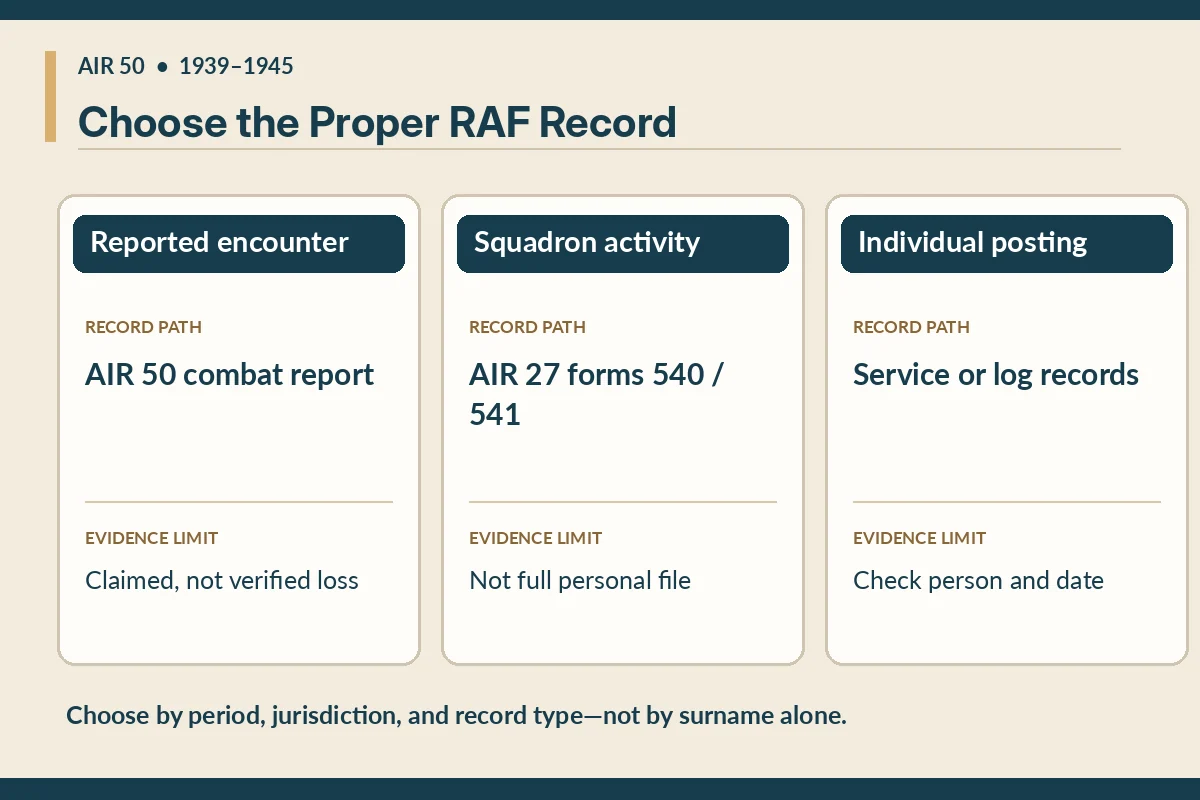
AIR 50 contains Second World War combat reports written after encounters with enemy aircraft. The National Archives dates the series to 1939–1945 and explains that it covers Fighter, Bomber and Coastal Commands, the Fleet Air Arm, and some Commonwealth and Allied units based in Britain. This is an account of a reported combat encounter, not a master list of people who flew a mission or every enemy aircraft destroyed.
The online search is chiefly keyed to the author of the report: a pilot for a fighter account or an air gunner for a bomber account. You normally cannot locate a record simply by entering the name of another crew member. If researching a relative who served elsewhere on the aircraft, establish the squadron, date and the reporting crew member from another source, then search AIR 50 using those anchors.
Read the Combat Narrative as an Eyewitness Account
AIR 50 documents may include a personal combat report, a Fighter Command combat report, correspondence and annotations. Common fields record the time and date, height, approximate location, squadron, type and number of hostile aircraft, and the reporter’s view of the result. Read those fields together with the free-text narrative. A pilot’s description of firing and observing damage is evidence of a report submitted, not conclusive proof of the other aircraft’s fate.
Copy the exact language used for “destroyed,” “probably destroyed,” or “damaged” where it appears. Do not quietly convert “probably destroyed” into “shot down.” Note whether the account says the target disappeared in cloud, was seen to strike the ground, or was merely emitting smoke. These represent different levels of observation. Also distinguish encounter location from the last known fate of the opposing aircraft.
Build a Sortie Timeline Before Linking Accounts
Transcribe the reported time, date, squadron and approximate position first. War operations often involved multiple aircraft, changing formations and overlapping combat claims. Two reports on the same day may describe the same encounter from different viewpoints; they may also describe unrelated fights. Compare aircraft type, direction of attack, altitude and any named formation before combining individual descriptions.
Time formats, clocks, and geographical references need careful handling. A British report may not match the time convention in an opposing force’s record. Record the source’s original time instead of silently standardizing it, and add any conversion as a clearly labeled analytical step. When the location is vague, write the vague expression; do not pinpoint a crash site on a modern map without separate evidence.

Compare the Squadron Operations Record Book
The most useful nearby official record is often the squadron Operations Record Book in AIR 27. Form 540 summarizes unit events; Form 541 provides detail of work carried out and may identify aircraft or crews. Search by squadron number and month, then read the pages for the date of the reported combat. This comparison can establish operational context even when the narratives are not identical.
A squadron record is not a personal logbook and may not name everyone. It may also summarize a sortie rather than provide every encounter detail. If AIR 50 gives a claim missing from AIR 27, do not assume either is fraudulent. Check whether the unit record groups missions by operational date, whether attachments survive, and whether the report was filed later.
Treat Enemy Aircraft Losses as a Separate Question
An air-to-air victory claim and a verified loss are different historical propositions. To evaluate a claimed destruction, seek independent enemy loss documentation, operational records, crash evidence, or carefully sourced specialist research. Match time, area and aircraft type before comparing names. A single Allied report with dramatic language may coexist with a different account of what happened to the target.
This distinction protects the credibility of a family story. You can write that a named pilot claimed one aircraft damaged in a dated report even if the outcome remains uncertain. It is not responsible to state that he destroyed a particular enemy plane without evidence identifying the opponent. When available sources disagree, present the disagreement in a concise evidence table rather than forcing a definitive tally.

Understand Missing Reports and False Negative Searches
The National Archives explicitly calls AIR 50 incomplete. Absence may reflect non-survival, indexing limits, a different reporting author, or an encounter that generated no surviving individual report. Begin with the spelling and rank used at the time, and consider a squadron-led search where the name route produces nothing. Record which search was actually conducted.
An absent AIR 50 report does not prove that no sortie occurred. Conversely, an AIR 27 sortie entry without a combat report does not prove that an enemy was engaged. Keep mission evidence, encounter evidence and loss evidence in separate categories. This makes it possible to add new discoveries later without rewriting earlier claims as facts.
Work Through a Two-Report Discrepancy
Imagine one pilot’s form lists an enemy aircraft as probably destroyed, while a wingman reports only hits. Quote each reporter separately and record the aircraft, time and location. If the sources describe the same event, the difference is evidence about eyewitness interpretation, not permission to select the more exciting account. Seek the corresponding AIR 27 sortie entry and any independent loss account.
If a relative is named in a squadron summary but not in either report, the squadron record may support their participation in a sortie without establishing that they fired on an enemy aircraft. Put that limit into the caption or family timeline. The goal is a traceable account of documented activity, not a reconstructed victory tally.
More Records and Archives Guides
How We Research RAF Combat Evidence
Our evidence sequence records the reporting author, the AIR 50 document reference, the exact wording of the result claimed, and an independent check using AIR 27 or another reliable record. We maintain separate fields for reported action, claimed outcome, confirmed loss and personal identification. When none of the later checks can be completed, we publish the claim as a claim.
The official AIR 50 research guide establishes scope and search mechanics; the squadron guide explains the related operational record. Neither substitutes for reading the individual image. Access models can change, and our affiliate disclosure explains the site’s link transparency policy.
They were commonly filed by pilots or air gunners after an encounter with enemy aircraft.
The National Archives says the online search is by the reporting pilot or air gunner, not by the names of all other crew members.
Not on its own. It records an observation or claim and requires comparison with additional records.
No. The coverage includes multiple RAF commands, Fleet Air Arm and some Allied units operating from Britain.
AIR 50 is incomplete. Search an AIR 27 squadron Operations Record Book or relevant aircrew log for additional context.