
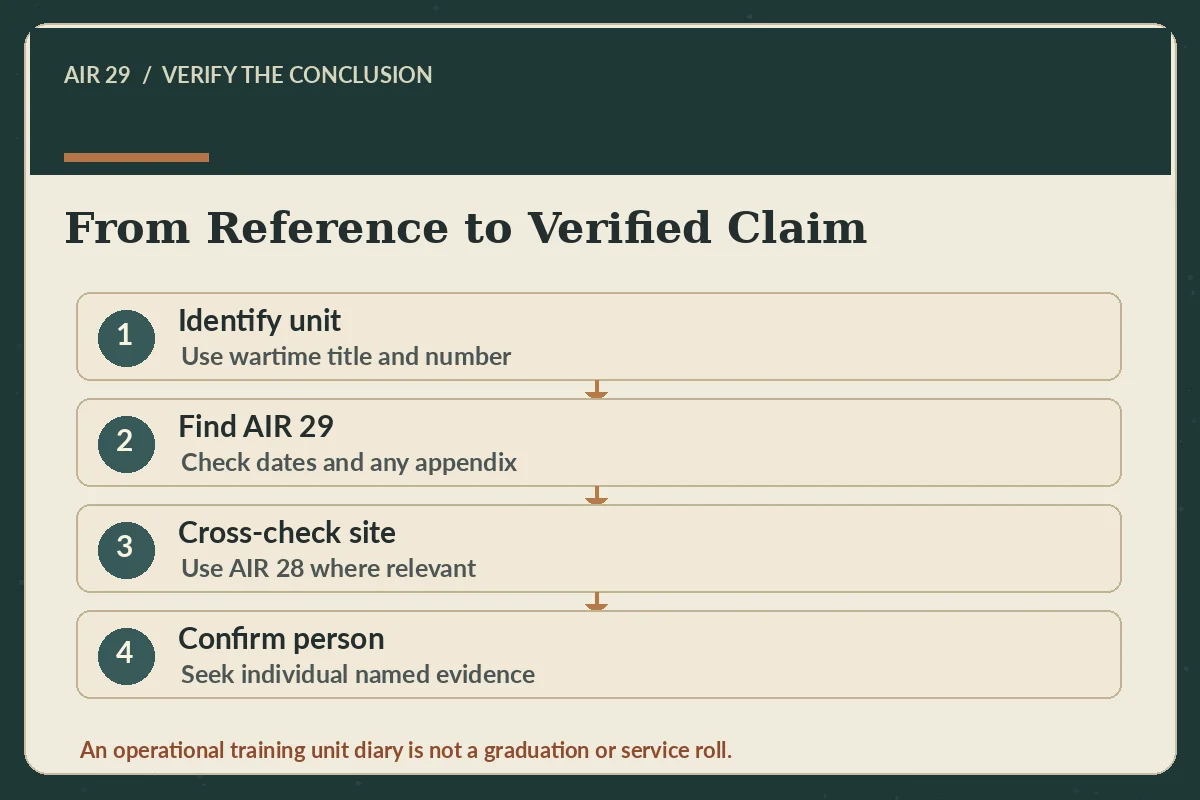
AIR 29 is a useful National Archives route for RAF miscellaneous units—including training and support organizations—whose operations record books may not be in the squadron series AIR 27. Begin with the unit’s number or title and date, not only the surname of a pilot. The National Archives explicitly distinguishes AIR 27 squadrons, AIR 28 stations and AIR 29 miscellaneous units. Even when a diary mentions a named airman or airwoman, it does not replace their individual service record.
Choose Squadron, Station or Other Unit
RAF operations record books were organized by different kinds of organizations. AIR 27 largely holds squadron books, AIR 28 station books and AIR 29 books for miscellaneous units, such as training organizations. A training detachment housed at a station could therefore appear in more than one administrative context. Search the unit designation as used at the time and check for changes of title, numbering and location.
If a family letter names an Operational Training Unit, searching only AIR 27 by the later operational squadron may leave out the period that matters. Start with the course, training station or unit reference if known, then search AIR 29 descriptions and relevant dates. Use AIR 28 to confirm the airfield context where needed. Unit coverage is not a guarantee of an entry for every day or every individual.
Read the Forms and Attached Material
Operations Record Books may combine the Form 540 summary of events with more detailed forms and appendices, but exact content depends on the unit. A training book can record courses, visits, aircraft, administrative changes and significant incidents. Each page belongs to a reporting period, and an appendix may be compiled or attached later than the event it describes. Record the date on the source rather than the date inferred from the file cover.
The National Archives features AIR 29/687/4, a book for No. 84 Operational Training Unit at Desborough, with WAAF notes from February 1944 and anniversary material later that year. That case shows social and support activity may survive beside operational entries. It does not mean every WAAF member appears in the diary. A named note proves only the activity attributed by that source, not a complete service record.

Separate Training Activity From Operational Service
A training-unit reference can show that the unit conducted exercises or received personnel, but it is not proof that a particular pilot completed a course, qualified for operations or served with a front-line squadron. A later squadron ORB may mention the person, yet the connecting chronology still needs individual evidence. Keep training, posting, promotion and operational flight as separate events with separate sources.
For an aircraft accident reported in a unit book, note the report’s wording and immediate context. It may describe a damaged aircraft, injury or investigation rather than a definitive cause. Seek a contemporary accident or casualty record if the question concerns an individual outcome. Do not turn a unit’s activity into personal participation merely because a family member is known to have been at the airfield that month.
Track Women and Ground Staff Honestly
WAAF entries in training ORBs can reveal shifts, visiting personnel, welfare events, hospital services and administrative changes. These traces are important in their own right and should not be discarded because they differ from flight logs. At the same time, the record was selected and written by the unit; activities and people not considered noteworthy may remain invisible.
When an airwoman appears by surname or role, compare date, rank or trade with a suitable service record or other named evidence. Common surnames and initials are weak identification alone. A station photograph may include personnel from many organizations, so an image taken at the unit does not establish that every person pictured served there. Preserve uncertain identifications and avoid assigning a name without a chain of matching details.

Search Changing Unit Names and Attachments
Units formed, moved, merged or were disbanded during wartime. A short-lived numbered unit might have its records catalogued under a successor name or attached to a station file. Build a small unit timeline with exact dates from the catalogue and original headings. Where two units share a number at different dates, do not combine them without proof of continuity.
A report can refer to attached aircraft or personnel who belonged administratively elsewhere. If the diary describes a course, a visiting instructor or an aircraft transferred to another unit, identify the relationship with words such as ‘attached’, ‘visited’ or ‘transferred’. Treat those words as distinct from permanent posting. An unrecorded departure date is an unresolved question, not evidence of uninterrupted service.
Create a Form-by-Form Evidence Grid
Suppose AIR 29 confirms that training occurred at a station in September 1944. Record the unit identifier, reporting dates, page and event. Next search AIR 28 for station-wide details, then AIR 27 only if a relevant operational squadron is known. Compare entries by date and avoid assuming the reports were compiled simultaneously or by the same officer.
For a named flight or graduation, add a separate column for individual proof. Personal service records, qualifications, photographs with verified captions and dated correspondence may each contribute different levels of certainty. A local newspaper report should be cited as a published account, not silently promoted to a military personnel record. Keep a list of missing forms and appendices so a future researcher can repeat the search.
Explain Access and Preservation Limits
Catalogue entries are finding aids, not full transcriptions. The National Archives states that some RAF ORBs are available online, but the access route varies by series and period. Do not promise that a chosen AIR 29 item is digitally downloadable before checking its current catalogue access conditions. Search by unit title, number, station and date; browse when keyword results are thin.
If only a unit history can be located, distinguish a verified unit event from a family assertion. An AIR 29 reference is valuable even without an ancestor’s name because it dates the institutional setting for further research. Cite exactly what the book says and what it cannot say. Do not assume the absence of a surname means the person never trained or worked with the unit.
More Records and Archives Guides
How We Research Sources and Boundaries of Proof
Our research method starts with the official subject guide and compares it with a second archival source. We record the holding archive, series, piece, document date, compiler and whether the document itself was inspected. A catalogue description is a lead, never a substitute for reading the original. We distinguish an administrative statement from a later event and a plausible interpretation from independent confirmation. Not every person, date or place can be proved from a surviving record; damaged, missing or unindexed items are noted explicitly. For information about our commercial relationships, review the affiliate disclosure.
No. AIR 29 is primarily for miscellaneous units; squadron ORBs are mainly in AIR 27.
Search AIR 28, using the station name and dates.
Yes. Some records include WAAF and other ground-unit activities, but coverage varies.
No. Seek a named qualification, posting or service record.
Do not assume so; check the catalogue access details for the individual item.