
AIR 76 officer sheets can list commissions, units, promotion and kin, but may include earlier RFC or RNAS service. Follow the 1 April 1918 boundary correctly. Begin with the official archive research guidance and read our affiliate disclosure before using any access service.
AIR 76 Is an Officer File, Not a Complete Flying Record
For a man commissioned into the early Royal Air Force, the correct first stop may be AIR 76, not an ordinary airman’s service number index. The National Archives describes more than 99,000 RAF officer records created from April 1918, often recording earlier Royal Flying Corps or Royal Naval Air Service service retrospectively. The core documents are personnel sheets, sometimes more than one for the same officer. They can establish a reported commission or unit posting but do not automatically prove that a named officer flew a particular sortie.
Before opening a search result, write down the prospective officer’s full name, initials, known rank, approximate birth date, commission date and any pre-RAF unit. Test whether the person held an officer’s commission rather than assuming every wartime pilot was an officer. Keep first- and second-hand family assertions separate. An initial-only entry is useful as a candidate, but a service sheet matched to a common surname requires other facts before you can accept it as your relative.
Search Discovery With Initials and Flexible Birth Dates
The archive’s official AIR 76 search guidance recommends testing initials when full names fail. The date of birth was not consistently recorded; removing that field may recover otherwise hidden matches. Some entries show only “1918–1919” because the birth date is absent, not because the officer was born during those years. Downloaded documents may include multiple same-name people, so the first plausible page is not necessarily the right person.
Create a candidate list recording the displayed catalogue title, piece or item reference, exact name form, rank and any birth-place detail actually on the sheet. Compare each candidate rather than relying on a single filtered database result. The catalogue can lead to a digital image with handwritten amendments; inspect every side and continuation page. Copy conflicting dates as written and retain the original reference so your identification can be audited after interface or indexing changes.

Apply the 1 April 1918 RFC and RNAS Transfer Boundary
The RAF began on 1 April 1918 by combining the Royal Flying Corps and Royal Naval Air Service. An officer who served in the earlier organizations may have a service history predating the creation of RAF records. AIR 76 can include those details, but a retrospective statement is not equivalent to the original Army or Admiralty record. Use dates and units to determine whether earlier RFC, RNAS or RAF material is relevant; the same man may appear in several administrative systems.
An RFC officer before April 1918 belonged to the Army environment; an RNAS officer belonged to the Admiralty system. The National Archives separately identifies ADM 273 for RNAS officers and refers researchers to Army records for RFC service. Treat a later RAF posting as a new organizational phase, not as evidence that the same rank, duties or station remained unchanged. Build a cross-service timeline with organization, rank, date, documentary source and any unresolved overlap.
Extract Each Field Without Supposing Operational Activity
An AIR 76 sheet commonly reports full name, birth details, next of kin, civilian occupation, commission, subsequent promotions, units and dates of departure or retirement. Some sheets mention specialist courses, aircraft types, awards or a Royal Aero Club certificate. Not every field appears on every person’s file. Next-of-kin identifies a person described at a particular time, but cannot by itself prove marital status or biological parentage.
Transcribe postings with effective dates, and distinguish an assignment to a unit from presence on a specific mission. An aircraft type or qualification entry is not a flight log. Where an award is stated, compare the date with an independent London Gazette notice. To verify a crash or combat claim, consult appropriate squadron records or other contemporary evidence rather than relying on the service summary alone. Cite the exact sheet side for each claim.
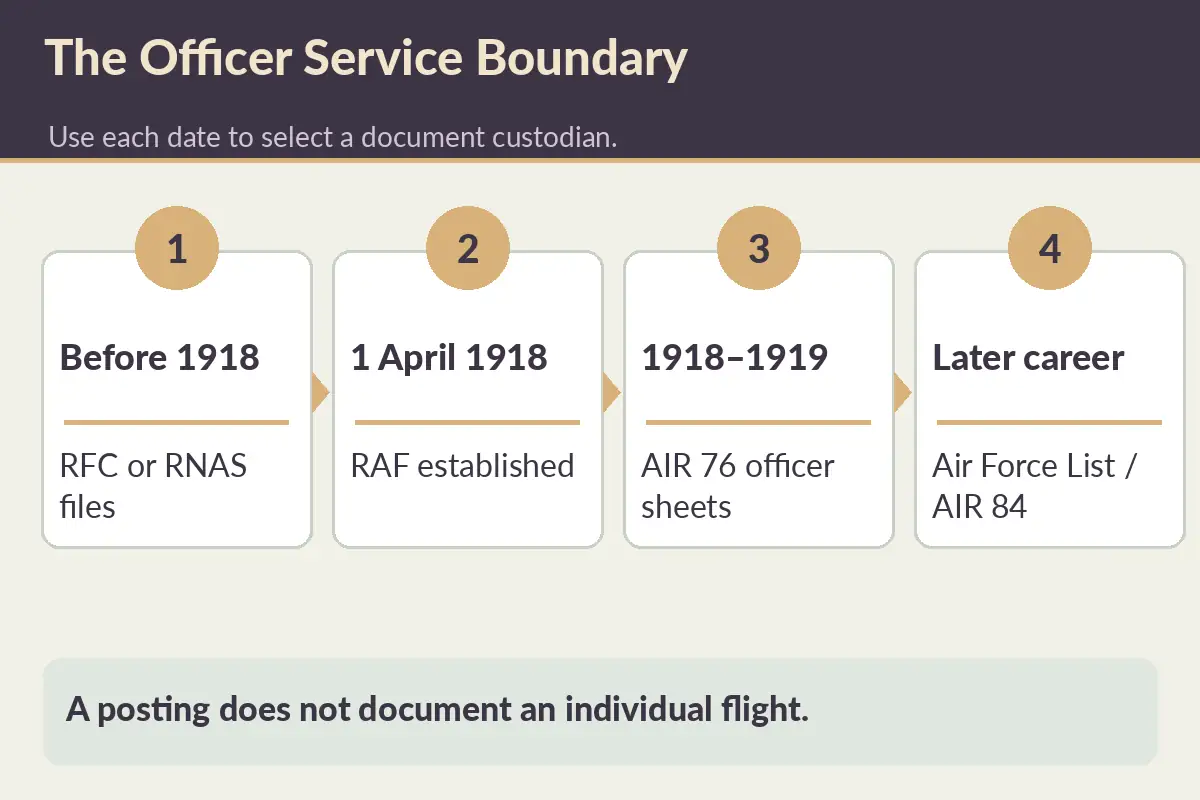
Route Later Service to the Appropriate Record Custodian
AIR 76 mainly represents early RAF officer administration; it should not be treated as a lifelong personnel record for every officer serving after the First World War. The National Archives separately describes transferred later officer service records in AIR 84 and explains that other records may still be held by the Ministry of Defence. Access can depend on the person’s age, closure status and processing stage. This is a different question from whether an AIR 76 sheet survives.
For an officer remaining after the early period, compare dates in the Air Force List, which begins in March 1919, with the service-sheet entries. The published list can track commission and promotion, and in some earlier periods some postings. It is not a replacement for the personal file or proof of a sortie. Keep a custodian log showing AIR 76, the contemporary published list, any later AIR 84 search and any actual access restrictions.
Resolve Same-Name Officers With a Documented Identity Matrix
For a candidate match, require more than one mutually supportive fact: birthplace, birth year, civilian trade, next-of-kin detail and a plausible transition from prewar life into military service. If the expected exact birth date is absent, do not reject a candidate automatically; instead rank the available independent checks. Compare other officers with the same surname to avoid merging two careers into one biography. A different middle initial may be significant but spelling and abbreviated naming varied.
Create a citation-backed timeline for birth, first commission, organization transfer, unit posting, promotion and termination of commission. Mark each entry as directly documented, indirectly inferred or unresolved. If a later civil marriage record disagrees with a next-of-kin name, test whether either was recorded earlier rather than forcing a correction. The result should be a reproducible officer identity conclusion, not an invented operational service history.

How We Research Raf Officer Records Air 76
We first test officer versus airman status and the April 1918 creation date, then search AIR 76 using full-name and initials variants without insisting on a birth date. We inspect multi-sheet results and capture commission, ranks and units with dates. Earlier claims go to the RFC or RNAS archive, later claims to the Air Force List or current file custodian, and flying operations require independent unit evidence.
More Records and Archives Guides
Original Archives and Evidentiary Boundaries
To reproduce this investigation, consult the principal official series guide (Documents the 99,000-plus officers’ AIR 76 sheets, search variants and officer fields, with retrospective RFC/RNAS details.). Independently compare the secondary archive reference (Distinguishes RAF airmen AIR 79, First World War officers AIR 76, and later officer custody and Air Force Lists.). Neither an archive catalogue title nor a later database index proves the full historical event without examining the underlying record and its context.
No; AIR 79 is the principal early personnel series for airmen rather than commissioned officers.
The birth date may not have been recorded on the sheet.
Yes. Earlier RFC or RNAS service may be described retrospectively and should be checked independently.
No. Qualifications and unit listings are not a sortie log.
Consult The National Archives’ updated officer guidance, including AIR 84 and relevant MOD access routes.