
AIR 11 contains photographs of airships, balloons and associated equipment and facilities held in records from the Naval Aircraft Works and later Royal Airship Works, with material dated 1911–1939. The National Archives also points to AIR 11 for information about airship design and construction in the interwar years. A workshop or airship photograph shows an object or setting; it does not establish that the craft made a particular flight, carried an ancestor or completed a planned route. This guide gives a precise source route, identifies what the archive can and cannot show, and names the independent documents needed before a personal or geographic conclusion becomes defensible.
Separate the Naval Aircraft Works from Later Airship Records
Begin with the airship name or type, a photograph caption, site or institution and a rough year. The official photographic guide describes AIR 11 as material once held by the Naval Aircraft Works and later the Royal Airship Works, dated 1911–1939. The photographs include airships and balloons as well as equipment and facilities in Britain and other countries. An image held in a British official file need not depict a British-built craft; foreign technical scenes formed part of the collection.
Preserve the literal caption and the archival series reference. If the photograph shows an airship at a hangar, confirm the place rather than attributing it to Cardington by default. If the airship name is partly illegible, compare shape and other identifiers only as search clues, not definitive identification. The collection contains photographs within files and a defined subseries, so catalogue descriptions might not identify individual frames. Search for type variants and institution names, then browse the relevant sequence.

Read Design and Workshop Images Without Inventing Completion
A photographed component may document experimentation, manufacture, repair or display. A nearly completed hull in a hangar can be visually striking without proving that the vehicle eventually flew. Record what the image shows: structural framework, control surfaces, envelope equipment, gondola arrangement, engines or workplace. Check a caption’s date and creator, and seek associated notes to learn whether the item is a proposal, prototype, replacement component or installed system.
Drawings in AIR 12 are a separate research route for airship design, according to the official RAF research-and-development guide. A design drawing can explain measurements and intended construction, but even it does not certify that the object was built as shown. Compare a technical drawing with the image by named component or type and mark revisions. Similar-looking equipment may have been shared across designs. Keep a proposed feature, a photographed assembly and a completed craft as three independent statements until the sources connect them.
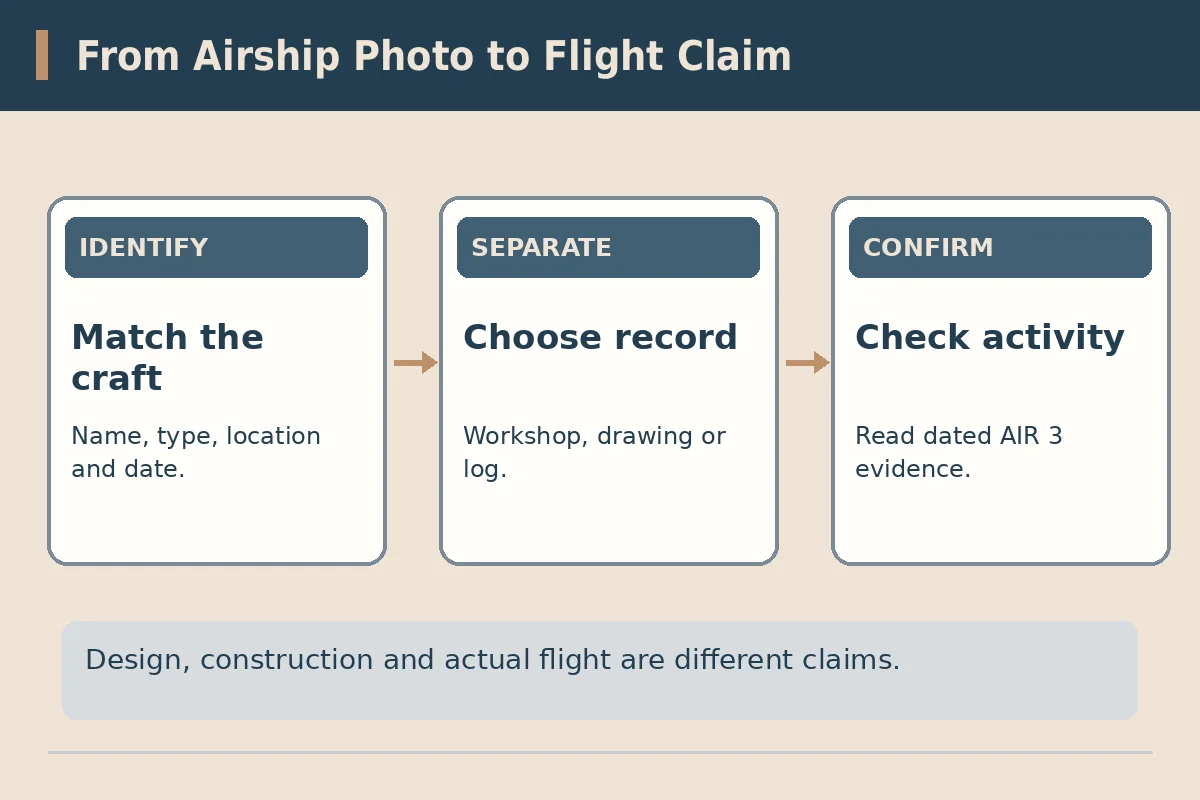
Hypothetical example: a family photo shows a silver airship inside a shed and is annotated “R 100 trial.” The image alone may not establish the craft or the flight. Compare AIR 11 context, an AIR 12 drawing if appropriate, and AIR 3 logbook entries for the stated date. A shed photograph in AIR 59 might help locate the site.

Choose AIR 11, AIR 59 and AIR 3 for Different Questions
Use AIR 11 when the lead concerns an airship, balloon or technical equipment in the Naval Aircraft Works or Royal Airship Works context. The National Archives identifies AIR 59 separately for photographs of airship sheds and related buildings at named stations, such as Cardington and Pulham. That makes AIR 59 a better alternative when the real question is what a facility looked like, rather than the design of a particular craft. The collections overlap in historical subject but differ in arrangement and document purpose.
For actual airship movements, the official guidance points to surviving airship logbooks in AIR 3, including those for R 100 and R 101. Look for the exact craft and date, then read the relevant entries rather than inferring activity from an airship silhouette or a hanger photograph. An AIR 3 logbook is not automatically a roster of everyone who worked in the factory, and an AIR 11 caption naming an airship is not automatically an AIR 3 flight event. The correct series depends on the question.
Verify a Named Worker or Passenger with Separate Evidence
A relative may have claimed to be an airship engineer, fitter, rigger or passenger. AIR 11 photographs can illustrate a working environment, but an unlabelled figure beside a craft cannot be identified from family tradition alone. A title block naming an official or photographer does not identify everyone pictured. Seek personnel material, employment registers where they survive, named correspondence, published records and independent family documents. Confirm the same individual through dates, roles and other identifiers.
For a passenger or crew claim, first confirm which craft flew on the stated date from a proper operational record. Then look for nominal lists or another source that can establish the person’s presence. Do not assume every engineer who helped design or assemble a craft accompanied it on its flights. The dates of construction, hangar trials, acceptance and operational use may differ. A sourced airship biography should show these milestones separately and avoid assigning an individual to an entire program merely because their workplace was involved.
Document Provenance and Keep Chronology Honest
For each candidate, log AIR 11 piece and image identification, caption language, any attributed creator, site, the date of photograph if known and the date of any later file annotation. An official archive file might contain contemporary prints together with material assembled later. If the photograph is a reproduction of an earlier image, say so. The National Archives explains that many photographs are not online and that some are only discoverable within parent files. The absence of a keyword hit is not proof that an airship was never photographed.
When concluding, state narrowly that a particular image documents an airship or technical component at a described site and approximate period, if those facts are supported. Then use separate AIR 12 drawing evidence for a design feature and AIR 3 logbook evidence for a recorded flight. If dates or airship identities do not align, retain both possibilities in the research log. The job is to test connections between sources, not convert an evocative workshop picture into a complete flight manifest.
An airship photo without a person’s name still has documentary value: equipment form, test environment and facility configuration can be compared with dated design records. But technology evidence is not the same as a named worker’s career or a logged flight.
More Records and Archives Guides
How We Research This Archive Series
This guide starts with the documented evidence in an authoritative source, not a claim that we have inspected a particular person’s private file or a specific original piece. The archival statements here concern the series or research method. A hypothetical example is labelled as such; it is not a newly discovered historical event. We use the Discovery search guidance to distinguish keyword matches from archive holdings and document contents, because catalogue descriptions do not transcribe every word of an original.
For every real candidate, record its historical place or person’s name, the creator, document type, date, full AIR 11 piece or item reference, access restrictions, and the exact claim being tested. The official citation guide explains how to document those references so another researcher can retrace them. An unread document remains a catalogue lead, never proof of imagined details. If a record is missing, preserve the searched terms and dates and examine survival and alternate custodians before interpreting the gap.
Before sharing a conclusion, audit the difference between original source wording and your interpretation. Require independent evidence for any further claim about an individual, property owner, legal effect, or completed action. Respect archival access limits and living people’s privacy. This website also provides an affiliate disclosure; no paid partnership or commercial access is implied by these archival references.
The National Archives identifies material dating from 1911 to 1939, held in the Naval Aircraft Works and later Royal Airship Works context.
Not from a photograph alone. Check the surviving airship logbooks in AIR 3 for recorded movements.
The official RAF research guide points researchers to AIR 12 for drawings.
AIR 59 is a separate collection of airship sheds and facilities, useful for site identification.
Only when there is reliable named attribution and independent identity evidence; an unlabelled worker cannot be assumed to be a specific ancestor.