
AIR 81 holds inquiries into missing RAF personnel and wartime aircraft losses. Search by name, aircraft and incident, then separate reports from findings. Start at the original repository’s guide and note its stated series coverage. See our affiliate disclosure before comparing paid record platforms.
Begin With the Airman, Aircraft and Incident Date
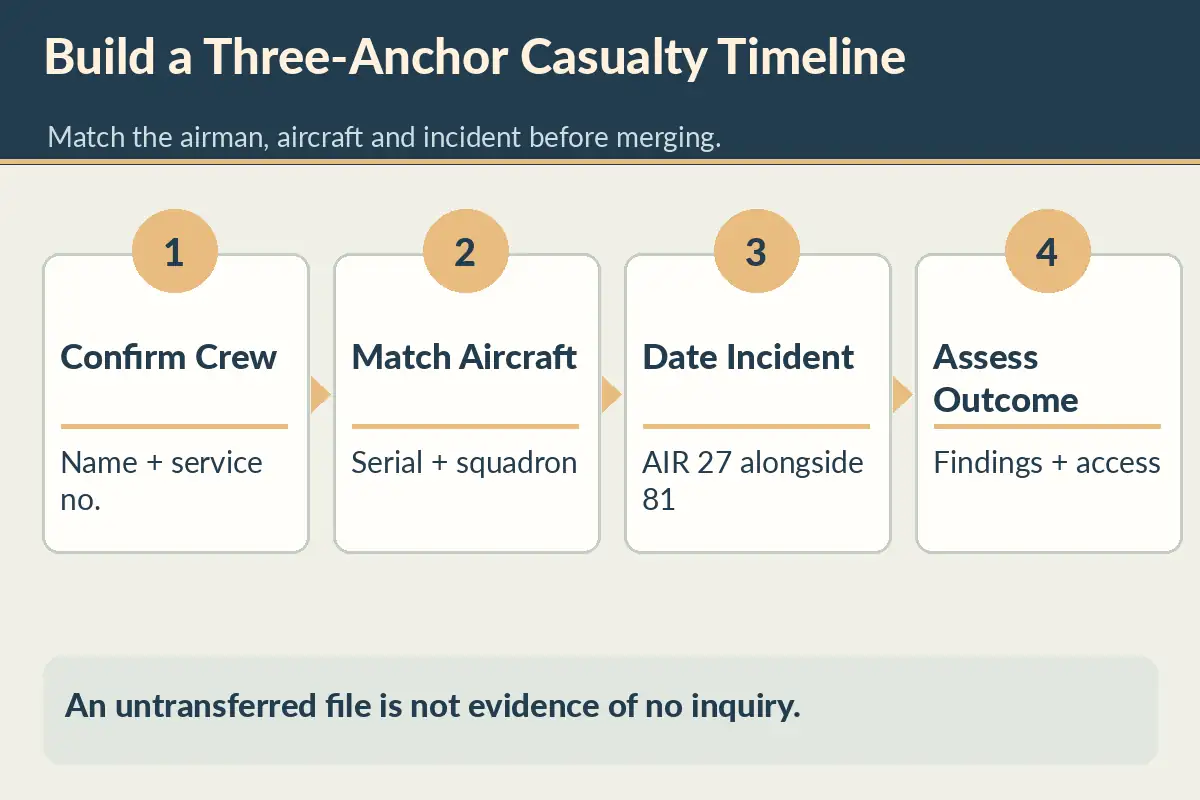
A wartime RAF casualty entry is a starting point, not an answer about what ultimately happened. The National Archives describes AIR 81 as enquiries into missing personnel and casualties from wartime flying incidents. Open a research sheet with a full name, service number if established, squadron, incident date, aircraft type and serial number. These anchors help distinguish crews with similar names and several aircraft lost on the same night. A date from a memorial may represent death recording rather than the instant an aircraft was lost.
Search the Discovery catalogue first by surname and initials; retry aircraft serial, squadron and the location or date of the incident. AIR 81 descriptions can be catalogued by crew, aircraft or event, and the series has been transferred in stages. The National Archives presently describes accessible holdings through June 1943, so a later-war absence in this collection is not evidence that no investigation occurred. Record the exact piece reference and any notice about access before planning a visit or copy request.
Separate the Missing Report From the Final Finding
An AIR 81 file can contain missing-person action sheets, family correspondence, eyewitness statements, enquiries into wreckage, death certificates, exhumation reports or questionnaires from repatriated personnel. Not every file contains all of them. The creator, date and audience of each document matter. A first alert that an aircraft failed to return establishes a reported loss of contact at that stage; a later investigation may change the account, narrow the location or identify individuals who survived as prisoners of war.
Prepare a document-by-document timeline: date of incident, date an initial report was sent, date a witness supplied information, date identification was accepted and date the family received notice. Put conjectures and disputed statements in separate columns. When a later typed summary contradicts a contemporary witness account, preserve both rather than choosing the more dramatic version. Even a final administrative conclusion about fate should be attributed to the responsible body, not rewritten as something an eyewitness personally observed.
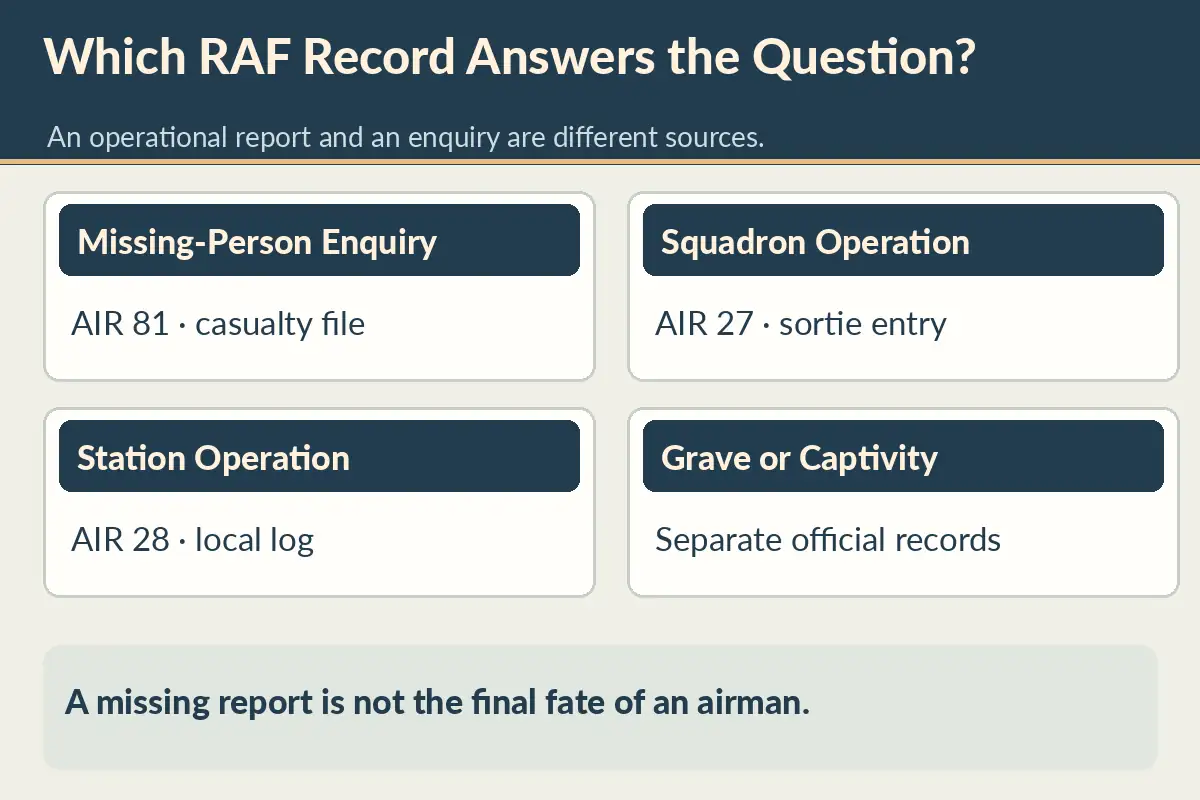
Connect AIR 81 to the Squadron Operations Book
AIR 27 is the appropriate place to look for many squadron operations record books; AIR 28 contains RAF station books. The Archives specifically warns that some entries are extremely terse, sometimes reporting only that an aircraft failed to return. Find the correct squadron for the particular date because transfers and attachments can put an individual in a unit different from the one shown on a later commemorative record. Confirm that the AIR 27 page covers the right operation and crew before copying its narrative into a family history.
A squadron operation book helps establish a contemporary unit account, but it is not the same as a casualty enquiry. Put an AIR 27 sortie row and an AIR 81 investigation row side by side using incident date, aircraft number, crew list and unit. Where the operation book names a destination or target, do not infer that a missing crew reached it. The intersection of two independent administrative records is more reliable than two derivative websites copying the same original summary.
Use Graves and POW Records Only for the Claim They Prove
A grave registration, death certificate or later CWGC entry may clarify the accepted identity and date of death; a prisoner-of-war record may establish detention after a reported disappearance. Neither class automatically explains the complete circumstances of the aircraft loss. The National Archives’ guide to prisoners of war includes AIR 81 within a wider group of relevant holdings, and it stresses that name-searchable descriptions vary among series. Cross-check the named person, rank, serial and service number wherever available.
If a casualty file contains personal letters or a photograph, distinguish the family’s belief at the time from later official identification. A POW questionnaire is testimony about captivity and may have limits of memory. A report about a found aircraft can refer to a different wreck if the serial number is missing. With modern relatives, share sensitive material selectively: recovery, medical and identification evidence can be distressing and may mention living family members. Cite the repository and piece, not a reconstructed private narrative.

Check Closures and Missing Files Before Declaring a Negative Search
Some AIR 81 records remain closed or have not yet been catalogued for release. The guide describes the collection as accruing, and available material is not necessarily digitized. Search results can reflect archival processing and access rules, not a documented absence of a casualty. Read each Discovery description for available formats, catalogue dates and restrictions. For an unopened record, use the archive’s stated access or enquiry procedure rather than attempting to obtain protected details indirectly.
Keep separate outcomes in your log: no catalogue result; a catalogue result without a digitized image; a closed file; an open file read in full; and an open file that contains no relevant named entry. These have very different evidentiary weight. When direct access is impossible, test nearby AIR 27/28 operational accounts, published casualty records and official grave records, clearly marking the substitute source. Never claim to have read personal correspondence only because a series-level guide says it may exist.
Build a Defensible Evidence Summary for the Family
Write the incident as a sequence of carefully attributed findings rather than one confident sentence. Include the airman’s identity evidence, unit and aircraft, the earliest reported nonreturn, later investigative statements and any verified identification. Assign each claim a precise archive reference and original date. If two people with the same surname served in the unit, show exactly which service number, position in the crew or earlier document separates them. The strongest conclusion can still leave the precise crash site or circumstances unknown.
A finished research log should include a transcription column for original wording, one for your interpretation, one for conflicting sources and one for the next disconfirming search. Attach no invented battle engagement, heroic act or cause of death to a bare missing report. Where the family can access only a catalogue description, state explicitly that the file’s contents have not been examined. Respect confidentiality, and prefer a cautious partial explanation to a vivid story that the papers cannot sustain.
How We Research This Archival Record Class
We first establish why an office created the record, the years and people actually covered, and its current custody and access status. A searchable catalogue description is not the original document, and a provider index may omit names or normalize dates. We record a positive finding exactly as written and distinguish it from inferences about identity, residence, family relationship or legal outcome. Every plausible namesake gets a separate comparison based on contemporary identifiers. Negative searches include what series, piece, years and spelling variants were really checked. A claim is accepted only when the evidence supports that narrow wording; gaps remain visible.
More Records and Archives Guides
Official Research Sources and Evidence Limits
The custodian’s collection guide confirms Explains AIR 81 missing-person and casualty enquiry files, their variable contents, incomplete transfers and restrictions.. Additional archive guidance confirms Shows that AIR 27 squadron and AIR 28 station operations records differ from AIR 81 casualty inquiries and that a crash report may be brief.. These describe surviving series, not an individual ancestor’s case. Check the actual Discovery entry for piece-by-piece access and current closure information, and cite the original page where possible rather than copying a later index entry without inspection.
No. Early missing reports and later identity, casualty or POW findings must be distinguished.
No. The series is still accruing; the current Archive guidance describes material through June 1943.
Use the correct AIR 27 squadron or AIR 28 station entry and independent casualty or POW sources.
Yes. Try name, aircraft serial, unit, incident date and location, while testing namesakes.
No. Catalogue access, digitization and closure status differ by record.