
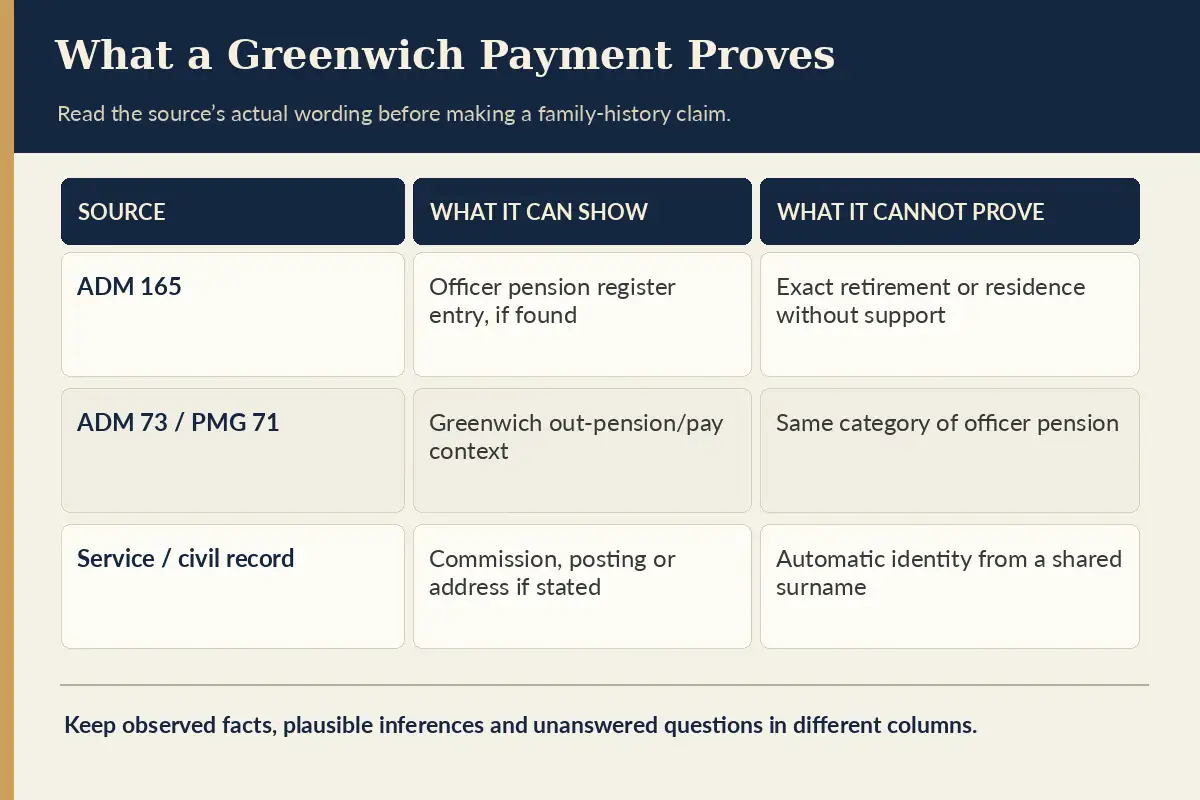
ADM 165 is a specialist Royal Greenwich Hospital pension route for naval and Royal Marine officers, with the period 1871–1961 given in The National Archives’ officer-pension guide. It should not be treated as a universal alphabetical list of every sailor who ever received money from Greenwich. The same guide distinguishes other pension and salary series, and warns that some are easiest to browse by date rather than by personal name. Start by defining the claimant’s rank and whether the search is for an officer, a rating, or a surviving family member.
A pension reference can document that an office administered an allowance or payment; it does not necessarily show the person’s whole career. Even the word ‘pensioner’ can mislead: Greenwich out-pensioners could work, and in-pensioners lived at the hospital under different arrangements. Men could re-enter naval service, with pension arrangements affected during that service. Therefore do not translate the appearance of a pension into an exact discharge, permanent retirement, or family residence.
Route Officers and Ratings to Different Records
A practical search begins with the original wording of the source that calls an ancestor a pensioner. Was he a commissioned officer, warrant officer, Royal Marine officer, or a seaman? Did the notice concern a widow or dependent child rather than the original serviceman? The National Archives lists Greenwich pension pay books in ADM 73, miscellaneous allowances in ADM 23, Greenwich out-pensions in PMG 71, and naval or marine officer pensions in ADM 165. Those are distinct records for different questions and periods.
If the rank is uncertain, look first for a commission, service certificate, contemporary Navy List, family letter or death notice that names it. Then examine the series guidance for the years that actually apply. An entry in a register of a pension fund cannot automatically be transferred to another person’s service record because the names agree. Keep the administrative scheme, amount, pay date, rank and any family role in separate fields.

Work With Year-Led, Not Only Surname-Led, Finding Aids
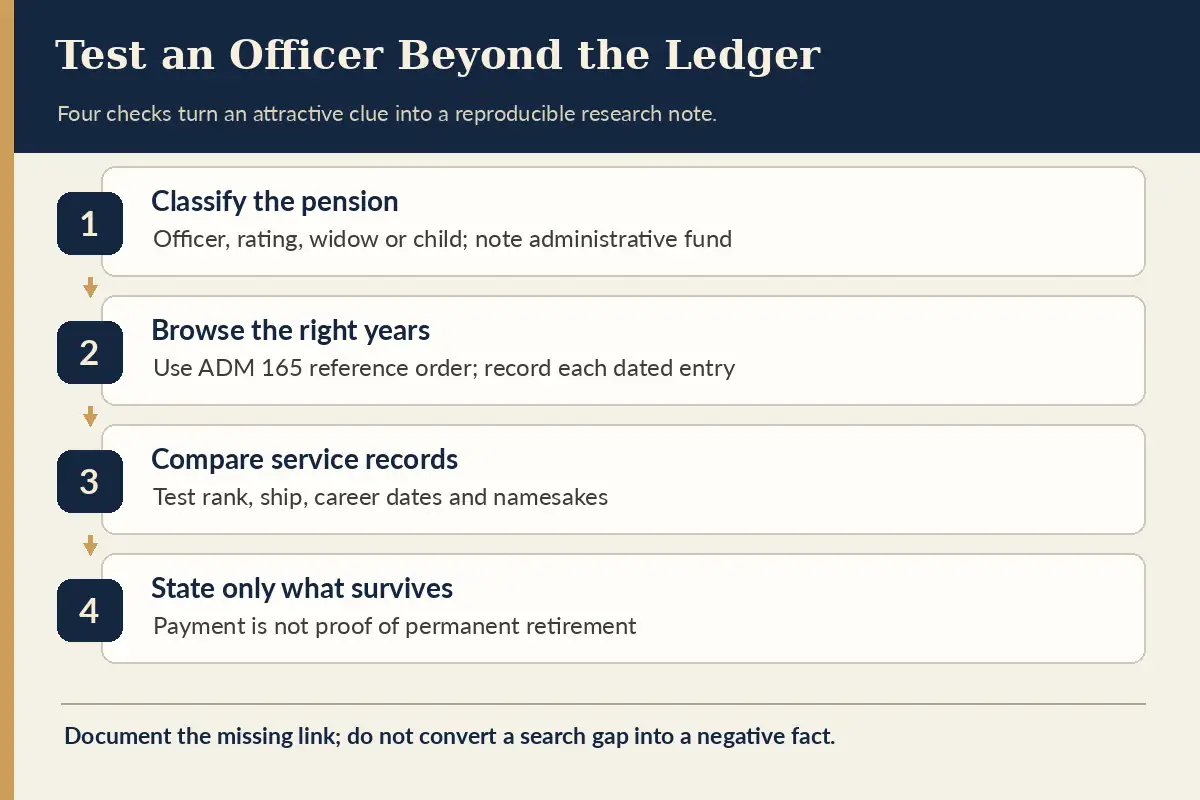
The National Archives cautions that many officer pension records do not have the person’s name in searchable catalogue metadata. ADM 165 is listed as a series to browse. Begin with a plausible pension year based on independently known career dates, not with a broad assumption that an online search engine will index every officer. Inspect the relevant series-level catalogue entries and pieces for their dates and subcategories. Make a note of the pieces already checked.
If a possible hit appears, distinguish the indexed description from the register’s actual contents. Record the full ADM 165 reference, entry or folio, the name and rank as written, any account date and payment wording. An annual entry may be a continuation of a previous allowance rather than a new award. A payment’s currency amount or date can help compare entries, but neither by itself establishes who the recipient’s parents or spouse were.
Separate the Original Officer From Dependents
The National Archives’ Royal Marines officers guide states that ADM 165 includes registers of pensions paid to officers in 1871–1961 and registers for officers’ widows and children in 1882–1933. Those are different categories of recipient. If you are searching for a woman named in a pension context, do not simply assume she was the officer’s widow: read the heading and relationship field, if present. A child might be recorded because of entitlement, but the reason for that entitlement needs verification.
Construct a recipient ledger with four columns: person who served, claimant or payee, payment authority and independent relationship evidence. The claimant’s married surname and the officer’s surname may differ; an exact spelling match may instead be coincidental. If a register provides a relationship, quote it carefully; if it does not, seek a marriage certificate, probate document, family correspondence or another official record before inserting parent-child or spouse links into a family tree.
Test a Career and Address Using Independent Sources
An officer might be in a pension register because of a specific entitlement without necessarily leaving the service forever. To check the career stage, trace commissions, seniority, ship postings and final service through series appropriate to the rank and date. If an entry names a ship, it can help identify the person but needs comparison with the time frame and the exact rank. A later Navy List or other dated source may show continued activity inconsistent with a guessed retirement date.
Likewise, payments made or authorized through a particular office say little about where the household lived. Avoid describing Greenwich as the recipient’s home unless an appropriate residential register or address-bearing document supports it. For an officer reported dead, do not use a final payment year as a death date; look for a civil death registration, naval death entry or probate administration. Different record sets establish different dates.
Record a Reproducible Pension Finding
Build a search log showing the rank or recipient category, date boundaries, series references tried, terms searched and the next record needed. For each ADM 165 result distinguish the catalogue title from the information actually read in the document. If access is at Kew or requires copies, mark that limitation explicitly. A negative result across one year or pension category is not an all-series proof of non-entitlement.
The finished proof note should contain a defensible statement such as ‘a register records a payment to an officer of a given name and rank in a given year,’ with the page cited. A separate statement can analyze whether the officer matches your target and which service evidence supports that connection. The point of ADM 165 is to illuminate a specific financial or family-history question, not to manufacture a seamless career from sparse payment entries.
More Records and Archives Guides
How We Research This Archive Route
Our source baseline is The National Archives’ Royal Navy officer-pension guide and its Royal Marines officers guide. Together they distinguish ADM 165 from the Greenwich pay books used for other recipient groups and identify the years and browsing route. They do not guarantee a person appears in a particular volume.
Reproduce the full volume, page, year and recipient category in the research log, then verify a candidate’s rank and identity from independent service or family sources. The archive’s citation advice helps keep those links reproducible. See the affiliate disclosure; this research method does not depend on an advertised service.
No. ADM 165 concerns officer pension records. ADM 73 and PMG 71 are separate routes for other Greenwich pension purposes.
Not necessarily. The National Archives lists the series as browse-led and warns that many names do not appear in catalogue descriptions.
The officer pension guide lists naval and marine officer pensions for 1871–1961; specific register sections require date checks.
The Royal Marines officers guide identifies related ADM 165 registers for officers’ widows and children for 1882–1933.
No. Out-pension receipt and residence as an in-pensioner are distinct; obtain an address-bearing source before asserting residence.