
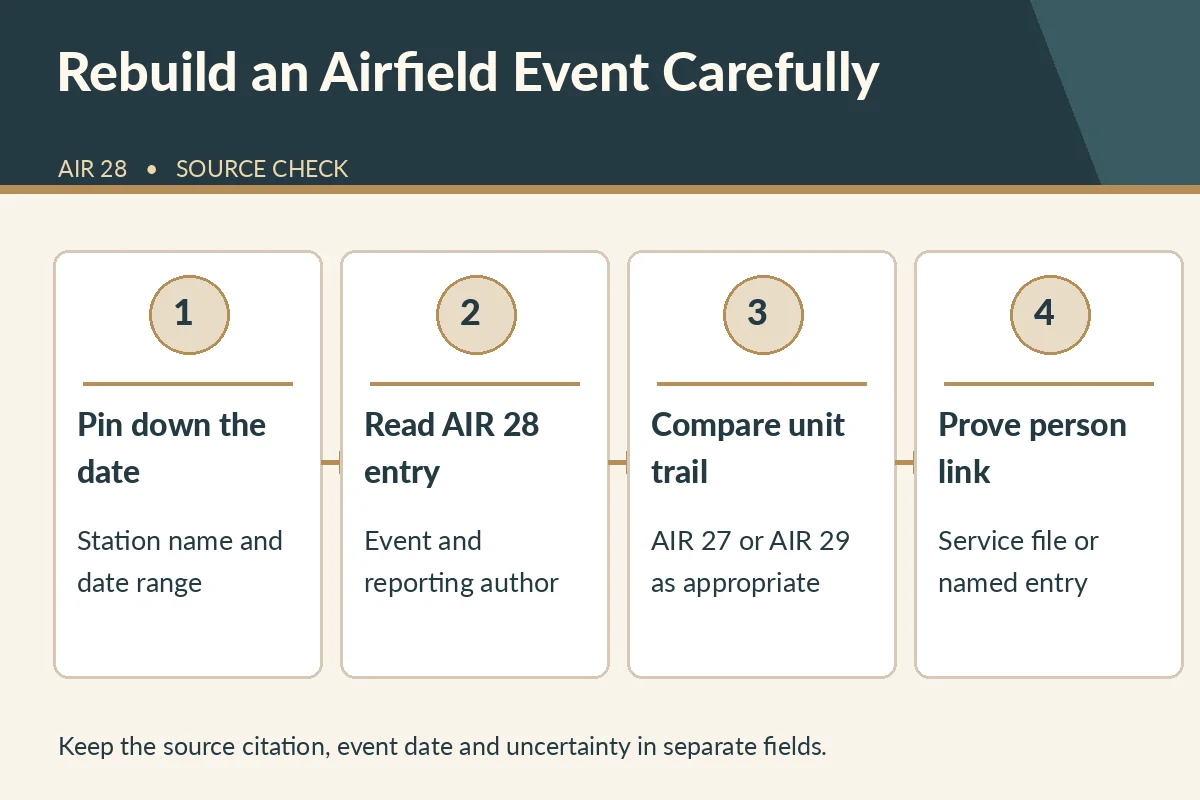
AIR 28 contains Royal Air Force station operations record books, useful for reconstructing activity at an airfield. A station entry can document an incident, inspection, aircraft arrival or administrative change without naming every individual present. The National Archives distinguishes AIR 28 station books from AIR 27 squadron operations books and AIR 29 records of miscellaneous units. If a family story says an airman served at a specific station, begin by dating the station event and then use personal or unit evidence to test the claimed link. The airfield’s story and the airman’s service are related but separate research questions. For the archival search route, consult The National Archives guide on the series. The National Archives guide on related records.
Choose the record creator before searching
Decide whether the event belongs to an RAF station, a flying squadron or another unit. The official RAF operations guide directs station research to AIR 28, squadron research to AIR 27 and miscellaneous unit research to AIR 29. A station may have hosted multiple squadrons, training units and detachments over the same period. Consequently, a record of a squadron arriving at an airfield cannot establish that a particular individual transferred with it. Search with the historical station name and a narrow date range.

Names of stations can change, and some airfields had overlapping civilian or military functions. Verify the period in which the location operated under the name appearing in the catalogue. If a family letter uses a local village name, map it cautiously to the official RAF station designation. Record both forms as search terms but do not merge different airfields simply because they are close together. The station record creator matters more than a modern map pin.
Read station diary entries in their own context
An operations record book is an administrative diary, not a complete roster. Entries may mention weather, training, aircraft movements, visits, security incidents, damages or casualties. Some entries will be terse. Others summarize a day’s activity after the event. Check who signed the return and whether it is an original entry, continuation sheet, corrected report or later copy. An administrative note of ‘no flying’ may refer to that unit’s recorded operations, not to all air activity near the station.
A useful event note includes the precise date, AIR 28 piece reference, type of event and wording that indicates certainty. If the record names an aircraft type but not its serial, do not select a serial number from an unrelated database to complete the story. If a station diary states that a pilot was injured, separate the incident from the later medical diagnosis or official casualty determination. Those may be recorded elsewhere and require their own sources.
Compare squadron and other unit books
The National Archives explains that AIR 27 squadron books often include Form 540 summaries of events and Form 541 details of work carried out. A station entry concerning a visiting squadron can be cross-checked against the squadron’s own chronology, where one survives. AIR 29 can be relevant for non-squadron units. Do not treat the three series as a single chronological sequence that every event must pass through. They reflect different offices and may emphasize different aspects of the same day.
For example, a station book might note an emergency landing, a squadron record might identify a sortie and a personal file might give a posting. Together they can support a more precise account. But absence from a squadron return is not necessarily evidence that an airman was absent from the station. Personnel could be detached or attached, and records are not guaranteed to preserve every movement. Describe mismatches openly instead of harmonizing them by guesswork.

Check crashes without inventing casualties
AIR 28 can record crashes or accidents involving a station, but it should not be mistaken for a complete air accident or casualty archive. The National Archives lists separate routes, including AIR 50 for certain combat reports, AIR 81 for wartime casualty enquiries and AVIA 5 for some accident reports. The Air Historical Branch and RAF Museum also preserve relevant categories of material. Which route applies depends on the date, aircraft, operation and institutional jurisdiction.
Keep an accident evidence grid: location, event date, aircraft identification as actually stated, reported injury or damage, investigating office and later finding. A report of an aircraft failing to return does not prove a death or even a final loss in the way a family memorial might suggest. Conversely, an AIR 28 entry may omit an accident that another unit recorded. Do not assume exhaustive station coverage when explaining a silence in the diary.
Link station history to an individual cautiously
A named individual can sometimes appear in a station operations book, but a person-level claim is strongest when anchored in a service record, squadron nominal roll, posting notice, signed letter or another explicitly named source. Compare dates closely: being attached to a squadron that operated at the airfield in one month does not show residence there throughout the year. Training, leave, hospital treatment and temporary duty complicate simple station-to-person arrows.
For local history, combine AIR 28 with contemporaneous maps and photographs only after checking their dates and the identity of the site. A later runway plan can explain topography but cannot automatically locate a 1940 building. In your published narrative, label claims ‘station recorded,’ ‘unit recorded’ and ‘individual directly named’ so that readers know the level of evidence available. The aim is an accurate account of an airfield that does not manufacture a complete biography.
More Records and Archives Guides
How We Research AIR 28 Records
We begin with the official RAF operations and squadron research guides to identify the unit that created each record. We inspect AIR 28 by station and period, compare AIR 27 or AIR 29 only when those record creators are relevant, and seek independent personal files for named-service claims. We document gaps, ambiguous station names and later corrections. A station operation, accident report or airfield photograph is not treated as proof that a particular airman participated unless the source actually establishes that connection.
Our explanations are independent research guidance, not access guarantees or legal advice. For transparency, see the affiliate disclosure. A link to an archive or a category is not a claim of a paid relationship.
The National Archives series for RAF station operations record books, distinct from squadron and miscellaneous-unit series.
No. It is an operations record and may omit most individual staff.
AIR 27 records squadron activity; AIR 28 records activities of stations.
Not necessarily. Compare investigative or casualty records such as relevant AIR 81 or AVIA 5 material.
Use a service file, posting, named squadron record or other independent evidence matching the date and place.