
Home Office HO 46 Registers: Recover an Old Paper Number Before Claiming a Decision starts with a distinction often missed in family and local history research: an archival entry describes a particular document or administrative act, but does not automatically establish every related event. Use the official series research guide to select the correct record, then check the related source guidance before extending the conclusion. The steps below identify what HO 46 Home Office correspondence registers can show, what it cannot show, and which independent reference could resolve uncertainty.
Recognize What a HO 46 Register Actually Records
HO 46 holds registers of Home Office correspondence, along with special-subject registers and indexes to correspondents. The archival guide gives the series broad coverage from 1841 to 1957, while some early Old Series papers were retrospectively registered. A register notes administrative receipt or routing of a letter; it is not the letter itself, nor proof that the Home Office took the action being requested.
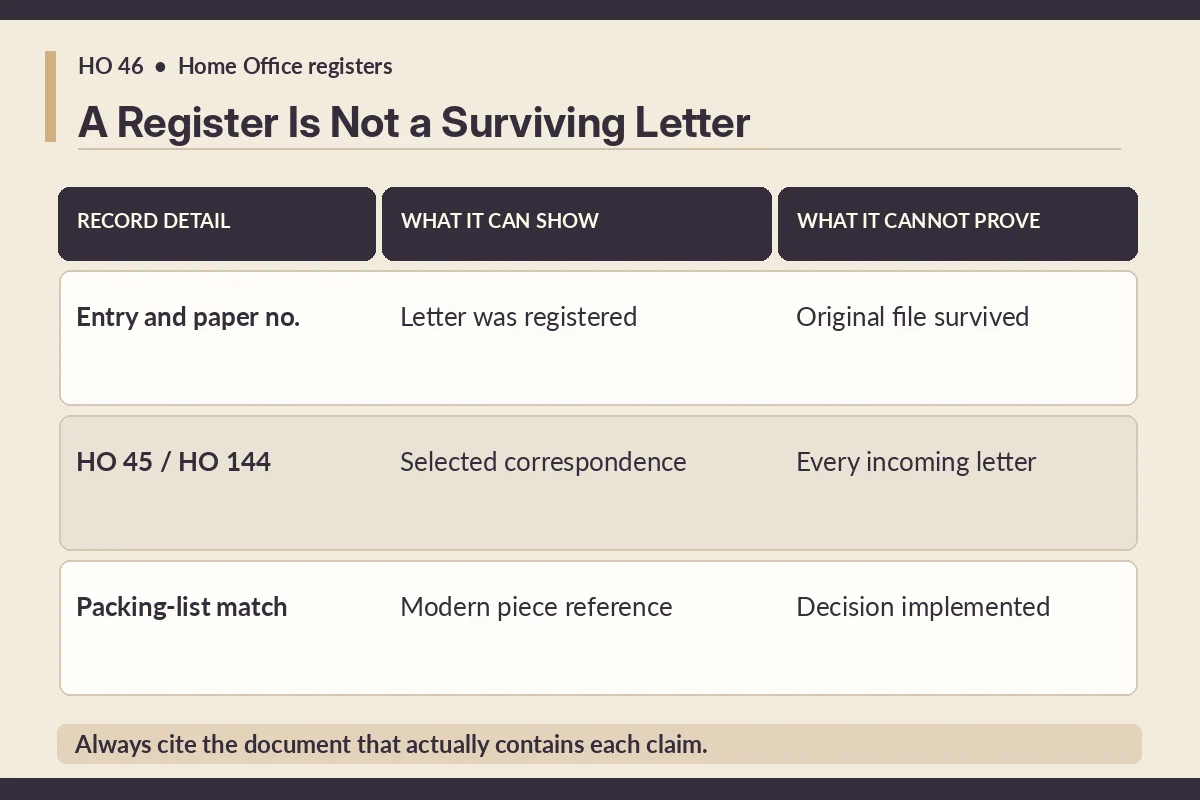
This is crucial because The National Archives explicitly warns that the correspondence registers recorded incoming letters whether or not those papers were subsequently selected for permanent preservation. A clear HO 46 entry can therefore point to a lost original. Begin with a plausible date and subject rather than assuming you can find the complete correspondence by surname in the online catalogue.
Choose the Correct Register Group by Year
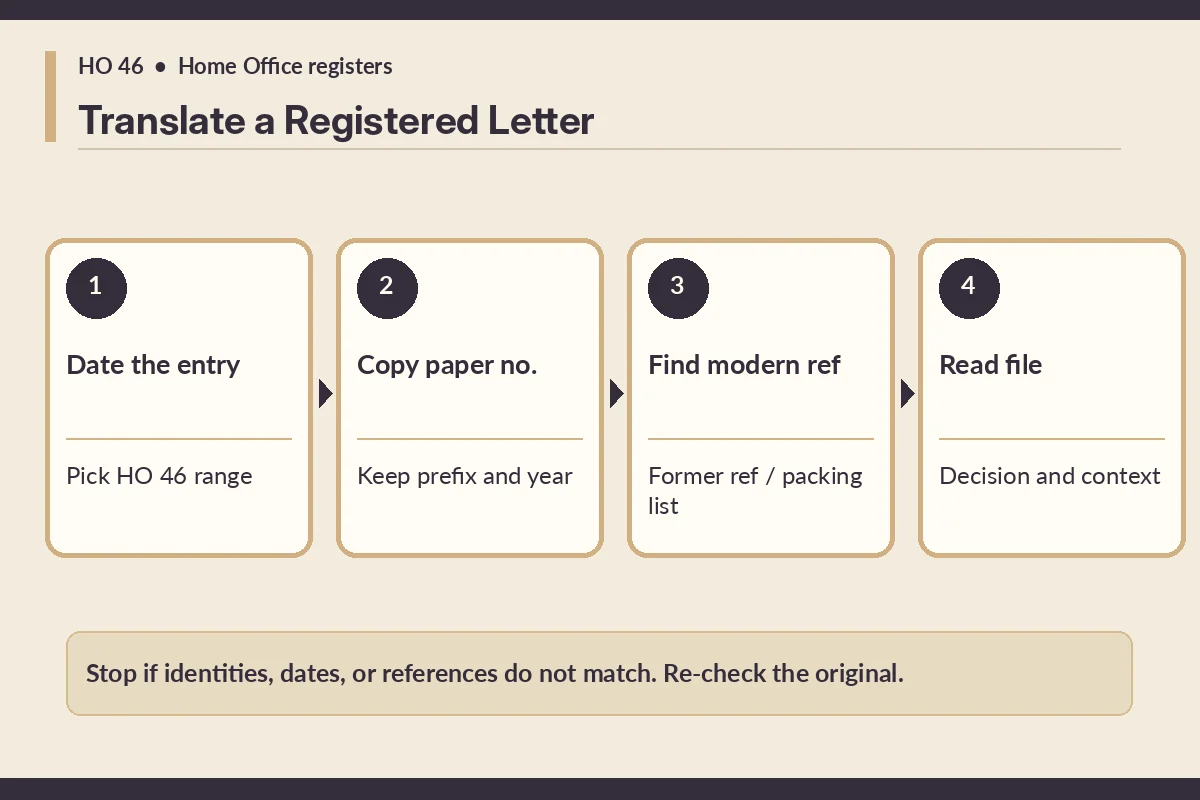
The registry system changed repeatedly. The official guide locates the retrospective Old Series in HO 46/1A, 1B and 1C; registers for 1850 to early March 1871 in HO 46/2–47; for 1871–1880 in HO 46/48–70; for 1881–1901 in HO 46/71–133; and for 1902–1948 in HO 46/134–389. These ranges provide a real date-based search fork, not a chronology of one person’s case.
For correspondence from 1949 onward, the Home Office moved away from the HO 46 system toward subject-specific Symbol Series, although older HO 45 files continued to be updated. Do not force a 1955 letter into the six-digit format used for an earlier period. First establish which registry arrangement was operating at the time the document was recorded.

Transcribe the Whole Historical Paper Number
Every registry entry should be copied with the date, correspondent, subject headings, the paper number and any prefix or cross-reference. The guide describes a numbering sequence from 1 to 100,000 for 1871–1880, followed by systems using letters such as A, B, V and X from the early 1880s. In the first half of the twentieth century, six-digit numbers beginning at 100,001 were used.
A bare number stripped of its letter or year can refer to the wrong correspondence. Preserve the clerk’s punctuation as written and record where the entry appears in HO 46. If the name is abbreviated or difficult to read, do not silently substitute a modern spelling. The exact original reference is often the one element that lets an archivist connect the old register to a modern piece.
Search HO 45 and HO 144 Without Assuming Survival
Many retained Home Office general correspondence files are in HO 45 and HO 144. Once you know the old paper number, try it in the “former reference” field of Discovery advanced search. The National Archives states that this sometimes leads directly to a surviving HO 45 file, but not all changes of indexing are straightforward. Keyword and subject searches can supplement rather than replace paper-number work.
When an online catalogue search does not work, the printed packing lists filed with HO 45 and HO 144 at Kew may be required. These lists relate older registry numbers to surviving pieces. Some date blocks are particularly dependent on this process. A failed former-reference search is not evidence of a vanished person or a rejected petition; it may simply mean a second finding aid is needed.
Distinguish the Registered Claim From the Decision
A letter asking for a pardon, nationality clarification or appointment is evidence that someone made a request. The registry entry may preserve only receipt and a short subject line. An administrative action could have happened later, been refused, or been handled through a file now missing. Neither the subject term nor a paper number should be paraphrased as an official decision.
To evaluate an outcome, inspect the surviving correspondence for minutes, annotations, draft replies or out-letters, and identify their authors and dates. A reply does not necessarily prove that the action it authorized was carried out. Where the series lacks the final step, seek an independent legal, court, local or civil source appropriate to the subject.
Use Printed Indexes and Catalogue Descriptions Carefully
Discovery searches descriptions of records, not the full words written inside every page. The National Archives explains that a surname present only in the body of an original may not appear in search results. HO 46 may therefore reveal a correspondent missing from catalogue keyword hits. A register is a retrieval tool with evidentiary value, but it is not a searchable digital edition of every incoming letter.
When an index uses broad labels such as “disturbance,” “petition,” or “aliens,” search the record creator’s terminology without endorsing it as a modern description of a person. Record how each search was performed. You may need to combine location, administrative office, year and subject instead of treating an absent name hit as a definitive negative result.
Work Through an 1887 Petition Example
Suppose a register entry from 1887 gives a surname, a brief petition description and a paper number beginning with a letter. Preserve the whole letter-number combination and the register reference. Try the former-reference field in Discovery for HO 45 or HO 144, and then consult the relevant packing list if no matching piece appears. Do not drop the prefix simply to produce more search results.
If an HO 45 file survives and contains a response, cite that response separately from the register and describe precisely what it says. If only the registration survives, report that a letter was entered in the Home Office system, not that the petitioner succeeded. This makes the historical account useful while keeping the missing outcome explicit.
More Research Method Guides
How We Research Historic Correspondence Registers
Our workflow begins with an exact date interval, records the correct HO 46 numbering system, preserves the original paper number, and attempts a modern reference through Discovery or Kew packing lists. The evidence log has separate columns for register, surviving letter, official response and subsequent action. Each claim cites the source that actually supports it.
The official correspondence guide is the principal series authority; Discovery’s help guide explains the difference between searchable descriptions and underlying documents. Neither means all historical papers are digitized or remain accessible. We link to sources with the transparency standards described in our affiliate disclosure.
The National Archives describes correspondence registers in HO 46 covering 1841–1957, with particular numbering schemes across earlier and later groups.
No. Registers include incoming papers that were not selected for permanent preservation.
Correspondence may be in HO 45 or HO 144; the appropriate route depends on the subject, dates and finding aids.
Sometimes the number works in Discovery’s former-reference field; otherwise the printed packing list at Kew may be needed.
The system changed in 1880, using letter-prefixed sequences; the complete prefix must be preserved to identify the paper.