
WO 373 Military Award Recommendations: Verify the Decision, Not Just the Citation starts with a distinction often missed in family and local history research: an archival entry describes a particular document or administrative act, but does not automatically establish every related event. Use the official series research guide to select the correct record, then check the related source guidance before extending the conclusion. The steps below identify what WO 373 military award recommendations can show, what it cannot show, and which independent reference could resolve uncertainty.
Decide Whether You Need an Award or a Campaign Medal
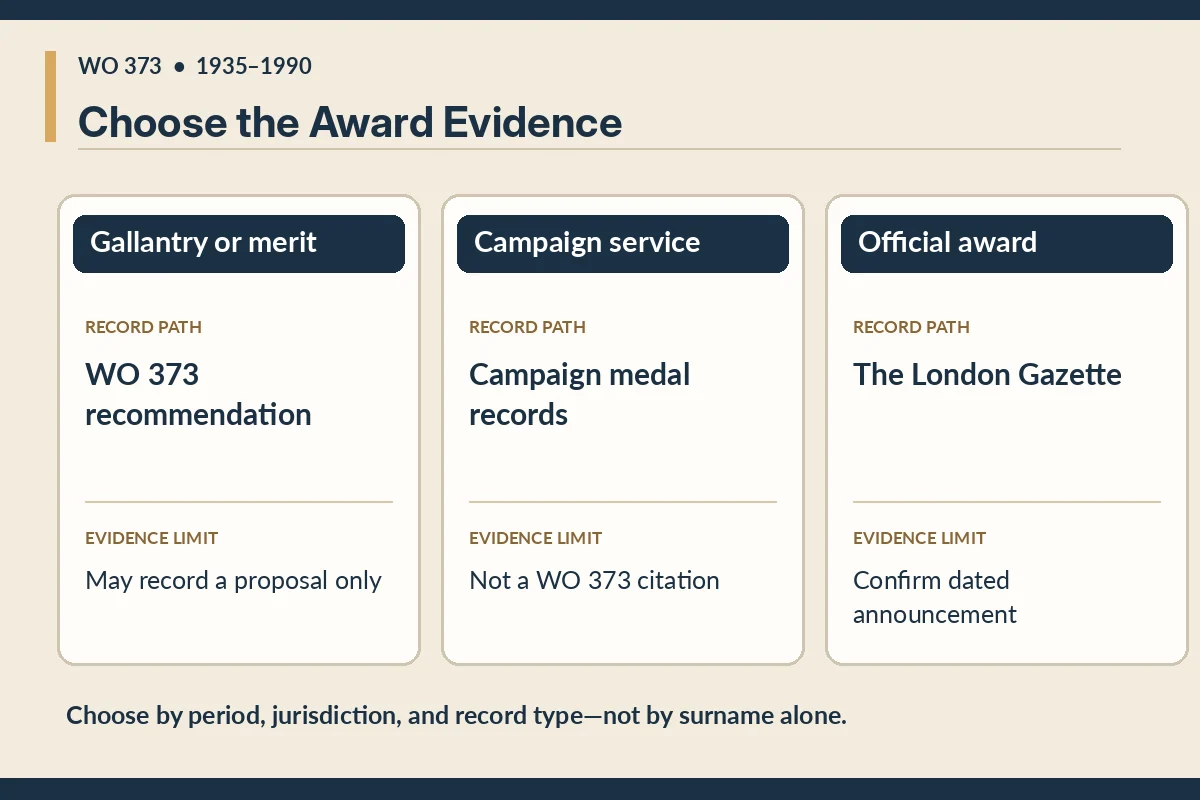
WO 373 records recommendations for military honours and awards covering 1935 to 1990, primarily for British and dominions army personnel, with some material on other services. The papers include nominations for gallantry in action and for meritorious or distinguished service. They are not the same thing as campaign-medal rolls. Someone who earned a campaign star or service medal may never appear in WO 373, while a person with a recommendation might never have received the suggested decoration.
Begin with the exact question. Are you testing a family claim that a particular Military Cross was awarded, or looking for why a person was recommended? A recommendation can answer the second question in detail, but the first needs a completed award outcome. Note the name as actually written, unit, rank, approximate action date, and the name of the honour before searching. Avoid treating an undated family medal photograph as proof of the intended recipient.
Find the Recommendation by Name, Unit, and Theater
The National Archives offers an online search of indexed WO 373 recommendations. A name search is a useful first pass, but it is not comprehensive. Some papers were too complex to index by individual name; others survive as lists, and several types of awards have poor survival. If a search fails, browse the relevant pieces by campaign theater and date rather than declaring that the person was never proposed for recognition.
Check middle initials, regimental spellings, service numbers where provided, and variant transliterations of names from imperial or Allied formations. Keep two candidates apart when the same surname occurs in different units. A useful research log records the Discovery catalogue reference, image or page number, exact quoted name, recommendation date, and the officer who forwarded it. Names in an online summary are discovery aids; the underlying document controls the evidence.
Read Endorsements Instead of Assuming Approval
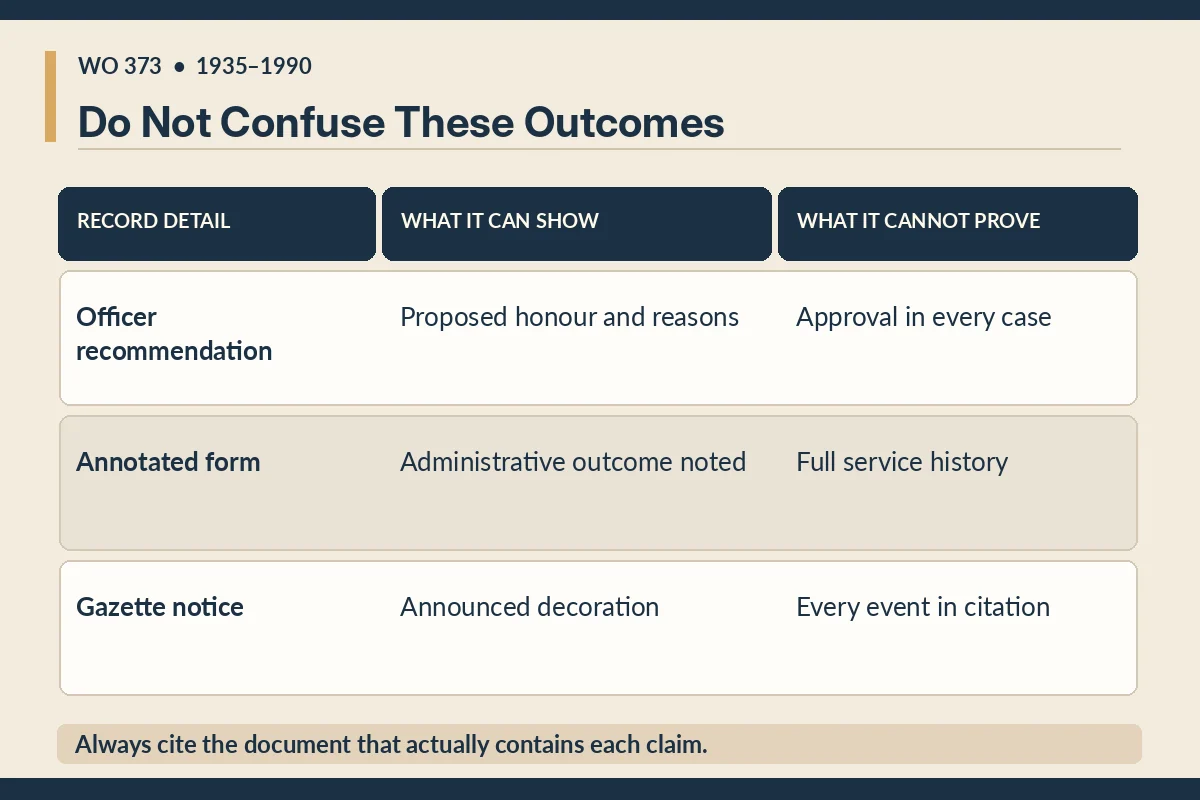
The standard recommendation form may describe an action, propose a particular decoration, and carry endorsements through a chain of command. The citation is evidence of what the proposer alleged or reported. It may be a valuable near-contemporary narrative, but language praising courage does not by itself prove a medal was conferred. Inspect handwritten annotations, approval fields, alterations and later endorsements rather than reading only the dramatic incident description.
Different participants in an award process could propose different honours. Record the initial decoration, any changed recommendation and any final notation in distinct fields, with who dated each. A blank area may indicate a missing sheet rather than disapproval. Some files consist of short listings; these should not be expanded into an imagined narrative. The National Archives warns that recommendations do not invariably lead to an award.
Check the Public Award Announcement
For most British military gallantry honours, a notice in The London Gazette supplies the formal public announcement. Search the recipient name and decoration, allowing for initials, rank variants and a delay between the reported action and publication. Copy the Gazette issue date and page as a second citation separate from WO 373. A recommendation date is not a Gazette publication date, and neither automatically equals the date of the gallant act.
If the Gazette lists a different award from the original proposal, do not conceal the discrepancy. State that the individual was recommended for one honour and publicly announced for another. For some awards and eras there are supplementary registers or service documents; consult the official gallantry-medals guide to identify them. A missing Gazette hit can reflect spelling or incomplete searching, not proof of rejection.
Test Whether the Named Person Is Your Relative
The same name can occur in more than one battalion or service, especially in large wartime collections. Cross-check the recommendation against an independent service record, regimental roster, casualty account or other record naming the unit and period. Rank is a moving attribute; a later rank in a family notice may differ from the rank on the recommendation. Compare the number and unit before attributing the citation to a relative.
Also test the action narrative against the relevant unit diary if the context matters. A recommendation describes a person’s reported conduct; the diary can describe the formation’s activity. Their accounts may use different dates or place descriptions because they were written for different purposes. Do not manufacture a precise battlefield location from a broad narrative or assume every person mentioned served continuously with the same unit.
Work Through a Conflicting Recommendation Example
Imagine a recommendation for a captain naming a particular decoration, while a Gazette search finds a similarly named lieutenant honored several months later. Record the proposal and the Gazette notice as separate hypotheses. Compare regiment, service number where available, initials and any promotions; only after that should you decide whether the records concern one individual. This guards against merging two unrelated careers.
Suppose the individual is certainly the same but the final award is different. The correct account says what was recommended and what was announced, with two dated references. It should not claim the initial award was received merely because the citation was detailed. If no final action can be found, explain the specific missing evidence and leave the proposed honour as unconfirmed.
More Records and Archives Guides
How We Research Gallantry Award Evidence
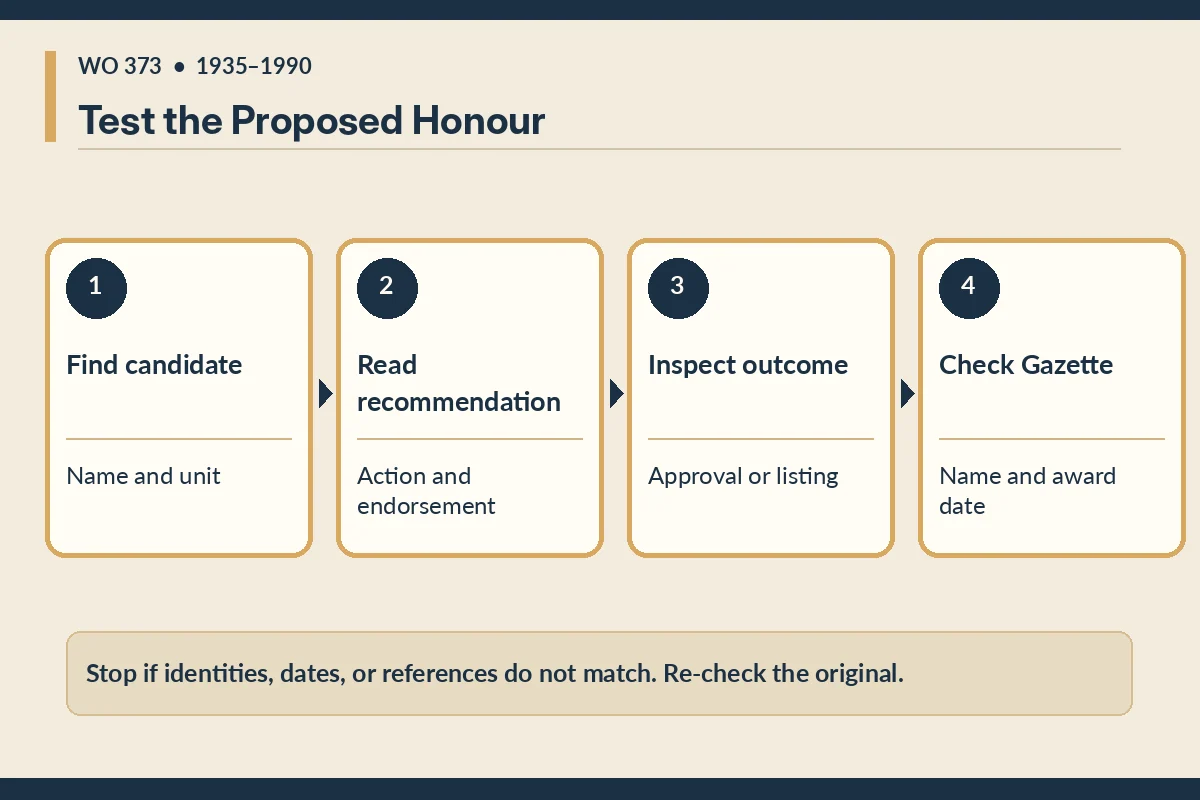
We capture an evidence trail with four stages: candidate indexed; full WO 373 recommendation read; administrative decision inspected; public announcement or other formal award evidence verified. Each stage answers a different question. The research note preserves uncertainty if only the first two can be completed. We also cite the original piece and the Gazette issue separately to make the conclusion reproducible.
The two official guides linked above explain both the series and the verification route; their scope is not proof about any particular soldier. Access models and online search coverage may change. We avoid implying paid access is necessary for every item, and our affiliate disclosure describes the site’s approach to links and commercial relationships.
No. It is the series for recommendations for gallantry and distinguished-service honours, not the routine issue of campaign medals.
No. A proposal might be amended, rejected, or recorded only in a list. Seek evidence of approval and the official announcement.
No. Name indexing is incomplete because of the variety and complexity of surviving papers. Browse relevant pieces by theater and date as needed.
No. The National Archives notes that comparatively few recommendations for Mentions in Despatches survive.
Record both wordings and dates separately. A recommended decoration and the decoration announced need not be identical.