
CUST 39 at The National Archives contains staff lists and pension material relevant to Customs officers, but it is not a searchable, continuous service register for every employee. The National Archives warns that these records are not indexed: a search has to begin with a plausible year, service branch, and location rather than a surname alone. A named entry is evidence of what a particular list records; it is not automatically a first appointment, every posting, or proof that the person received a pension.
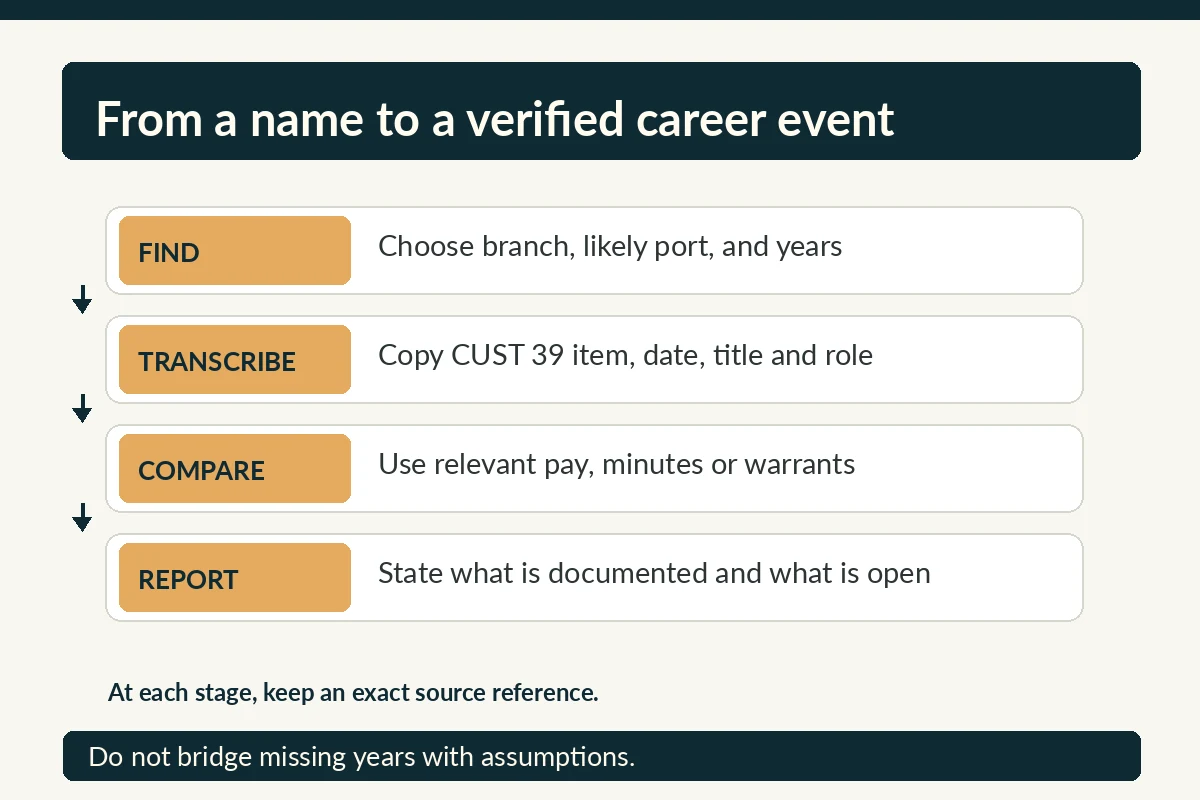
The central task is to reconstruct separate career events, each tied to a document. Record a listing date, the office or port if shown, the person’s designation, and the original CUST 39 reference. Next test that finding against salary bills in CUST 18 or CUST 19, board decisions in CUST 28, or an appointment warrant identified through C 202 and C 208. These sources answer different questions, and a gap in one is not proof of absence from the service.
Start with the correct revenue branch and year
First distinguish Customs from Excise or Inland Revenue. The Archives’ separate research guides explain that CUST 39 also holds material for the latter branches, and they identify Inland Revenue staff files within CUST 39/235–248. Treat a shared departmental reference as a filing system, not proof that every officer worked in Customs. Make a search note with the known employer wording, a likely port or district, and the earliest and latest independently attested dates.
If the only clue is a census occupation such as ‘customs clerk,’ preserve the census year and address and estimate a reasonable volume range around that date. Use the original occupational phrase rather than silently upgrading the person to a senior officer. Search Discovery at the series or piece level for the relevant time span; do not assume an unindexed staff list will appear in full-text name results.

Read a staff-list appearance as a dated observation
A historical list may name a person, post, grade, salary or office, depending on the particular item. Transcribe only the fields that are actually visible, and note whether they refer to a snapshot, annual establishment or payment. A familiar surname in the right city is not enough to merge two entries: compare initials, duties, location and the distance between dates. If a list covers a year but a date is not printed beside the name, label your conclusion ‘listed in the volume covering’ that year.
Build three columns for the record reference, the literal observation, and what remains uncertain. ‘Named on a staff list’ is supportable where the document shows it. ‘Worked continuously from 1810 to 1820’ is not supportable merely because the name appears in two volumes a decade apart. A person may have moved, retired, changed department or shared a name with someone else. This is a research distinction, not an argument that any particular move actually occurred.
Separate pension evidence from pay and appointment
Pension material can preserve a claim, calculation, recommendation or other administrative step. Check whether the paper records a request, an authorization, or a payment before describing somebody as a pension recipient. A late pension reference should not be turned into a firm retirement date without examining the wording. Likewise, a name on a pay list supports a financial association for its accounting period; it does not by itself prove the appointment instrument or all earlier service.
The National Archives distinguishes salary bills in CUST 18 and CUST 19, Customs Board minute books in CUST 28, and appointment warrants found using C 202/267–269 and C 208 for 1714–1797. These are conditional routes: the appropriate path depends on date and what question is unresolved. In particular, CUST 28 records decisions affecting existing officers but is not the general appointment register. Its early survival is limited by the 1814 Custom House fire.

Build a port-by-port career timeline with gaps
For each plausible match, draw a row with date or range, post, stated branch, record type, reference and confidence. Record a change of port only when two documents support a changed location, and mark the interval as unexplained until other records bridge it. If a person’s name appears in a quarter’s salary bill but not in another quarter you have examined, record the omission exactly; do not declare a dismissal from that silence. Archives are partial and different record sets were kept for different administrative purposes.
A useful hypothetical illustrates the method. A staff list puts a J. Morgan at a coastal port in one year; later minutes mention a transfer for J. Morgan; a pension entry uses a full forename. It would be tempting to write a coherent career immediately. Instead compare rank, former port, dates and, if supplied, service history. Where none establishes that all three documents concern the same individual, keep the entries as candidate matches rather than one biography.
Write a result that survives a second researcher
Quote the exact series and item reference in your notes, together with volume date, page or folio, transcribed name, and how the document was consulted. Distinguish a Discovery catalogue description from the paper or image inspected. If you have not seen the item, say ‘catalogue entry located’ rather than ‘record verified.’ Identify the precise event proved: present on a list, subject of a board minute, or named in a pension paper.
Finish with an evidence-status table: confirmed, possible, and not yet established. A confirmed staff-list listing can coexist with an unproven date of appointment; a confirmed transfer decision can coexist with an unknown date the person actually took up the new post. The next archival step should address one uncertainty at a time, using the branch and years you recorded. That produces a defensible family-history note instead of a smooth but untraceable employment story.
More Records and Archives Guides
How We Research and Verify These Records
This guide uses the record-series descriptions and the boundaries explained in The National Archives guide Secondary archival guidance. The sources identify the kinds of documents, their arrangements and possible access routes; they do not certify any particular ancestor, institution or map as independently inspected. Check each original item and the current catalogue access status before quoting a detail as a documentary finding.
We separate a catalogued lead from an original document, an administrative statement from an event, and a possible identity from a proven link. Historical names, jurisdictions and date ranges can be uncertain; missing entries are not negative proof. Reader information is editorial, not a claim of professional archival representation. Review our affiliate disclosure before following any commercial material on the site.
No. It contains surviving staff lists and pension material, and The National Archives cautions that the records are not indexed. Scope varies by item.
A surname search in catalogue descriptions may help, but it cannot substitute for browsing relevant unindexed year-based volumes.
Not necessarily. Separate a petition, authorization and actual payment; read the item’s dated wording before assigning a retirement date.
For the relevant historical period, the Archives identifies appointment warrant indexes in C 202/267–269 and warrants in C 208; other dates require different research.
Record the volume and years searched. Absence from one surviving list does not show the person was never employed.