
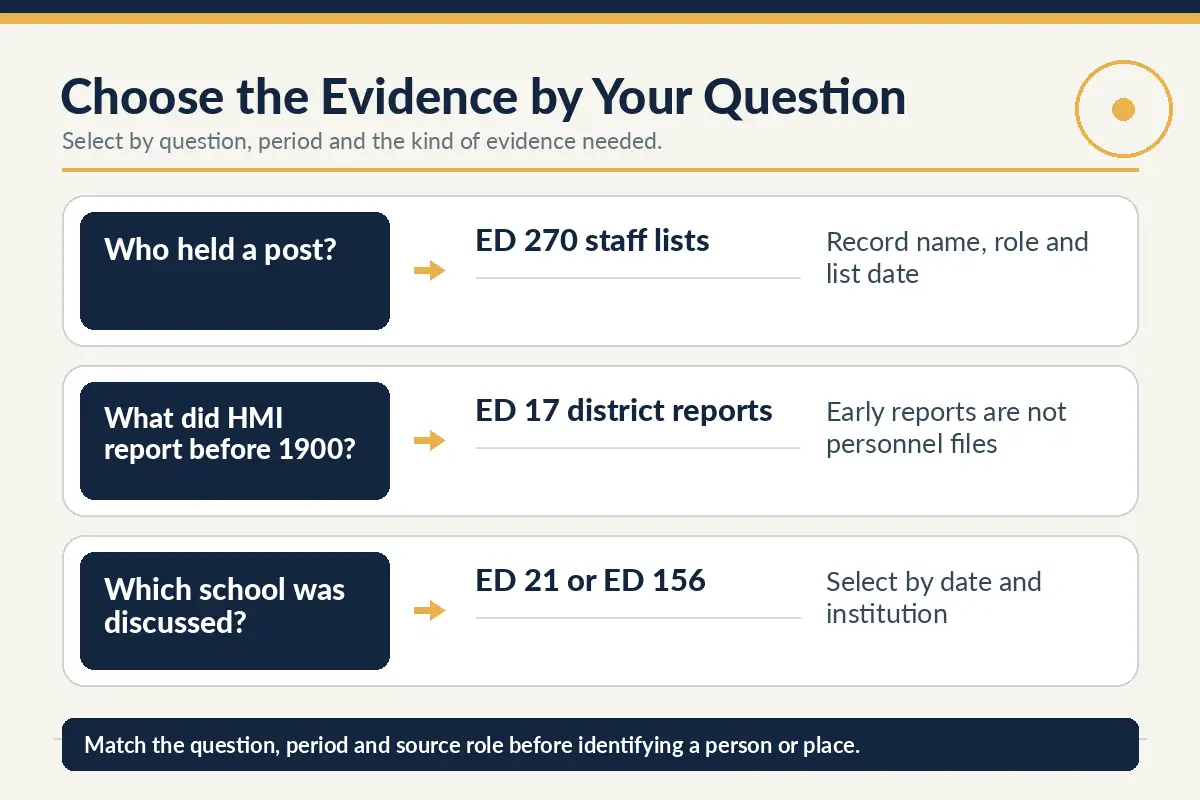
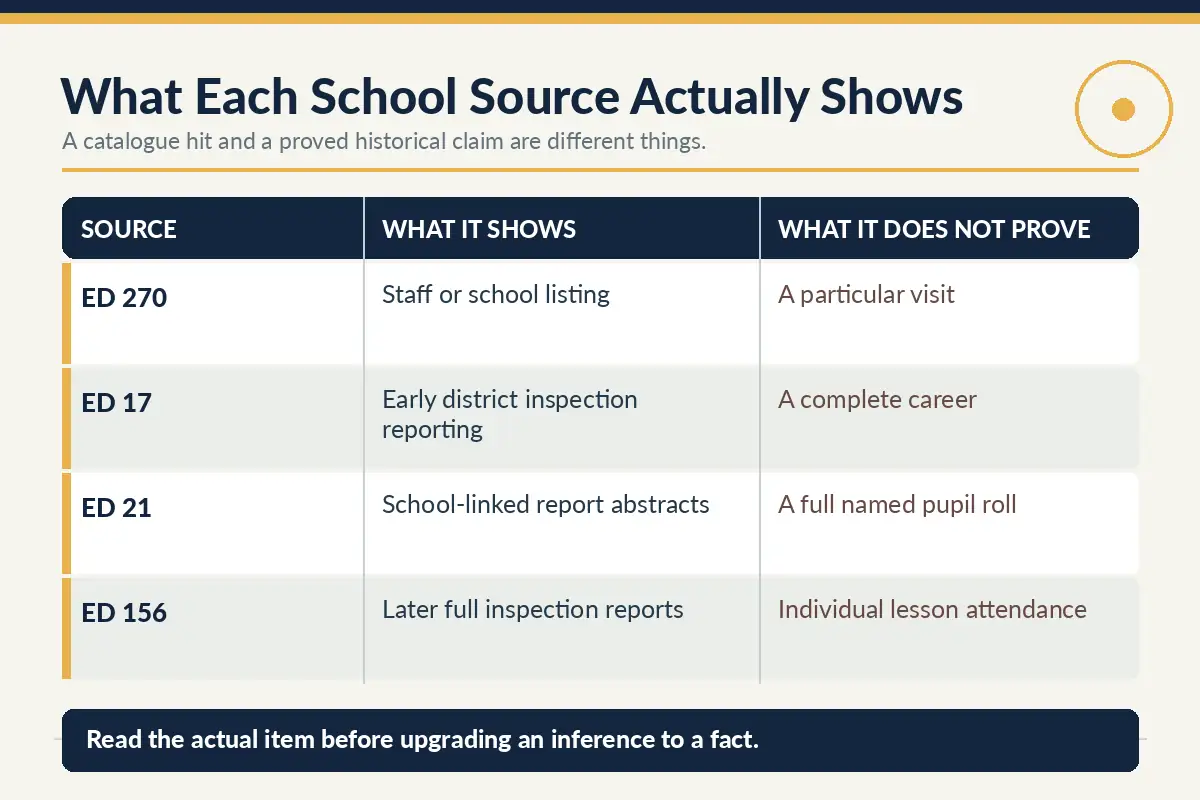
ED 270 is the series The National Archives recommends for historical inspectorate staff lists covering 1839–1986; it includes school lists as well. A name in a staff list can help identify an inspector and narrow an appointment period, but it does not by itself prove the person inspected a particular school, entered a classroom or wrote a surviving report. Build a dated personnel claim first, then use school-specific records only when a plausible school, district and period can be established.
Start With a Named Inspector and a Dated List
Write down the spelling of the inspector’s name, any initials, an approximate working period, an educational district or county, and the source of each clue. Family papers may call somebody “school inspector” long after retirement, while a directory might give a title without a department. Treat the phrase as an occupational lead, not as proof of an appointment. Record married names, titles and alternate initials so that two people with similar surnames are not automatically merged.
The National Archives’ inspectorate guide identifies ED 270 staff lists for 1839–1986. That is a collection span, not a promise that every year survives, that every individual appears, or that each list gives a complete biography. In Discovery, begin with ED 270 as the reference and inspect the descriptions of individual volumes. If a surname search fails, browse the relevant dates. An archival catalogue often describes a list as a whole without indexing every name printed inside it.
A staff-list entry should be transcribed literally: printed name, office, position, any district or affiliation actually stated, the list’s stated date and the full piece or page reference. Do not convert an undated change of title into an exact promotion year. A list prepared for a particular administrative purpose may reflect information gathered before printing, so preserve the difference between the date on the volume and the period that the entry is supposed to represent.
Separate Inspectorate Divisions and School Types
Historically, Her Majesty’s Inspectorate covered elementary, secondary, technical, teacher-training and art divisions. The surviving reporting systems did not all develop at the same speed. A person named as an HMI official may have had responsibilities for a type of institution, a subject or an administrative region; the title alone does not identify a particular school. When the list supplies a division, keep it in a separate field from a geographic district.
The early elementary reports printed for Parliament are in ED 17 and are organized in part by district and, before 1870, by denomination. ED 21 contains later school-linked abstracts, while ED 156 includes full elementary or primary reports for 1946–1993 arranged by county and county borough. These are alternative routes selected by date and record purpose, not consecutive chapters in an individual inspector’s personnel file. A 1912 secondary-school question, for example, calls for different series from a 1952 elementary-school question.
If a family story includes a particular school, verify its historical name and educational authority before searching for a report. School registers, local committee minutes and school logbooks may be held in county or other local archives rather than at Kew. The National Archives school guide cautions that many central school files record administrative correspondence, premises and inspection, not the day-to-day histories of particular pupils or a complete list of every teacher.
Build an Identity Matrix Before Linking a Visit
Use a four-column evidence sheet: recorded name, dated role, administrative context and possible supporting source. Add an explicit “not shown” column. A list mentioning “A. J. Mason” is not enough to identify a family member called Arthur Mason without further details. Conversely, a second list with the same full name but a different subject division may suggest a transfer or a namesake; do not decide between them merely because the surname matches.
A report bearing an inspector’s signature is stronger evidence of that person’s involvement in producing the report than a staff list alone. Even a signed report may summarize work carried out by a team and does not prove the signatory personally entered every classroom. Distinguish preparing, signing, approving and inspecting in your notes. If the document names a school but not the official, say that the institution was inspected, not that your candidate did the inspection.
Consider a clearly hypothetical case: a family letter claims an ancestor inspected a school in 1895, but a dated ED 270 list places a similar name in a different district. The conflict is a reason to search for transfers, a correct year, a misremembered school or another inspector. It is not permission to modify the letter or insert an unsupported reassignment. Two independent sources should narrow the identity before the school-visit claim enters a family narrative.

Record Missing Coverage and Access Conditions
Browsing ED 270 is often more effective than expecting a searchable person-level index. Discovery searches titles and descriptions, not every handwritten or printed name inside undigitized records. Filter results to the correct holding archive, note whether a piece has been digitized, and obtain the document by the permitted route. Many inspectorate materials described in the guide must be consulted at Kew or requested as copies. A catalogue hit is not the same as reading the named entry.
Where a volume is unavailable or does not name the person, log the exact span and sections examined. An absent result may arise because an officer worked in another division, the name was abbreviated, the list was annual rather than continuous, or the relevant volume was never retained. Try contemporary education reports, published directories and local education-authority files as distinct supporting sources. A school’s own copy of an inspection report may survive locally even if a government original does not.
For a final citation, capture ED 270 plus piece, printed title, page, entry date and archive. Maintain separate notes for the person’s occupation, geographical posting and any school visit. This lets a later reader audit exactly which assertion comes from the staff list and which comes from a report or local record. Avoid adding pupils’ names or private information that the sources do not actually support.
More Records and Archives Guides
How We Research Inspectorate Personnel
We use the National Archives inspectorate guide to place ED 270 beside, but not inside, the inspection-report series. We use the schools guide to distinguish administrative files from school-created records and the Discovery instructions to check the search-versus-browse strategy.
Examples of people, placements and conflicts in this article are hypothetical, not transcriptions of specific ED 270 entries. We do not infer an inspection or a personnel appointment from a catalogue title. Our affiliate disclosure explains relevant editorial relationships, without implying that any archive has endorsed this guide.
The National Archives lists staff lists for 1839–1986. Individual volumes must be checked for exact survival and coverage.
No. Use a dated report, school file or locally retained record to test that separate claim.
No. Catalogue descriptions are not full-text indexes of all entries; browsing the relevant volumes may be necessary.
Use date and place to choose among ED 17 early district reports, ED 21 school abstracts and ED 156 later full reports.
No. A list of schools or staff is not evidence of a named pupil’s attendance.