
WORK 25 contains planning and design evidence for the 1951 Festival of Britain, from graphics and drawings to contemporary photographs and administrative correspondence. A submitted design is not proof that it was installed. Match the venue, the item and the stage of the project before describing a proposal as a completed exhibition.
Begin With a Venue, Object, and Date
WORK 25 contains records of the Festival of Britain Office and related planning activity, including original graphic designs, drawings, photographs, minutes and correspondence. It is exceptionally useful for researching the shape of the 1951 Festival of Britain, but a drawing submitted to an organizer is not automatically an image of a built structure. Start by identifying exactly what you are investigating: a pavilion, exhibition graphic, product display, construction decision, visitor photograph or the later fate of a site.
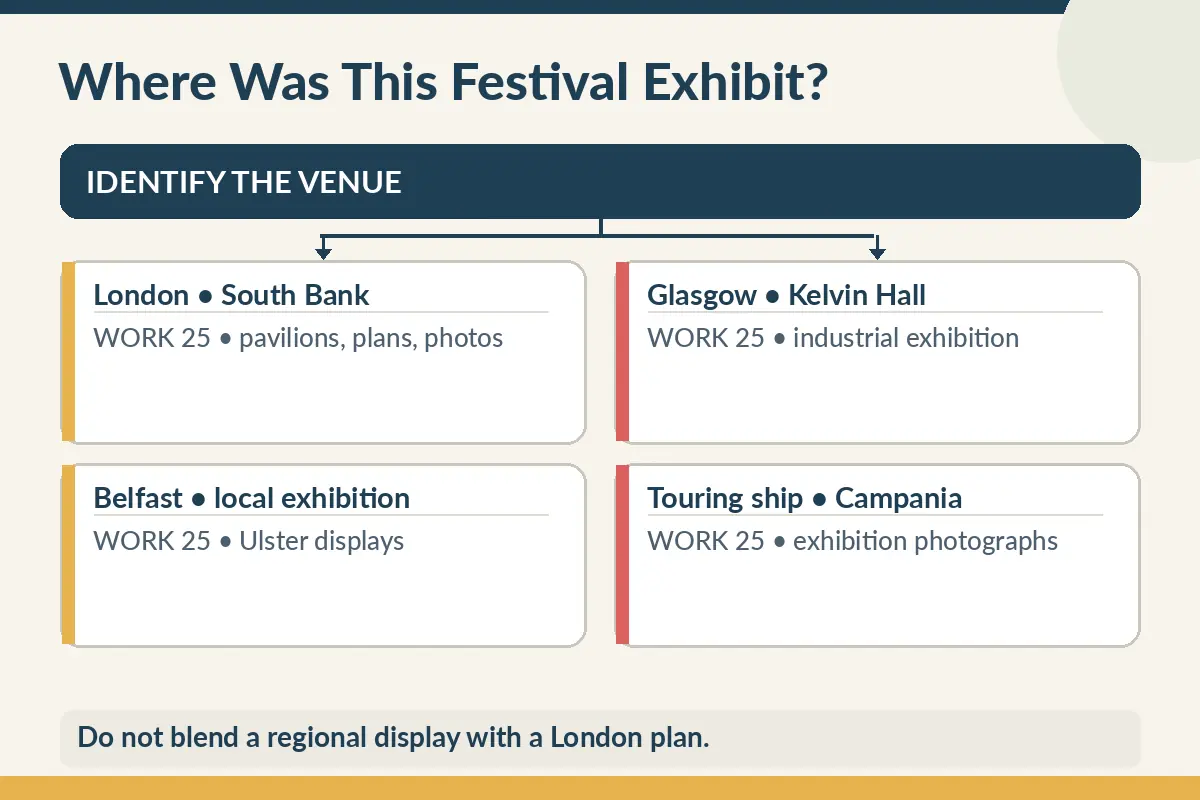
The Festival was not confined to one London location. Its main South Bank exhibition had its own pavilions, routes and terraces, while there were events elsewhere in Britain and a traveling exhibition on HMS Campania. The National Archives describes materials connected with Northern Ireland, Glasgow and local events. A reference to “the Festival” therefore needs a venue label and, where possible, a date. Without these, researchers may accidentally combine a proposed exhibit in one city with a photograph taken in another.
Separate Design Submission From Approved Installation
The National Archives identifies original WORK 25 submissions for the Festival symbol and other publicity, including designs by Abram Games. A competition entry is documentary proof of a submitted design; it does not prove it was selected or printed. A scheme drawing, meanwhile, may represent an architect’s first idea, a revised plan or an approved construction drawing. Note labels such as preliminary, revised, competition, approved or as built only if they genuinely appear on the object.
Create a stage field for every find: submission, decision, construction, exhibit in use, or dismantling. The archive’s online Festival collection shows a prototype for Games’s symbol in WORK 25/73/B3/B4 and a panoramic architectural image of the South Bank site in WORK 25/64/B1/SB-Gen/25. Those references tell you where to begin, not that each depicted detail reached a completed state. Compare surviving plans with contemporary photographs to establish what visitors could actually see.
Read Location Names Against the Real Festival Geography
The South Bank site occupied a redeveloped Thames riverfront in London and included the Dome of Discovery, Royal Festival Hall, smaller pavilions and the temporary Skylon structure. Its layout was divided by Hungerford Bridge. A photograph of one festival structure without a visible landmark may be difficult to place precisely. Identify the building name, river orientation, neighboring structures and photographer’s perspective before assigning a location.
The official Festival of Britain collection feature also identifies records from Belfast, Glasgow, a touring Campania exhibition and smaller local events. For a family memory of visiting the Festival, use a program, ticket, dated photograph or local newspaper to test which venue a relative attended. An image of the South Bank cannot prove that an individual visited London merely because the family remembers “the Festival.”

Use Photographs to Test Which Designs Were Realized
WORK 25 includes extensive photographs of exhibitions and festival activity. A dated photograph may establish that a particular structure, sculpture or feature was present at the time the exposure was made. It does not automatically reveal the planning approval, total lifespan, exact materials or who designed every element. Look for the photograph reference, caption, date and original context; a modern reproduction may omit important archivist notes or crop out the feature needed to identify the site.
Cross-check a design drawing against an independent photograph using three anchors: the feature’s outline, its position relative to surrounding structures and a compatible date. Where those match, you may be able to say a proposed feature appears to have been constructed. A conceptual rendering without a matching photograph remains a design witness, not construction proof. For an interior exhibit, compare objects and signage carefully because designs could change between mock-up and installation.
Track What Happened After the Festival Closed
The Festival’s South Bank exhibition opened in May 1951 and ended in September 1951. The National Archives’ account of the South Bank’s aftermath explains that decisions about the site’s later use were being considered even before the Festival ended. This creates a separate research phase. A removal proposal is not the same as a completed demolition, and the continuing existence of a landmark should be established from subsequent plans and photographs.
Classify each later document by action: site clearance proposal, materials recovery, lease, transfer, physical removal or later use. If your interest is an individual pavilion, compare its location on the Festival plan with later aerial photographs and site histories. Do not attribute the same outcome to every structure. The Royal Festival Hall, for example, is a specific building to follow through its own institutional sources, not an interchangeable label for all temporary Festival architecture.

Make a Reference-Level Design Provenance Sheet
For each item, save the full WORK 25 reference, object description, document type, venue, stated date and whether the evidence is a proposal or observed installation. The National Archives’ art guide makes clear that WORK 25 also holds copyright documents and council material, so a designer credit should be checked against the relevant original records and not inferred from visual resemblance. A familiar graphic style alone does not prove authorship or ownership of an image.
Keep personal memories on a separate line with their original wording and source. A relative may accurately remember seeing a distinctive pavilion but misremember the city or year. A dated program or family photograph can test the recollection. The defensible end product is a site-and-stage account: which design was proposed, which structure can be observed in contemporary evidence, and what is still uncertain about subsequent alterations or removal.
More House and Local History Guides
How We Research and Check the Archival Evidence
We checked the archival descriptions and record-family boundaries against these sources: The National Archives; The National Archives; The National Archives. The cited guides support the series and period statements but cannot authenticate an unknown item, family relationship, particular named worker or undocumented file that we have not examined. A catalogue result is a finding aid. Read the original where access permits, record the full reference, and cite each separate factual claim at the level of its actual evidence.
Our evidence rule is simple: quote a source for what it records; label any deduction as a deduction; and leave gaps visible until an independent record resolves them. These guides are informational and do not imply that records are online or free in every case. Commercial relationships, when applicable, are explained in our affiliate disclosure; none of the research routes above requires an affiliate purchase.
No. The series includes submissions, designs and administrative material. Establish the document stage and compare plans with photos or completion evidence.
No. The main exhibition was on the South Bank, but the 1951 Festival also featured regional events and an exhibition that traveled by ship.
A well-dated, correctly identified photograph can establish an observed structure at that time, but it does not prove every design or construction decision.
Not necessarily. Review the relevant copyright documents, contracts and context rather than assuming authorship, employment and rights are identical.
Use later site plans, demolition or reuse correspondence, dated photographs and building-specific records. A proposed clearance is not proof that removal occurred.