
WORK 55 is a distinctive photographic source for the history of British consular buildings in East Asia. The National Archives identifies six volumes depicting consulates in China, Japan, Korea and Thailand, with some other buildings in Hong Kong and Indonesia. The relevant photographed buildings are described chiefly for 1907–1947, though the broader series date range extends beyond that selection. It is a building collection, not a staff service register.
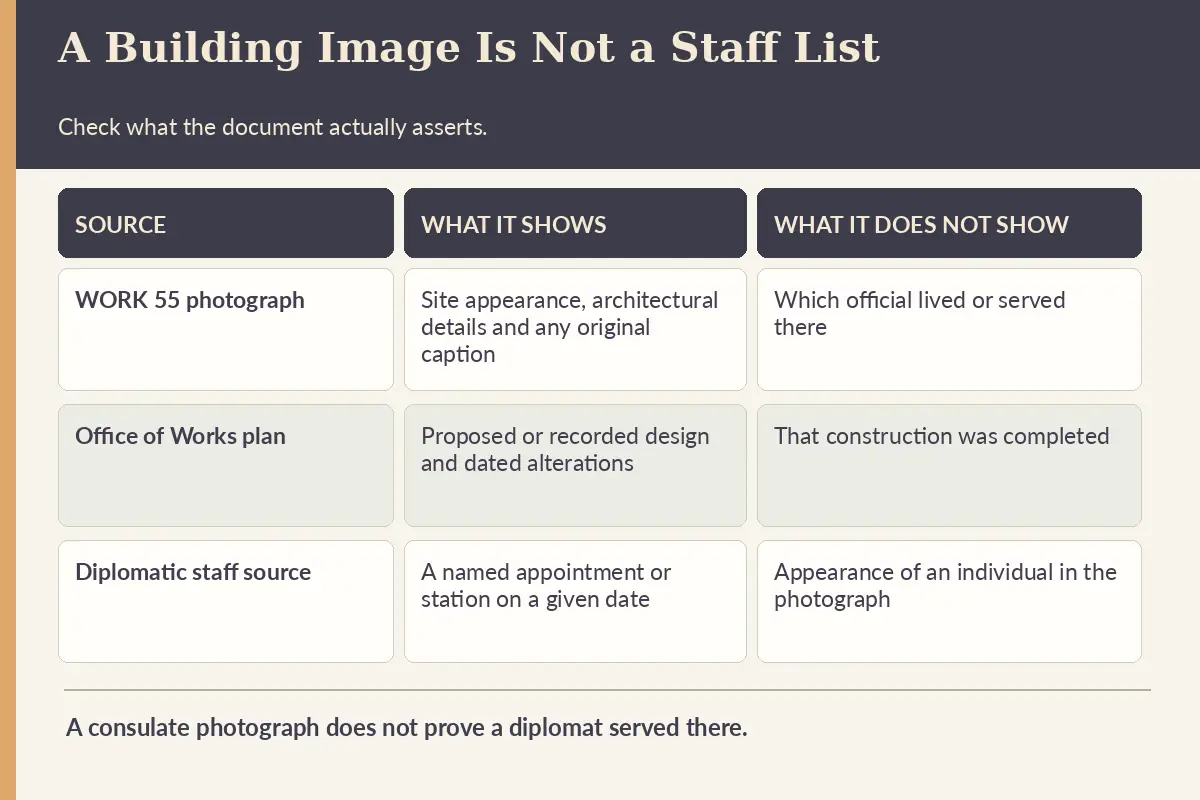
The National Archives photographs guide places WORK 55 under records of the Office of Works and its successors. This provenance is important: the images are evidence of structures that government officials managed or documented. A photograph of a consulate does not establish that a particular ambassador, consul, clerk or family member was in that room or country on the day it was taken.
Search with historical city names and present locations
Make a table of the place name used in the period, modern geographic name and known administrative jurisdiction. In East Asia, romanized place names and political boundaries changed across the twentieth century. Search WORK 55 by city, consulate, mission and variant spellings, while keeping the original wording of catalog entries. A modern country label is not a substitute for the historical heading under which an office filed its photograph.
A building may have changed function or been replaced, and a consular operation may have moved from one address to another. Start with a dated consular directory or contemporary map if available. Record whether the pictured building is described as an office, residence, compound or other government property. Those functional categories should not be collapsed into one assumed house.

Identify the pictured building before constructing its story
Inspect architectural features that can be compared independently: roof forms, window bays, boundary walls, street crossings, neighboring buildings and a visible name plate if legible. Record the camera direction where it can be inferred from a map, but do not invent a precise viewpoint from an indistinct scene. Captions may reflect historic naming or an official description rather than the building’s function at every date.
If a photo is undated, use dated maps or a documented alteration to establish bounds rather than inventing a single year. A picture of an old roof beside a later plan might show a change, but the plan is not proof of completion. Cross-reference any Office of Works drawings with photographs taken after the supposed work and local construction records, noting differences between proposed, approved and executed work.
Do not infer appointments from a site image
Official portraits, departmental lists and consular correspondence have different evidentiary purposes from property photography. A member of staff could be assigned to a city without occupying a particular residential building; a pictured person could be a visitor or caretaker rather than the named official. When the family question is where someone served, use dated appointment notices or personnel files. When the question is where they lived, seek records that actually provide the household address.
Suppose a family biography says a relative worked at a consulate in 1928. A WORK 55 photograph labeled with that city and approximate year can illustrate the institutional setting but not independently prove service. If a staff list confirms an appointment, cite that list separately. Even two dates that appear to align do not establish that the person was present in a photograph without an identifying caption.
Recognize gaps, duplicates and archival access limits
The six volumes do not represent every British consulate in East Asia or every year of a building’s history. Some photographs may document just one site at several points in time. A catalogue description may not include every building visible or every photograph within an album. Search the series and record the volume reference even when an individual image cannot be viewed digitally. The National Archives warns that much photographic material requires visiting Kew or obtaining copies.
Do not treat a negative online search as proof that the consulate never existed. Related visual material may be in Foreign Office correspondence, local municipal archives, maps or diplomatic collections elsewhere. When a series yields several similar views, check captions and physical marks before declaring them different buildings. A duplicate print is not independent evidence of a second event.
Publish a place history without erasing uncertainty
The strongest short account states the original WORK 55 reference, the location as captioned, the approximate date and the visual features that support the site match. Then it cites a separate plan, map, directory or appointment file for any additional claim. Avoid modernizing a historical address without recording the source used for the conversion. If the correspondence between the image and current building is uncertain, give alternative identifications and a next test.
Preserve the difference between consular architecture and diplomatic biography in captions, SEO summaries and diagrams. A defensible caption might say “A historic view of a British consulate building, attributed to the named city in WORK 55”; it should not claim that a specific diplomat is inside unless identified by direct evidence. Such precision makes the material more useful to both family historians and researchers of changing urban landscapes.

More Place and Jurisdiction Guides
How We Research and Verify the Archival Claims
Our research starts with the National Archives collection guidance and its actual statement of series purpose, date range and limitations. We compare that guidance with Discovery search practice, retaining repository, series, piece and page. A series description is a finding aid rather than proof of every fact in an individual record. Each claim in this guide distinguishes contemporary document wording from our interpretation and identifies the independent record that could confirm an added inference.
Our visual charts are original research aids, not scans of original registers, passport forms, inspection reports or photographs. Descriptions of sample holdings and approximate series dates are not guarantees of complete survival. Before using any paid copying service, read our affiliate disclosure; no commercial relationship is claimed by this guide.
The National Archives describes six volumes of photographs of British consular buildings, especially in East Asia.
The guide mentions China, Japan, Korea and Thailand, plus some sites in Hong Kong and Indonesia.
The consular building images highlighted by The National Archives are mainly from 1907–1947; check each item.
No. Use appointment, personnel or correspondence records to establish an individual’s service.
Compare the original caption and architecture with dated city maps, plans, directories and other photographs.