
Photo albums of Hamburg-American Line facilities and an emigration facility in Hamburg, Germany, survive in the records of the United States Shipping Board. NARA describes 325 photographs in the SB group of RG 32, dated 1914–1918. They can show spaces associated with a shipping company, but the archival description does not make them passenger lists, dated records of one relative’s departure, or proof that a named immigrant used a particular room. The date span should be treated as a group-level description until each photograph’s original caption and context have been inspected.
That distinction is important in family stories. A person might have sailed on a Hamburg-American Line vessel in a different year, embarked from a different port, or traveled on another company entirely. An attractive photograph of a building can illuminate migration infrastructure without documenting the traveler’s presence. Begin with the RG 32 still-picture listing, and keep photographic context separate from dated passenger and immigration evidence.
Find the SB Albums and Read Their Original Captions
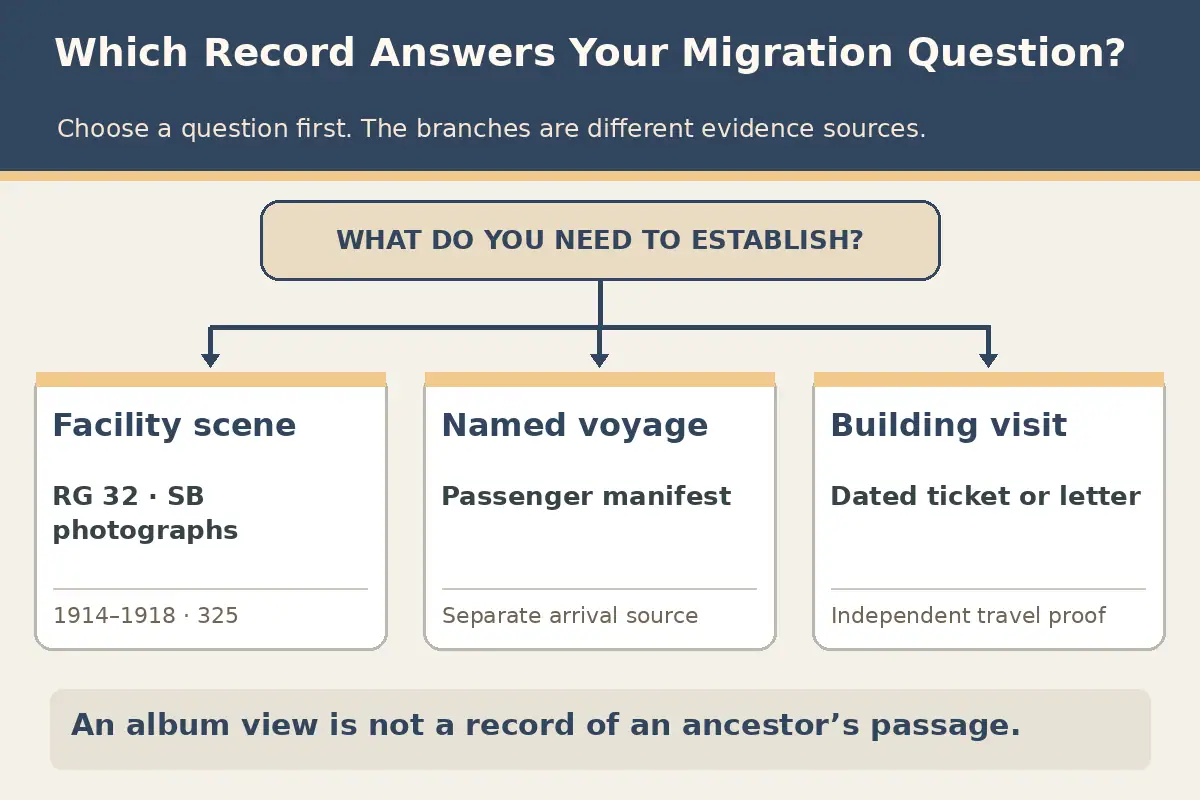
NARA’s RG 32 section 32.8 lists the SB photographs among still pictures, distinct from the United States Lines publicity photographs and other Shipping Board subjects. The guide specifies 325 images of Hamburg-American Line facilities and an emigration facility at Hamburg during 1914–1918. Begin with that SB designation, the described subject, and a precise request for the album or photograph identifier. The “Hamburg” office correspondence listed elsewhere in RG 32 relates to later Shipping Board activity and should not be assumed to describe the same album or document an earlier passenger journey.
When viewing an image, record the album context, caption, page or print number, location as stated, and date if given. An album’s order may reflect editorial arrangement rather than the chronology of events. A photograph can depict an earlier structure copied into a later album. Ask NARA Still Picture staff for the item local identifier if a digital catalog entry omits the original album notation. Avoid treating a modern web caption or a machine-translated German sign as authoritative without checking the visible source and archive metadata.
Identify the Building Before Inferring Its Purpose
A group-level description mentions an emigration facility but does not say that all 325 photographs depict that facility. Separate images of docks, waiting spaces, offices, ships and accommodation areas before assembling a route through the site. Read any signs or labeled floor plans only when the originals are clear. A hall resembling a waiting room may have served different functions over time, while a building with a shipping-company emblem may be administrative rather than residential. The exact caption and verified location should drive the interpretation.
To locate an identified building, consult dated Hamburg maps, architectural records, port guides, shipping-company publications and municipal histories. Note demolition, reconstruction, wartime changes and street names. An image labeled as a “facility” is not evidence that every traveler passed through it. Record whether the photograph is of an entrance, dormitory, ticket counter, baggage area or general exterior only when source evidence makes that function clear. If functions cannot be distinguished, use a neutral label and preserve the uncertainty.
Treat 1914–1918 as an Album Range, Not a Travel Date

The 1914–1918 span belongs to the NARA still-picture group; it does not establish when an ancestor emigrated or that every depicted service operated throughout those years. World War I complicated commercial maritime travel, but it is still necessary to verify the specific line, route and applicable year rather than write a generalized voyage story. Check each photograph for a date and any indication that it was copied or reproduced from an earlier image. An illustrated company brochure could also reuse a promotional photograph beyond the moment it was first taken.
Build two timelines. In one, place authenticated image dates, building changes and album descriptions. In the other, place independent events in the traveler’s life: birth or residence, ticket or booking, embarkation, ship passage, arrival, inspection, onward travel. Keep the timelines parallel until an identified document links the traveler with a specific facility. The fact that both timelines mention Hamburg is only geographic overlap. It is not proof that the person stood in the pictured hall.
Find the Passenger in the Right Travel Records
For a named migrant, search passenger manifests, departure registers, naturalization files, contemporary letters, tickets or other primary travel documents for the claimed journey. NARA provides passenger-arrival research guidance for U.S. ports; an arriving manifest can substantiate an entry on its stated date and may identify vessel and port information, but it does not automatically establish use of a particular Hamburg facility. Departures from Europe may require holdings of archives in Germany or a separate shipping-company source. Match people using age, birthplace, relatives, destination and travel date, not surname alone.
Keep passenger and ship evidence in separate rows from the photographic record. A ship name printed in an album might be a subject of company publicity rather than the vessel an ancestor took. Likewise, being booked on a line does not establish the exact pier, lodging location or transit path. If the family history mentions a migrant facility, test the claim against a dated source such as an address, ticket notation or explicit letter. Where access to original documents is limited, mark the visit as unconfirmed rather than turning a visual illustration into a documented itinerary.
Publish an Ethical Photo Caption With Clear Limits

A strong caption identifies the RG 32 SB album and exact photo item, then reports what the caption or visible scene reliably establishes. If a family member is known to have emigrated from Hamburg, state that documented journey separately, with its own source. This respects the difference between migration context and personal evidence. Do not label strangers in a crowd as ancestors or infer nationality, religion, citizenship or immigration status from clothing and appearance. Buildings and institutional practices can be researched without assuming the identities of everyone shown.
To obtain a copy, retain the record group, SB series, album or box location and unique photograph number in line with NARA Still Picture guidance. Check reproduction rights for the item and the original caption before reuse. An illustrative reconstruction for a modern article should be explicitly distinguishable from an archival reproduction. The result can make an ancestor’s journey more understandable while leaving the unsupported steps open for further documentary research. Historical context is useful precisely because it does not need fictional personal details.
More Place and Jurisdiction Guides
How We Research These Historical Records
We verified NARA’s SB photograph count and broad album dates under RG 32, reviewed its Still Picture request guidance, and used NARA passenger-arrival research instructions to separate photographic context from documentary travel evidence. The guide does not identify each person, facility room, vessel or passenger journey shown in the albums. We treat the range 1914–1918 as group-level provenance and require distinct passenger and departure sources for individual itineraries. Affiliate disclosure.
They are described as photographs of Hamburg-American Line facilities, including an emigration facility, not as a name-indexed passenger list.
No such claim appears in the group description. It covers company facilities as well as the facility in Hamburg.
No. A traveler’s departure, ship and arrival must be verified independently.
Usually not. It may document an arrival and vessel but not a specific building visit in Hamburg.
Caption the identified facility photograph as context and cite travel records separately for the individual.