
The National Archives guide to Record Group 3 describes an album of 312 photographic prints of trolley cars and tracks in several eastern U.S. cities, dated 1918–1919 and identified as MTF. The album sits in the reference-library records of the U.S. Housing Corporation. It is evidence that streets and transport infrastructure were photographed, not a register of the passengers who rode a particular car.
For family or neighborhood history, start with the photographed street and its date rather than searching for a surname. A recognizable shopfront, line junction, overhead wire or distinctive building may lead to a street address. Only a contemporary caption or independently dated municipal record can establish the location confidently; a streetcar appearing near a workplace does not prove that an ancestor worked there or used the line.
Select the MTF Album Instead of Housing Construction Pictures
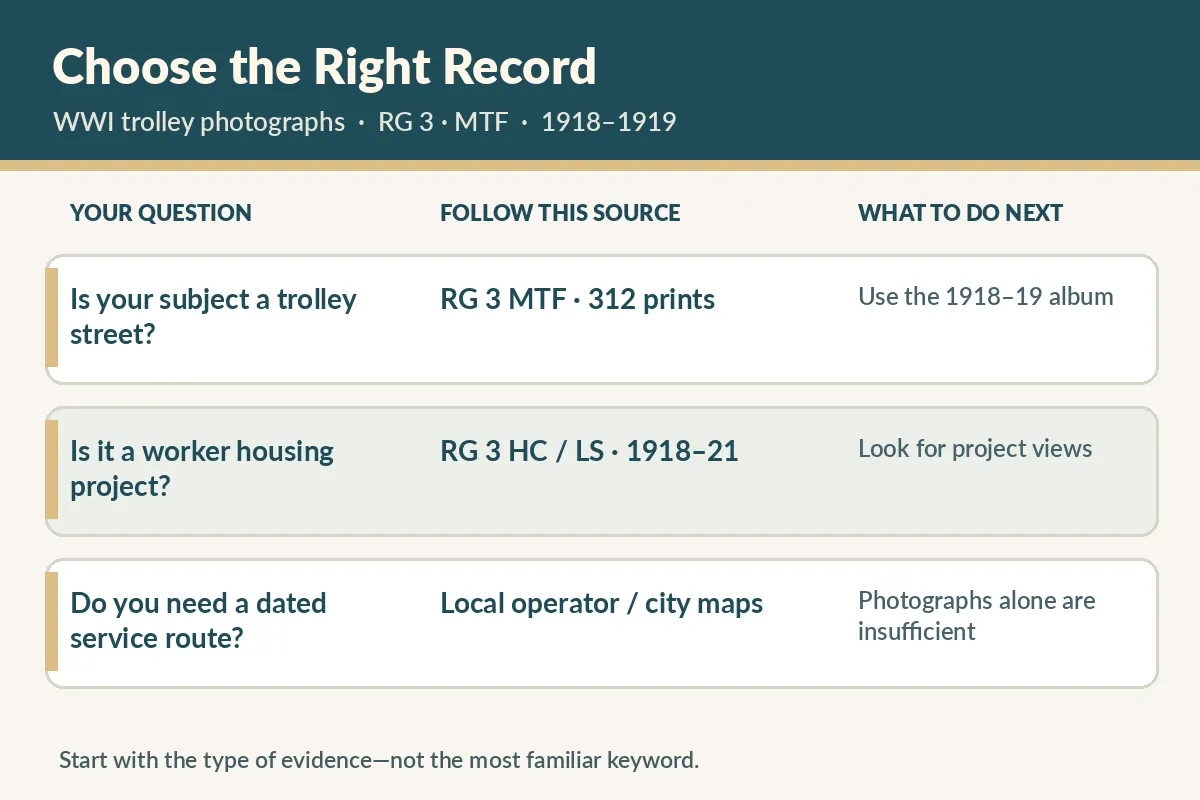
Record Group 3 contains several visually related but different sets. In the reference library, MTF concerns trolley cars and tracks. HC and LS cover stages of government housing projects and planned communities from 1918–1921, while BGP contains negatives of housing designs from 1918. Searching the broader record group without the photographic designation can mix construction scenes, plans and streets. Note the group code before comparing two prints.
The photographer may have been recording transport conditions relevant to wartime worker housing, but the guide does not identify the objective of every MTF print. Do not silently recast a photograph of rails as a federal investment, an authorized timetable or an official plan to extend a route. The surrounding caption, album order, and any accompanying report matter more than the broad administrative title of the holding.
Locate a Street by Stable Details, Not Impressions
Record any legible street sign, building name, cross street, track curve, bridge, grade or platform. Describe what can actually be seen before proposing a city. Then compare period street directories and fire insurance maps with the photograph. A facade that looks familiar today may have been rebuilt, and a line name printed on the car might identify its operator rather than the street where the photograph was made.
If the image contains a trolley car number, preserve that number as a clue and search operator histories or rolling-stock lists. It does not itself establish the day, route, or ridership. A blurred shop awning is weaker evidence than two independently matching street intersections. Keep a confidence note with every proposed address and do not place a modern map pin on an image that lacks an adequate location match.
Distinguish Track Presence From a Working Timetable

Tracks in the pavement demonstrate that rails were present when the photograph was taken, if the image date is reliable. They do not establish that regular service was operating that morning. A parked car may be an inspection subject, a demonstration, or a vehicle outside its usual route. Look for a dated timetable, franchise map, transit company annual report or municipal engineering drawing to document actual operations.
The 1918–1919 range belongs to the album description, not automatically to each photograph you encounter as an online copy. Write down the original image date, album label and any later reproduction date separately. If a track was removed later, a city ordinance or public works record may explain when, but a comparison of two undated photographs is not sufficient to set the removal year.
Use Wartime Housing Context Without Inventing Employment
The U.S. Housing Corporation was organized around the housing needs of wartime workers. The same guide identifies the Transportation and Municipal Loans Division, with field-office documents concerning transport and related projects. Those records may help explain why particular corridors were photographed. They are separate sources: an image subject and a policy or financing file should not be treated as one document.
A factory in the background can establish proximity to a line, not an employee’s use of it. To connect a named worker to a plant, consult city directories, employment papers, union records where available, or a family letter with an address and date. To connect a household to a trolley line, match an actual residence address and period route map. Even then, proximity is not proof of commuting.
Identify Photographic Copies and Caption Layers

When an MTF image is located in the National Archives Catalog, copy its precise title and hierarchy, the album or series designation, any image number, and the repository’s stated dates. Distinguish a caption written on the print from wording supplied by a later cataloger. A scan may crop the original mounting board, obscuring information that establishes the maker or location.
Search both the photographic group and the physical street or company name. A failed name search is unsurprising because this is not a personnel index. If the online result is only a series-level description, ask the repository whether an item description, print, or contact sheet can be examined; do not announce that 312 digital files must exist simply because 312 prints appear in the published guide.
Build a Street-by-Street Comparison Ledger
A useful research ledger lists image reference, visible landmark, caption statement, proposed street, date range, and corroborating source. Keep separate columns for the literal description and your interpretation. A street map and newspaper photograph made within a few years of the trolley album may independently support the identification, whereas two copies of the same government image are still one source.
For multi-city albums, do not assume consecutive photographs belong to the same municipality. They may be grouped by subject or later album arrangement. A rail junction identified in one print does not automatically locate a nearby uncaptioned print. Verify each frame or document the explicit album sequence that supports grouping. Note alternate spellings of street names and changes in municipal boundaries.
Request the Right Image Before Publishing a Claim
Use the official Catalog with RG 3, MTF, trolley, streetcar, possible city names and the 1918–1919 range. Record the full descriptive citation even when no image is online. NARA advises that requests for copies of less common records often require exact citations. Ask for the print and any caption or album page that helps identify it, not just a cropped thumbnail.
For a publishable local history caption, identify what comes from the image, what comes from an archival caption, and what was established by a separate map or directory. If the street or direction of travel cannot be demonstrated, say so. This is stronger research than assigning an attractive but speculative location or naming unidentified people in a century-old transportation scene.
More Place and Jurisdiction Guides
How We Research the Archival Trail and Its Limits
Our method begins with the NARA record-group description and records the exact subject, group code, medium, year span, and stated holdings before interpreting a particular item. We distinguish what the published guide confirms from what a caption or original image would have to establish. The Catalog guidance explains why a series description is not the same as a digitized item.
For specific claims about people, places or property, we compare at least one independent dated record and retain negative or ambiguous results instead of filling gaps with plausible stories. We do not assume that all items are online, that an illustration is a faithful facsimile, or that a proposal was completed. NARA’s copy-request guidance explains why a precise citation matters. Our affiliate disclosure explains the site’s policies; no affiliate relationship is asserted by these archival links.
No. NARA describes an album of trolley cars and tracks, not named riders or fare receipts.
The record-group guide gives a print count; it does not guarantee item-level digital images for every print.
Not by itself. Route signage identifies a possible line; use dated city maps and landmarks to locate the exposure.
No. A named worker and actual residence or employment need independent documents.
RG 3, the MTF designation, the catalog or album identifier, the exact caption when present, and repository details.