
The National Archives guide to Record Group 120 identifies a 49-print album marked GO showing Quartermaster oil and gasoline storage facilities in France and Belgium during 1918–1919. It is an unusually focused visual source for following the support infrastructure of the American Expeditionary Forces (AEF). A storage tank, pipe, shed or rail siding tells you about the appearance of a facility; it does not itself quantify fuel issued, establish a location or list the people who worked there.
The useful question is therefore not “Which soldier handled this fuel?” but “Which specific facility does the photograph document, and what other records establish its date, function and operations?” Begin with the GO image identifier and original caption, then compare site geography, Quartermaster administration and dated transportation or engineering records. Record the limits of each source before drawing a conclusion about a depot’s role.
Keep the GO Fuel Album Separate From Other AEF Photos
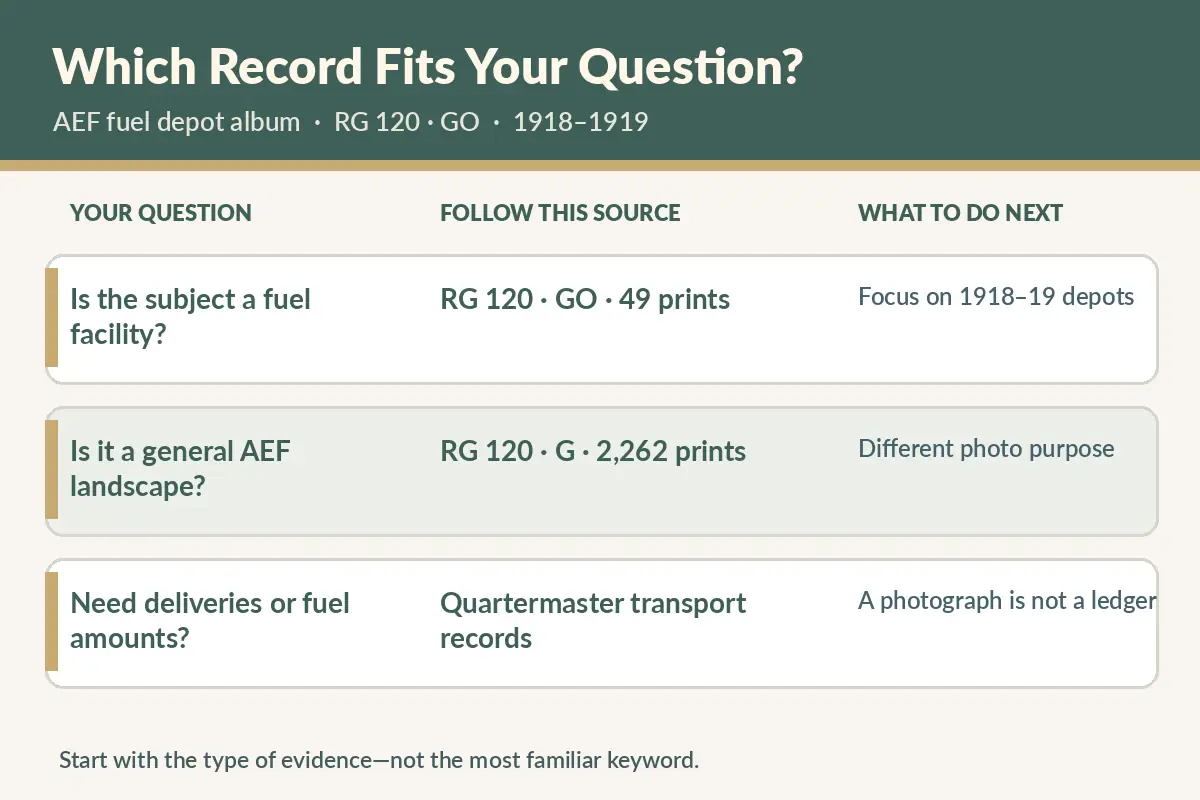
NARA places GO in the general still-picture holdings of RG 120 with 49 prints dated 1918–1919. The same section lists G views of areas occupied by American troops, HB images of a 116th Engineers training program and other photo groups. G, HB and GO are independent subject groupings, not sequential stages in a fuel-delivery process. Search the GO designation first when investigating storage infrastructure.
A broad search for “AEF France” can return battlefield scenes, camp life or troop portraits. Those results are useful context only when a specific place and date connect them. Do not assume that two album titles referring to France cover the same railhead. Write down the group and exact image reference for every candidate before combining it in a site history.
Read the Facility Layout Before Assigning a Place Name
Describe the physical arrangement: tanks or drums, receiving platforms, hoses, rail spurs, roads, fencing, embankments and nearby buildings. Look for inscriptions or distinctive terrain. A yard full of barrels may suggest temporary storage, but without scale or a caption it is unsafe to estimate capacity, ownership or number of workers. Even the word “gasoline” in a broad album title does not identify the contents of each visible container.
Test a proposed French or Belgian place name against contemporary maps, period spelling and railway junctions. Postwar street names and rebuilt industrial sites can conceal the original geography. A captioned town might describe a regional Quartermaster office rather than the exact site of an exposure. State whether you have an address, a likely local area or only a broad national location.
Date a Construction View Without Assuming an Operating Depot

A platform under construction and a depot in use are different observations. Keep separate columns for exposure date, visible condition, dated engineering report and documented acceptance or operation. A row of assembled tanks could be awaiting connection to pipes; an empty rail siding could be photographed between movements. The image alone cannot establish the first issue date or sustained wartime operation.
The album date range spans the end of the war and the following year. Facilities may have been maintained, adapted or cleared after fighting ended. A 1919 photograph of a depot does not prove that it existed in the identical form in 1918. If the item date is uncertain, avoid using the Armistice as a convenient but unverified line dividing construction from dismantling.
Separate Storage Capacity From Deliveries and Consumption
Do not turn a tank’s visual size into a claim about gallons stored or issued. A construction plan might specify designed capacity, an inventory might report fuel actually on hand, a shipment record might record receipts, and a distribution return might record issues to units. Each answers a different question. None automatically proves that an individual regiment received the fuel pictured at the site.
If the research requires quantities, seek contemporary Quartermaster inventories, transport records or ledgers that name a depot and a date. Watch for differences between volume, weight, containers and fuel grades. Never assume a single photograph captures peak capacity. Where independent numbers do not survive, it is better to describe a documented storage facility than to publish speculative throughput figures.
Follow the Rail Connection Without Inventing a Route

Rail wagons, sidings and unloading platforms can provide clues about how supplies moved, but they cannot show an entire journey. Compare a dated railway map with station or depot records and any surviving transport schedules. A rail line touching a mapped depot does not establish that a particular shipment used that track or reached the trenches.
Maps may show planned connections, wartime alignments or later reorganization. Record the year and source for every route segment. If two images appear to show related infrastructure, require a caption, shared landmark or other link before drawing a single network. Fuel support was a logistical system, but an individual GO image is only one observation within it.
Find Named Personnel Only in Name-Bearing Records
A uniformed figure near a tank might be a Quartermaster worker, engineer, driver, contractor or visitor. Clothing and proximity do not establish an individual’s assignment, rank or employer. A caption may name a supervising officer, but it does not automatically identify all workers at that site. Search personnel, unit and employment documentation separately.
Even when a service record places an ancestor in Quartermaster duties in France, that does not prove service at a particular GO facility. Build an evidence ledger with separate columns for person, unit, documented station, date and photo reference. Mark a proposed connection as hypothetical until a name-bearing record or unambiguous original caption supports it.
Build a Depot History From Distinct Record Types
For a publishable local or family history, assemble a small file of the GO photograph, a contemporary place or rail map, and a dated administrative record that identifies the facility. If an engineering plan exists, note whether it is preliminary, amended or as built. If a later inventory or closure record exists, cite that separately instead of treating it as visible in a photograph.
When requesting a print, provide RG 120, GO, the album or image identifier and all original caption details. Ask whether a negative, mounting page or other context survives. A short, accurate conclusion might be that a fuel depot of a given design was photographed near a named town in a date window; shipment volumes, workers and closure should remain unstated until different sources prove them.
More Place and Jurisdiction Guides
How We Research the Archival Trail and Its Limits
Our method begins with the NARA record-group description and records the exact subject, group code, medium, year span, and stated holdings before interpreting a particular item. We distinguish what the published guide confirms from what a caption or original image would have to establish. The Catalog guidance explains why a series description is not the same as a digitized item.
For specific claims about people, places or property, we compare at least one independent dated record and retain negative or ambiguous results instead of filling gaps with plausible stories. We do not assume that all items are online, that an illustration is a faithful facsimile, or that a proposal was completed. NARA’s copy-request guidance explains why a precise citation matters. Our affiliate disclosure explains the site’s policies; no affiliate relationship is asserted by these archival links.
NARA lists 49 photographic prints of AEF Quartermaster oil and gasoline storage facilities.
France and Belgium, for the 1918–1919 GO photographs.
No. Quantities and movement require dated inventory or shipment records.
No. A line on the ground is not an identified train movement.
Only with additional name-bearing station, personnel or employment evidence.