
Start With a School, Not a Soldier’s Assumed Class
The American Expeditionary Forces operated several training schools in France during World War I. National Archives Record Group 120 describes their records separately from battlefield maps and personal service documentation. A letter mentioning Langres or Saumur may identify a probable educational locality but does not by itself prove enrollment at a named course. Begin with the original wording, date and person who wrote the letter. Then decide whether your immediate question concerns the location of an AEF school or the training history of an individual soldier.
The distinction matters because a map can depict a training ground used by many units and instructors. A soldier might pass through the same town while on another assignment. Record the historic French place name, the school or corps if named, and a defensible interval from the letter or service record. Do not use a generalized 1918 AEF map to replace an undated personal claim. Keep any ranks, units and course names as separate fields to be tested against contemporary records.
Separate Training-Area Maps From Instructional Sheets
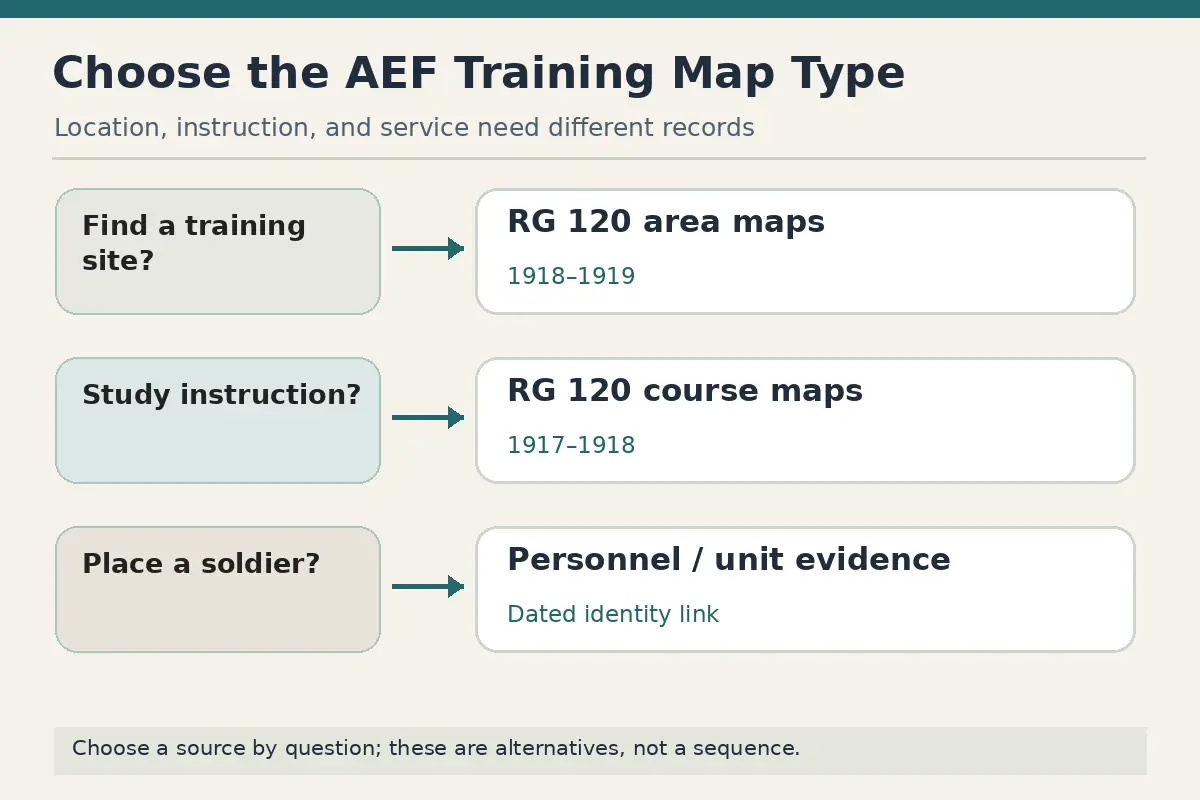
RG 120 §120.3.5 identifies 99 maps of training areas and facilities for 1918–1919. It separately identifies 159 instructional maps for 1917–1918, and two target-range maps of Saumur Artillery School at Fontevrault for 1918. Those are distinct source types, not three successive stages of a training program. A location map may orient you to a physical installation; an instructional map may show an exercise or example terrain; a target-range sheet concerns a particular training facility.
To avoid confusion, transcribe the map title, creator, legend, date and scale before using it. An instructional map depicting a tactical problem must not be treated as proof that a real battle or troop movement took place at the drawn location. Even a detailed target-range plan gives no automatic roster. If your goal is to follow a soldier’s training, first use the maps to locate a plausible school and then seek unit orders or individual personnel evidence for the same dates.
Use Langres School Records for Institutional Context
The NARA guide lists records for Headquarters Army Schools and several specialties at Langres during 1917–1919, including artillery, engineering, infantry, intelligence, machine-gun and signal training. It also describes school-related records at other French locations. Do not combine these descriptions into an imaginary single school attended by everyone posted to Langres. Identify the specific school or training department named in your source and whether the document is correspondence, a report or a map.
A reference to Headquarters Army Schools may lead to organization files while a named technical school may hold course-specific correspondence. These can reveal when training operated and how its facilities were organized, without supplying the name of every student. If a relative’s papers mention one course but a map shows another branch of instruction, leave the mismatch unresolved until you find a confirming record. A location match is valuable context; it is not equivalent to a documented course completion.
Account for Saumur and Other Training Places

Saumur target-range maps in RG 120 relate to an artillery training area at Fontevrault in 1918. The same archival section also identifies records for AEF University at Beaune, a bandmasters’ school in Chaumont and several corps schools in other French towns. These names represent distinct institutions and locations. A family reference to “army school in France” should therefore trigger a choice among possible places, not a default assignment to Langres because it appears prominently in the guide.
Use period place spellings and surrounding geography to evaluate a candidate. A training area might lie outside the town used in its administrative title. Search local historical maps and surviving facility records to locate the actual site. When translating a French place name into a modern map reference, preserve the archival name and note any uncertainty. A modern marker proves where a place lies today, not where a particular 1918 class assembled or slept.
Find the Correct Map Description and Copy
The RG 120 guide is a record-group overview. It indicates counts and types of maps but is not a complete image index of each training ground. In the NARA Catalog, search for the series under RG 120 with the school, site and date. Inspect whether the hit is for a series, file unit or individual map and whether it offers a digital image. Request the reference for the particular sheet needed; do not assume all published inventory maps are immediately downloadable.
If a map description names only “training areas,” contact the relevant repository with the site name, date interval and the reference to §120.3.5. Ask how the individual sheets are arranged. Record any map number or original caption supplied by the archivist, not merely the search-result heading. Reproductions can omit legends or marginal notations, so verify whether the accessible scan includes the whole sheet before relying on distances or symbols.
Check a Soldier’s Unit and Dates Independently

A dated service or unit source is necessary to link a named person to a place shown on a map. Begin with the soldier’s full name, organization, rank and confirmed service dates, then consult the appropriate individual or unit records. A division’s presence in a region does not establish that every member of every subordinate unit trained there. Nor does an AEF school opening date establish that a particular soldier was enrolled for the entire session.
A useful example is a letter postmarked in the vicinity of Langres. The postmark supports a mailing location on a particular date; it may not identify where the writer was physically stationed or studying. A unit order naming a temporary duty assignment could add the missing link. If there is conflicting evidence, preserve both dates and investigate travel, transfers or postal routing rather than forcing a neat chronology onto a complex war record.
Avoid Reading Training Maps as Battle Reports
The AEF also kept operations, situation and frontline maps in RG 120. These records answer different questions from the school maps. An arrow on an instructional sheet may describe an exercise rather than an actual advance; a battle situation map may portray the front but give no indication of classroom activities. Decide which record creator and function fits your question before interpreting color, arrows or unit symbols. If the legend is unclear, do not invent a military meaning from a modern convention.
Where a map depicts mock trenches or a firing range, state that it represents a training environment, not necessarily combat. When comparing a soldier’s itinerary with a school location, treat the school sheet and an independent unit movement report as separate types of evidence. Map dates can be printing, revision or operational dates. Keep these distinct in your notes and do not infer a soldier’s arrival date solely from when a plan was drawn.
Publish a Location Finding With a Confidence Limit
A defensible outcome may be that an RG 120 map locates a documented AEF training facility in France in 1918 and that separate correspondence describes a unit in the surrounding area. Unless a name-level record connects the person to the training course, stop short of saying that the ancestor attended it. Cite the precise map title, date, RG 120 reference and the independent person or unit source. A high-quality family-history map should show which points remain hypothetical.
Maintain a compact evidence table with one row for the physical site, one for institutional operations and one for the soldier. Add the source and a confidence explanation to each. If subsequent orders or personal correspondence verify a temporary training assignment, upgrade only the affected claim. This approach yields a useful history of military education without converting geographic proximity into an invented service record.
More Place and Jurisdiction Guides
How We Research This Archival Question
We checked the archival description for RG 120 and its relevant series, then distinguished what the official source explicitly documents from what a researcher might infer. The date spans on this page describe the listed holdings or survey, not a claim of complete digitization or coverage for every locality. We assessed each map, report, directory or inventory at the level of the individual item needed for the research question, rather than treating a series heading as a personal record.
We also compared this route with the relevant repository access guidance and use the National Archives Catalog guidance when a particular file unit or digitized image remains to be located. Evidence limits, alternative explanations and missing dates are named rather than silently filled. Our informational articles contain no confirmed affiliate offer; our affiliate disclosure explains the site policy.
NARA lists location maps for 1918–1919, instructional maps for 1917–1918 and Saumur target-range maps for 1918.
No. Map content and person-level school attendance are different evidence questions.
No. NARA describes Saumur artillery target-range maps as a distinct set.
Not by itself; instructional diagrams can depict hypothetical exercises.
Correlate the map with dated unit orders, service evidence or direct personal correspondence.