
Identify the Forum Before Identifying People
The Federal Forum Project was a nationwide adult civic-education initiative, not a register of the people who attended meetings. The Office of Education established the project in January 1936 to support discussion groups and provide relief-era employment; its termination came in June 1941. Record Group 12 contains administrative and state files as well as a separate photographic series. Start with the town, state, meeting topic and approximate month that can be established independently. Do not turn a recollection that a relative “spoke at the forum” into a confirmed participant before locating a named source.
The first defensible result may simply be that a project was active in a state during a particular year. Project correspondence can document organizational decisions, schedules, staffing or publicity, while not establishing who entered a hall on one specific night. Write the family story as a question rather than as a heading in the evidence log. Preserve alternate spellings of the hall, city or sponsoring institution, since an event might have been advertised by a local school or civic organization instead of by the federal project name.
Route State Files and Forum Photographs Separately

NARA describes correspondence, issuances, state project and data files, publicity records and budget materials for 1936–1941 under RG 12 §12.5.5. These are not interchangeable. State project files may establish administrative activity in a locality; a budget document can show planned spending without showing how many residents came. Photographic prints belong to a different descriptive pathway. Make the question precise before requesting records: do you need evidence of organization, an image of a particular gathering, or the identity of one attendee?
The same guide lists 203 photographic prints of adult and youth forums, staff and publicity images. NARA’s Still Picture Branch guide identifies PF photographs dated 1939–1941. Those dates narrow the photograph search; they do not mean that every forum from 1936 onward was photographed or that all 203 pictures show public meetings. When an image turns up, retain its series identification, original caption and any date information. Do not substitute the general project years for the date of an undated print.
Build a Locality-and-Date Search Ledger
Create one line for each possible forum: historic place name, state, month or year, advertised topic, stated organizer, and documentary source. Leave missing fields blank. Group the entries by date first, then compare the specific venue or sponsoring body. A newspaper notice advertising a lecture on the 14th may refer to a proposed meeting; a later press account can indicate that a meeting occurred, but reporters may summarize rather than list everyone in the room. Distinguish a future-tense notice from a report written after the event.
If several forums appeared in the same city, search the exact event theme and street address rather than merging them under the city name. Where federal files use regional or state administration, note that filing arrangement before looking for local material. A state heading is not proof that surviving files include every town. Save negative searches with the date, catalog terms and series coverage so that a later researcher can see the difference between a missing name index and actual negative evidence.
Read PF Captions as Attributed Statements
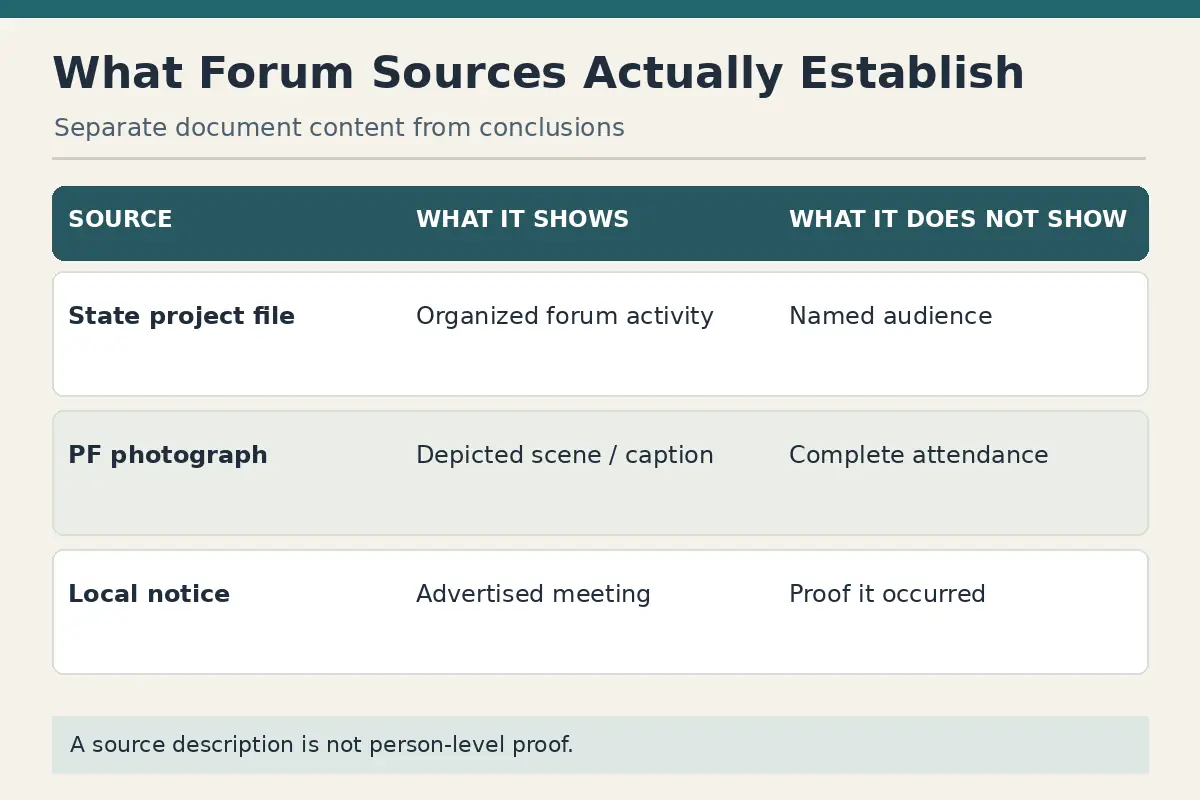
A PF image might show a speaker at a lectern, a discussion circle, a staff group or a publicity scene. Look closely at the caption’s wording and creator before adopting any identification. A caption saying “forum at a school” proves only that the image was labeled in that fashion; it does not establish the names or relationship of listeners. Photographs may have been selected for publicity, which can emphasize representative scenes rather than routine meetings. Record visible clues separately from the caption’s reported facts.
Compare the image with the hall’s architecture, contemporary newspapers and any dated program, but avoid identifying faces by resemblance alone. If an image shows a name on a sign, transcribe it exactly; it may belong to a sponsor or lecturer rather than an attendee. When the print has no date, use the documented archive date range as a search boundary, not as an invented event date. An independent identified portrait or signed program is stronger for linking a person to the scene.
Distinguish Forum Employees From Audience Members
The project also created employment, so the identity question may concern staff rather than the audience. A person described as a discussion leader, clerk or organizer requires different evidence from someone said to have attended a single public forum. Search payroll, appointment, agency correspondence or a dated staff list when available; a publicity article describing a “federal forum” need not record a federal employee. Note the employer and source for any reported job title. A federal funding connection alone is not proof of federal employment.
Suppose a family account names a relative as a moderator. A photograph of the room without a caption naming the moderator cannot confirm that claim. A contemporaneous printed program naming the moderator is stronger but still should be compared with a report of the event, since announced speakers can change. If a state administrative document names a worker, check dates and location. Maintain separate statuses for “named in planning,” “named in report” and “confirmed staff service” instead of flattening them into one biography.
Use Federal and Community Sources Together

A strong reconstruction combines the federal series with a locally independent record. Historical newspapers, municipal event schedules, library programs, school bulletins and surviving civic-group minutes may give finer detail about a particular gathering than the central project files. Use the event date and official organizer to find the appropriate issue or volume. Each source should contribute a distinct fact: the federal file documents a program, the local notice advertises a meeting, and an account published afterward may confirm a gathering took place.
When a local newspaper reports ten attendees but names only the chair, do not create names for the other nine. Conversely, a signed letter describing a person’s role may require comparison with a dated report to determine whether that role was carried out. Coverage gaps are common in local papers and surviving records. Log the titles and dates actually inspected. The absence of a family surname from a publicity photograph cannot prove nonattendance, and an unindexed name may remain in a series file.
Request a Specific Series Rather Than All Forums
For a productive inquiry, state that the subject is the Federal Forum Project in RG 12 §12.5.5, supply the state and approximate year, and explain whether you seek a state project file or a PF still photograph. Ask the current repository how the files are arranged and whether the relevant item is digitized. The NARA guide describes holdings; it does not promise immediate online images for every file. Preserve the original descriptive identifier when you find a candidate record.
If you ask about a photograph, include the photographed location, subject and any PF number or caption if already known. If you need records of local sponsorship, identify the town and probable sponsoring body so reference staff can narrow the search. Do not ask an archivist to establish a person’s attendance solely from a national project description. Request the closest original document, note its creation date and archive reference, and plan a distinct person-level search afterward.
Write a Conclusion With Explicit Limits
A careful finding might read: “State project correspondence documents a Federal Forum Project activity in this locality in 1939; a PF image shows a forum scene described by the archivist as being in that state.” It should not read that a named ancestor attended unless another document identifies the person and connects them to the event. Report how much of the project’s date range and the relevant local newspaper issues were searched. This makes future revision possible without hiding a weak identification.
Keep the final research table with columns for claim, source and missing confirmation. For participation, record name, role, event date, locality and the evidence actually linking them. If those details remain unproved, the article’s method still yields a useful account of local educational history without fictional names. Revisit the question if a later annotated photograph, meeting minutes or personal letter emerges; until then, describe the limit plainly.
More Records and Archives Guides
How We Research This Archival Question
We checked the archival description for RG 12 and its relevant series, then distinguished what the official source explicitly documents from what a researcher might infer. The date spans on this page describe the listed holdings or survey, not a claim of complete digitization or coverage for every locality. We assessed each map, report, directory or inventory at the level of the individual item needed for the research question, rather than treating a series heading as a personal record.
We also compared this route with the relevant repository access guidance and use the National Archives Catalog guidance when a particular file unit or digitized image remains to be located. Evidence limits, alternative explanations and missing dates are named rather than silently filled. Our informational articles contain no confirmed affiliate offer; our affiliate disclosure explains the site policy.
NARA dates the Office of Education project from January 1936 to June 1941.
No complete attendance register is promised; the files document administration and project activity.
It is the Still Picture Branch series of adult and youth forum photographs and publicity, including 1939–1941 material.
A poster advertises a planned event; compare an after-event report, program, or local account.
Look for a dated document naming the person and role, then cross-check the event and locality.