
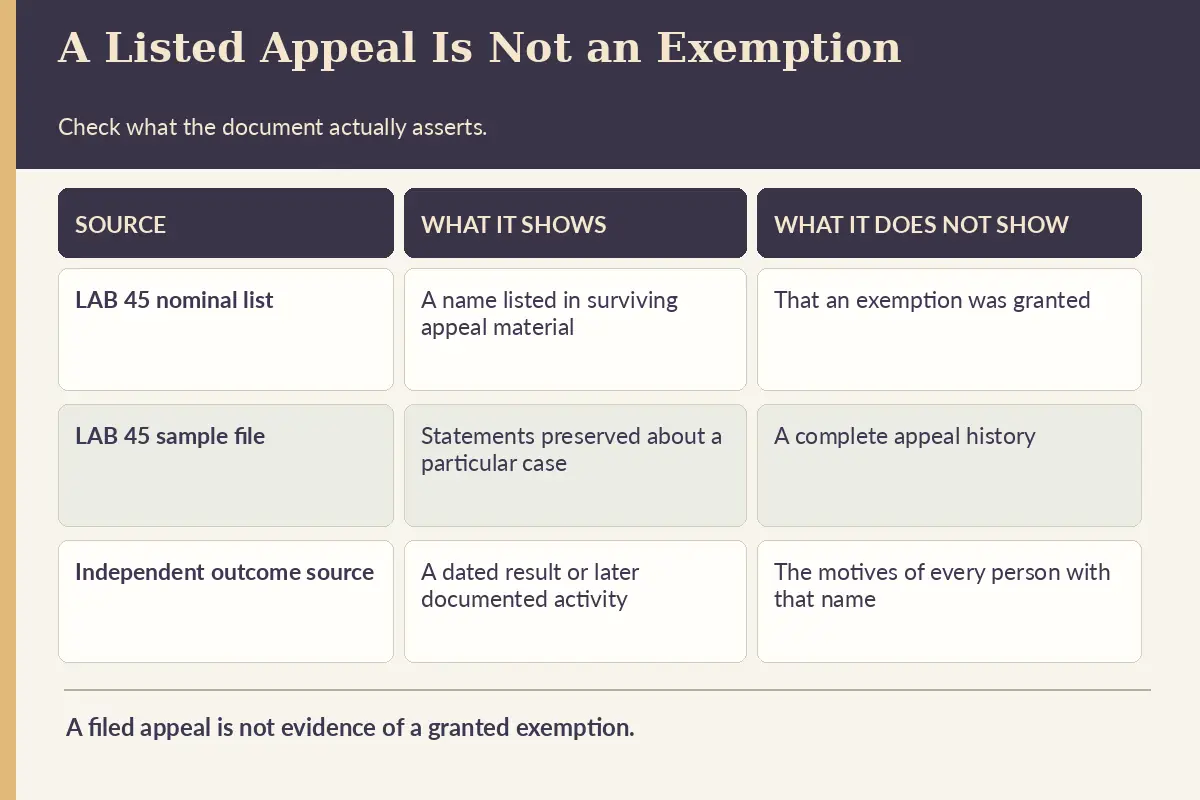
LAB 45 contains sample documents and nominal lists of conscientious-objector appeals from 1939 to 1962, as identified by The National Archives. The lists are arranged by surname, which makes them a useful entry point for family historians. But a name on an appeal list shows participation in a documented administrative process, not automatically that the person received absolute exemption, was imprisoned, or undertook non-combatant service. Those are separate claims that need separate evidence.
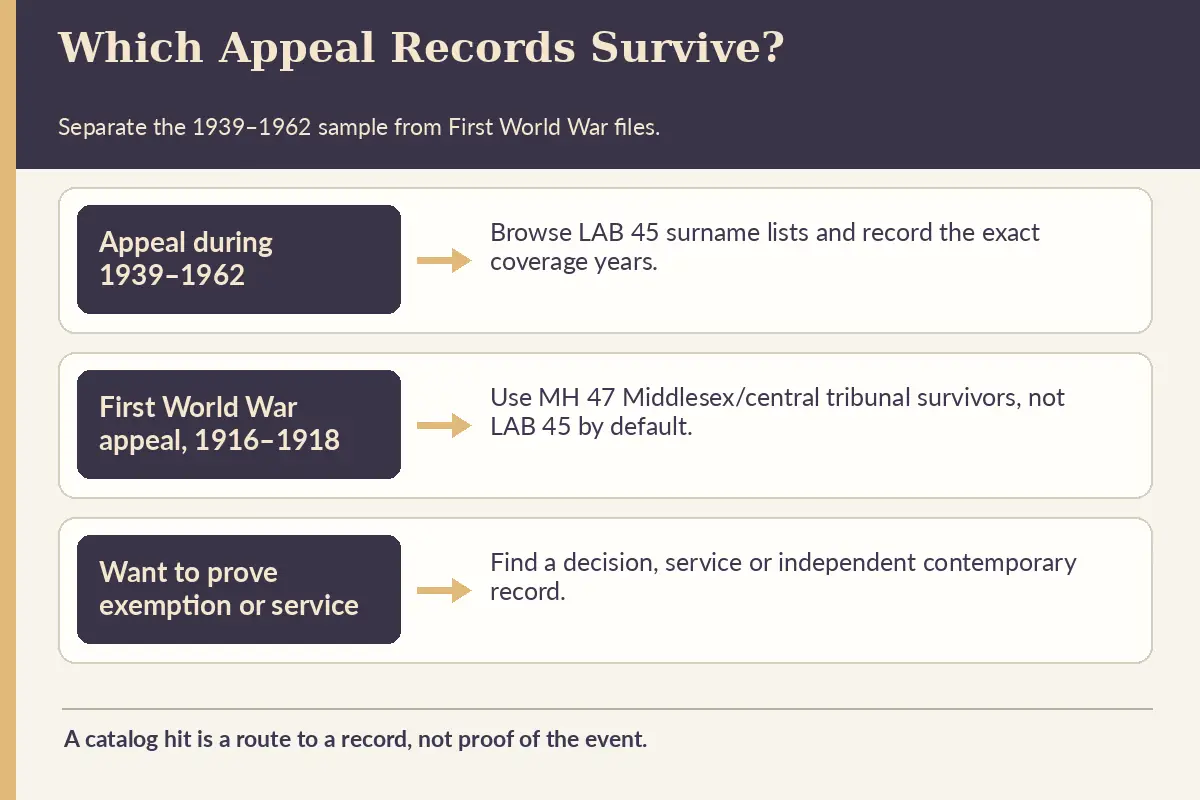
Begin with the correct war and conscription period. The National Archives guide to conscientious objectors explains that surviving material is incomplete, and most First World War exemption case papers were deliberately destroyed under a 1921 decision. LAB 45 concerns later records and should not be presented as a universal replacement for the small First World War survival in MH 47.
Distinguish the application, appeal, and final result
An applicant could ask for recognition of a conscientious objection, receive an initial decision, challenge that decision or be directed toward a particular form of service. The mere word “appeal” does not disclose the result. When a nominal list uses initials, dates or case numbers, transcribe them faithfully and avoid inventing meanings for a mark without a key. A list may be an administrative finding aid rather than a preserved case narrative.
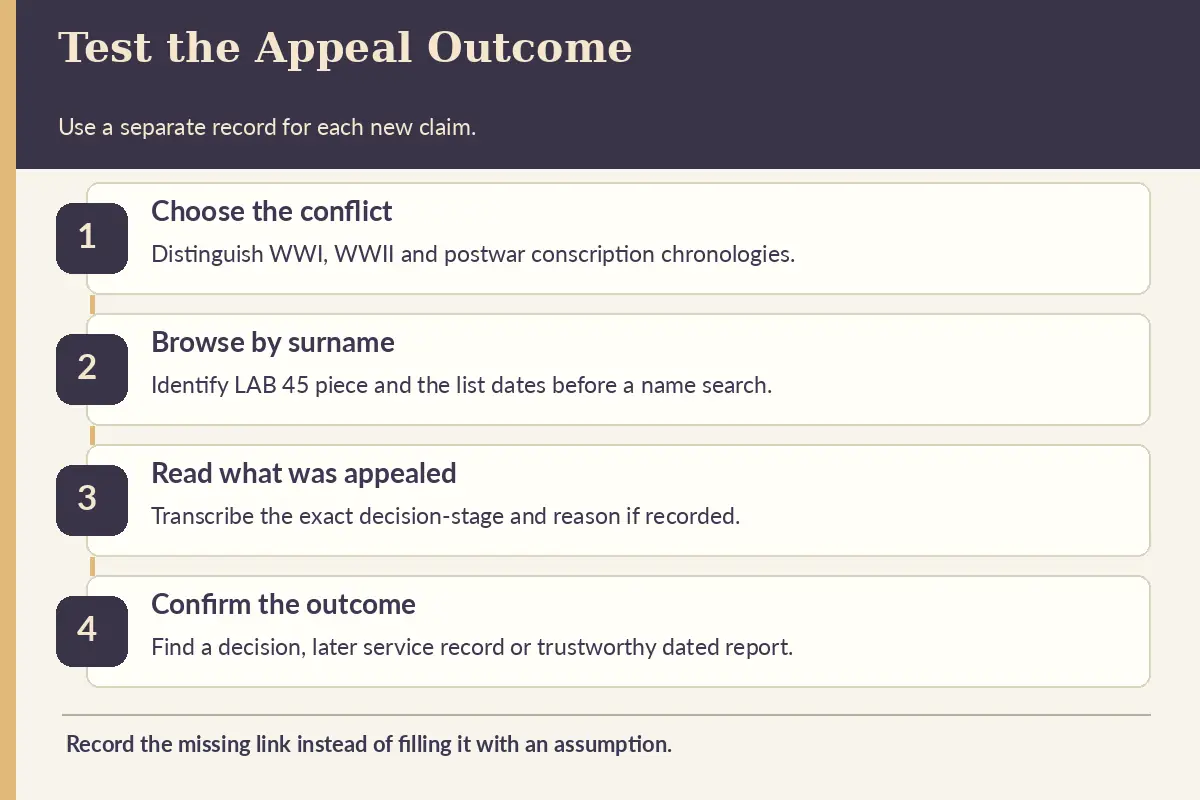
Create a claim-level ledger: a person was listed, the tribunal considered the case, the appeal was allowed or refused, the individual served in a stated capacity, and later life events. Mark which document independently confirms each assertion. A newspaper’s report of a hearing might give a reason or outcome absent from a list, but it may also contain editorial framing. Cross-check the person’s residence, age and employment before joining the sources.
Use surname arrangement without overlooking same-name cases
TNA says nominal LAB 45 lists are arranged by surname. Search a surname’s common variants and look for initials, middle names, addresses or dates that distinguish individuals. It may be necessary to browse the whole piece because the online catalogue might describe the volume rather than every named person. Record the exact year range of the piece: a person’s absence outside that range is not a meaningful negative result.
For common surnames, build a two-candidate table. A “William Clarke” listed in one year may not be the William Clarke of a known household. Associate an entry with a birth year, occupation, town, spouse or other independent identifier where possible. If those details are not preserved, keep the identity uncertain and continue researching. A surname list is a search path, not a ready-made proof of descent.
Know the special gap left by First World War destruction
The National Archives reports that a 1921 Ministry of Health decision destroyed the vast majority of individual First World War exemption case papers and tribunal minutes, except those of the Central Tribunal. For certain Middlesex and central material, MH 47 survives. Those facts explain why a World War I family story cannot be checked using the same coverage assumptions as a LAB 45 World War II or postwar appeal.
Do not project absence in a surviving national sample onto the entire population of objectors. Other repositories may hold local council material, newspapers, personal papers or oral testimony. State the jurisdiction of each alternative source and note whether it reports an allegation, a self-description, a formal objection or a decision. These categories are related but not interchangeable.
Handle sensitive motives without overclaiming
Objection to military service could be grounded in ethical, religious or other stated convictions, but an archive list often does not provide a complete account of the person’s beliefs. Never assign a motive from a surname, organization, assumed religion or subsequent employment. If a surviving statement gives the applicant’s own words, attribute them to that person and preserve the date, tribunal context and any later challenge to the statement.
This is also a family privacy topic when later people may still be living. Use published, legally open evidence, do not expose unnecessary modern personal details and avoid language that treats application as guilt or exemption as dishonor. A clear, dated case summary that separates reported positions from independently established acts is more informative than a dramatic narrative unsupported by the records.
Produce a reproducible finding with unresolved branches
A useful report identifies the precise LAB 45 document reference, image or page, list heading, date span, name as entered and any case number. Add a separate field for whether you have read an original item, a scanned copy or only a transcription. If a relevant outcome appears in a different series, cite that source too. Where there is no surviving decision, describe the appeal as listed and leave the outcome open.
The final paragraph should tell the reader what evidence could change the conclusion: a signed decision, a dated institutional letter, another tribunal register, a contemporary press report or a later service record. No database can compensate for a missing original without making the gap visible. A careful search may end in uncertainty, but it should end with a documented and testable uncertainty.
More Records and Archives Guides
How We Research and Verify These Records
We first review the National Archives research guidance for the collection’s official purpose, record ranges and known omissions. We then review Discovery search methods, which distinguish an indexed name from a piece description and an item actually examined. For a difficult claim we ask what an original document could establish directly and which different source would be needed to prove residence, identity, a decision or subsequent action.
Our diagrams are original editorial explanations, not reproductions of historical manuscripts. Dates are kept as stated by the archival custodian; uncertainty, gaps, and alternative searches are visible rather than hidden. Our affiliate disclosure explains the site policy. None of these archival routes depends on a paid endorsement.
The National Archives describes sample documents and surname-arranged appeal lists from 1939–1962.
No. It identifies an appeal or related record; the decision must be verified separately.
Most individual First World War tribunal papers were destroyed under a 1921 decision; some MH 47 material survives.
They are surname-arranged, but item-level catalogue indexing varies; browsing may be needed.
A dated outcome document or independently created record that confirms the same person and decision.