
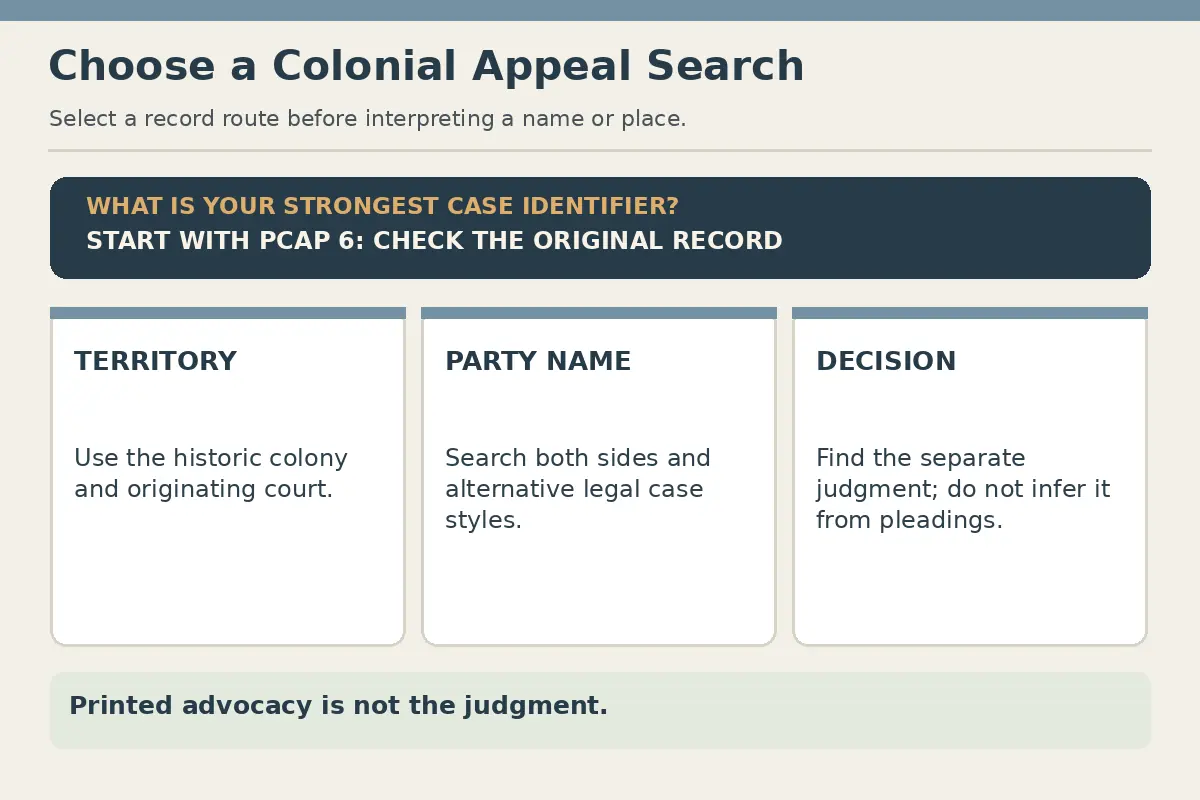
PCAP 6 contains printed appeal papers associated with cases from the British Empire and colonial jurisdictions before the Judicial Committee of the Privy Council. The National Archives specifically identifies the series for colonial appeal research. A printed case is a curated presentation of an argument; it is not automatically a transcript of the final decision. Search by territory, named parties, approximate date and originating court, and distinguish what each side alleged from what judges later ruled.
Locate the Historical Jurisdiction Before the Case
Begin with the territory as it was known when litigation occurred, not only its current country name. A former colony may have had a different political designation and court hierarchy. Note which lower court heard the matter and the approximate date of the appeal. Those details can be more stable search terms than a common family surname.
The National Archives warns that most original colonial court records remained in their local jurisdiction. PCAP 6 is therefore a potential London-side appeal record, not a comprehensive archive of every case filed in that territory. A missing result can simply mean the dispute never reached the Judicial Committee, the index is incomplete or the case is described differently.
Search Printed Appeals by Party and Origin
Create a search table with both litigants, alternate spellings, territorial name, lower court and year range. Published legal history research about PCAP 6 explains that modern catalogue descriptions can be searched by parties, date, originating court and colony as cataloguing has progressed. Search both plaintiff and defendant names, because the order of the parties may change on appeal.
Preserve the full case style exactly as printed. A family name may identify a company, estate, executor, local official or collective litigant, not a single ancestor acting personally. Before entering a name in a family tree, identify what role the party played and whether the same person appears in a dated local document.
Read the Printed Paper as Advocacy
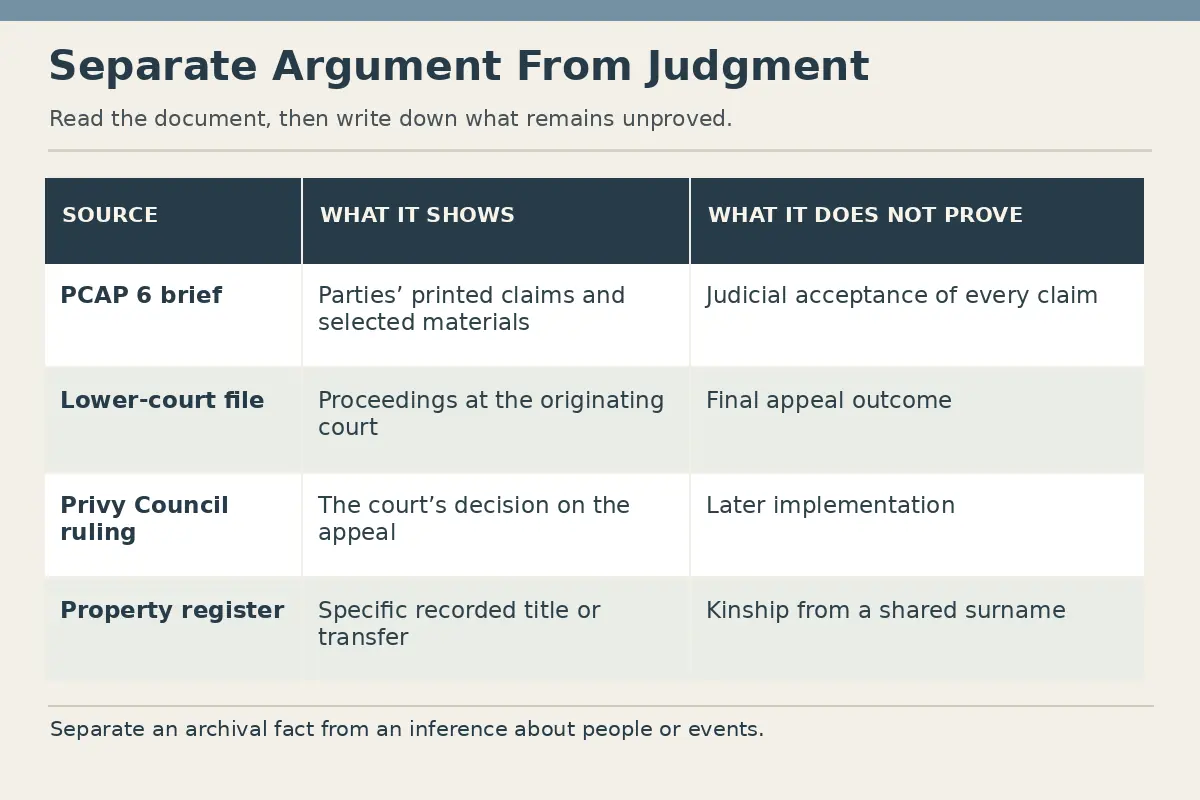
Printed appeal papers may present pleadings, statements of the case, selected exhibits or an explanation of proceedings below. Do not presume a universal bundle structure: inspect the title page, contents and each component in the surviving piece. Highlight which statements were asserted by one side, which facts were expressly admitted and which matters remained disputed.
A petition that says a merchant owned a parcel is evidence that someone advanced an ownership claim. It is not conclusive proof of legal title or actual residence. Similarly, a witness affidavit describes attributed testimony, not necessarily a finding accepted by the court. Cite a quoted claim to the speaker or document, rather than to “the Privy Council” as if the judges adopted it.
Locate the Final Decision Separately
The National Archives points researchers to published or digitized Privy Council decisions, including legal decision databases, while distinguishing PCAP records. A printed set of appeal papers can predate the hearing and may omit the ruling. Search a reliable judgment source by party name, date, jurisdiction and any case citation, and record the court’s actual disposition.
Distinguish an order allowing an appeal, dismissing an appeal, remitting a matter for further proceedings or changing a lower-court order. A case summary may compress the procedural history; verify the wording of the final result before writing that money was paid, land changed hands or an individual won a lawsuit. A judgment does not automatically prove later enforcement.
Compare London Papers With Local Court Holdings
Find the original lawsuit’s local court or archival repository if the question requires testimony, earlier orders or exhibits not reproduced in the appeal set. Colonial case materials often remain in the successor country’s court or archives. The London printed paper may quote or summarize an earlier document, but the summary should not be treated as if the complete original survives in PCAP 6.
Build an evidence bridge with columns for lower-court reference, quoted excerpt, printed-paper page and independently checked judgment. Mark absent documents explicitly. A name appearing as a witness in a selected extract supports a narrow role in the appeal record; it is not a verified family relationship to another litigant.
Test a Fictional Land Dispute Claim
Imagine a printed colonial appeal names “M. Clarke” as an appellant and asserts rights over an estate. The named person could be a trustee, heir, official or company representative. Record the party style, pleadings and reported lower-court outcome separately. Before claiming family ownership, seek the actual conveyance, probate file or local register covering the property and date.
Even if the Judicial Committee later accepted one legal interpretation, it does not prove every genealogical assertion in the pleadings. The example is fictional and illustrates a crucial source distinction: a printed argument, a judicial outcome and a later property transfer are different events needing different documentation.

Record the Citation, Bias and Access Status
Cite PCAP 6 with the exact piece, full case title, originating court, date, and relevant printed page. If consulted through a research project or partial digitization rather than an original volume, name that derivative source too. The published research literature says the collection was transferred to The National Archives in 2019 and has been undergoing improved cataloguing.
Colonial records may reflect legal power imbalances, translation choices and disputes over indigenous or customary law. Describe those perspectives with attribution instead of repeating disputed claims as neutral historical fact. Your conclusion should identify what the printed record actually documents, what the judgment decided and what remains unresolved about the family or place.
More Records and Archives Guides
How We Research Original Records and Verify Each Claim
We began with the relevant National Archives research guide, compared its specific series statements with a second directly relevant source, and kept the document’s administrative purpose separate from later interpretations. Descriptions, indexes, printed extracts and originals can give different levels of evidence. We therefore track custody, original reference, document date, named actor, historical context, conflicts and the next independent verification source. Hypothetical examples above are clearly labeled; they are not purported transcriptions of real cases.
Archive catalogues are living research aids. Individual files may not be digitized, search indexes can be incomplete, and access restrictions may differ by piece. Before claiming that a document has been read, confirm the original image or a clearly identified reproduction rather than relying on a search snippet. We avoid claims about the private circumstances of living people. Our site explains possible commercial relationships at the affiliate disclosure page; citing an archive does not imply sponsorship.
Printed appeal papers for cases before the Judicial Committee of the Privy Council, including colonial appeals.
No. It presents case material and may not contain the final judgment.
Yes. Combine the historical territory name with party, court and date details.
Many remained in the original jurisdiction; consult the relevant local archive.
PCAP 6 piece, case style, origin, date and printed page where available.