
BT 320 is a route to historical merchant engineering qualifications, not a crew list. The National Archives places engineers’ chronological certificate registers in BT 320 for 1913–1935, with the important warning that these records have been in a transfer process from the National Maritime Museum. Start with a named engineer, a date or a certificate number, and preserve a clear distinction between examination, issue, renewal and employment. A qualification record can help identify a person; it does not show where that person served on any day.
Start With an Engineer Rather Than a Ship Name
Prepare the person’s name as reported in a contemporary document. Record initials, variants, approximate birth date, place of birth and any certificate number already mentioned. A surname by itself is an unsafe search key: merchant careers often cross ports, and the same name can appear in several occupational records. Work backward from the most reliable known event instead of attaching the first certificate entry to an ancestor.
Use a two-column identity worksheet, with facts copied directly from an original source on one side and possible matches on the other. Include the date of the source because a person might have held several certificate grades over a career. A later obituary that calls someone a “chief engineer” is a research lead; it cannot retroactively establish the grade printed in an earlier issue register.
Choose the Correct Register and Its Date Range
The National Archives groups chronological registers of certificate issues in several series. BT 317 covers masters and mates; BT 318 extends across masters, mates and engineers; BT 320 focuses on engineers for 1913–1935. These are overlapping record categories, not a mandatory route through three stages. Pick the register based on occupation and the kind of transaction you hope to document.
For BT 320, the official guide explains that the registers are being transferred from National Maritime Museum references RSS/ENG/5–6. Do not promise that every volume is already searchable or downloadable at Kew. Check the live catalogue or contact the named custodian about the particular date range. If the relevant volume is not presently accessible, document the gap rather than claiming the engineer never obtained a certificate.

Transcribe the Issue Entry Without Merging Its Dates
The chronological-register guidance identifies date received, name, examination date, certificate number, grade, destination port and examination port as kinds of details recorded. On the volume in hand, inspect the actual column headings and record only those that appear. The date the register received a paper is not necessarily the examination date; neither automatically fixes the date someone first went to sea.
Keep an exact transcription and a normalized working version separately. Preserve unusual initials, crossed-out entries and marginal annotations rather than replacing them with the spelling in a family tree. A registration number may be a strong link to another certificate source, but a number without its grade and date context is not enough to match people who had similar names.
Use BT 352 to Check the Engineer Candidate
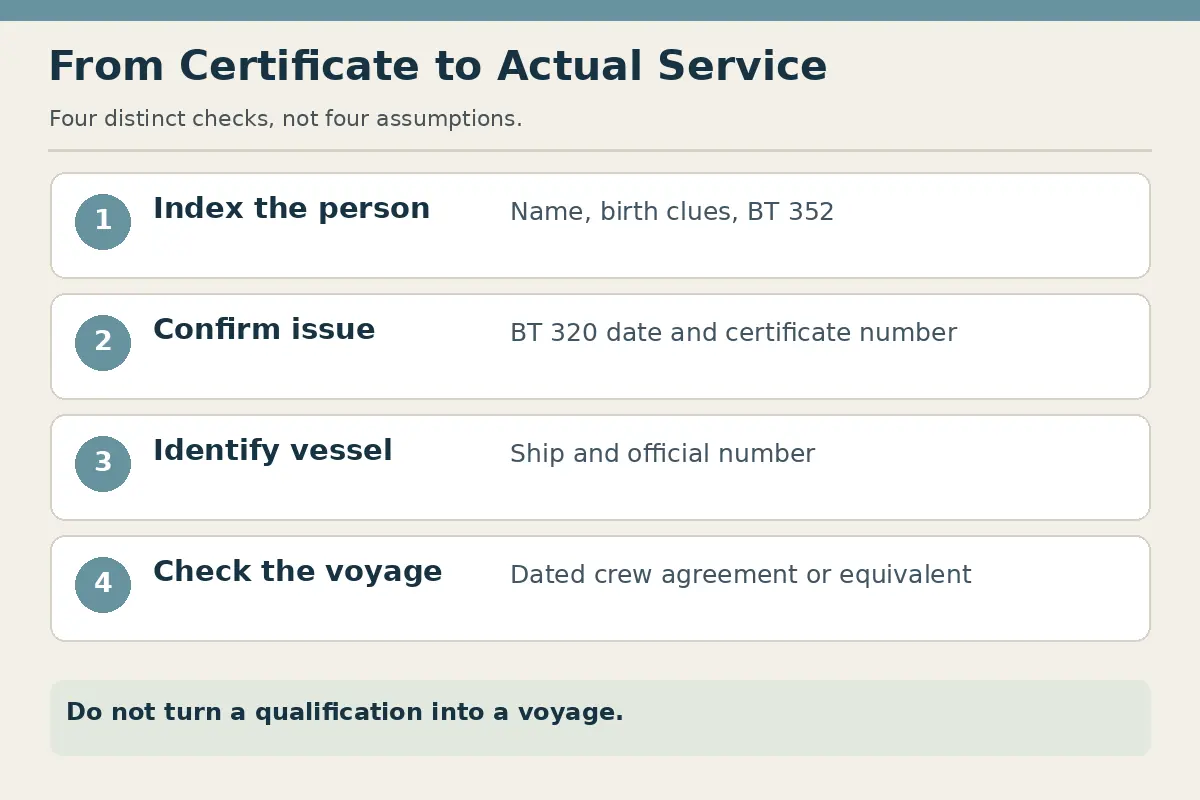
The combined certificate-card index BT 352 covers masters, mates, engineers and fishing officers in 1910–1969. The National Archives describes engineer cards as pink and notes fields including certificate number, examination date, birth details and examination port. This creates an independent lookup route within the certification system when a chronological page is hard to locate.
A card and a chronological register may repeat information from a single administrative transaction, so agreement does not mean two independent eyewitness accounts. Compare them for a consistent full name, grade, certificate number and date. If a card reports a birthplace not present in the register, treat the extra detail as a clue to test against a birth registration or other genuinely separate record.

Separate Qualification, Employment and Voyage
A certificate indicates a recorded professional qualification or related administrative issue. It does not prove the engineer signed a specific crew agreement, boarded a named vessel, sailed its full route or remained employed continuously. Use surviving crew agreements for the particular ship and period before drawing those conclusions. Registry records identify ships; neither a ship registry nor an engineer certificate is a universal employment history.
For a claimed voyage, build three linked propositions: this is the correct certificate holder; this is the correct vessel; this person is documented aboard on the relevant date. Prove each through the record suited to that question. A note in a crew agreement could support the third proposition while a photograph of an engineer beside a ship might only suggest an association.
Test Two Similar Names in a Hypothetical Search
Imagine two engineers named Robert Allen. One appears on a certificate card for an examination at Cardiff, and a second has the same initials on a crew list from another port. The names do not establish identity. Compare certificate number, grade, date and any reliable age or place information. Flag the case as unresolved if the available data do not exclude two people.
If one register line mentions a promotion to a higher grade and a separate voyage list gives an older rating, do not erase the contradiction. It might reflect different reporting dates, terminology, a copying error or separate individuals. Preserve the original wordings and use a dated record chain. The example is invented to demonstrate research logic, not a real claim about a sailor.
Cite the Volume and Record What Remains Missing
A useful citation gives The National Archives, BT 320, the specific piece or inherited museum reference, volume date, page or image, and entry details. If you only consulted the published research guide, cite the guide rather than inventing a folio. Keep a search log for alternative spellings, index cards, dates and unsuccessful enquiries to the custodian.
The conclusion should say precisely what was established: an engineer with specified identifying details had a recorded certificate issue or renewal. Family connections require independent household or vital records, and service at sea requires a suitable crew source. Even a complete certificate search is not a full career reconstruction; the evidence limit is a feature of the record type.
More Records and Archives Guides
How We Research Original Records and Verify Each Claim
We began with the relevant National Archives research guide, compared its specific series statements with a second directly relevant source, and kept the document’s administrative purpose separate from later interpretations. Descriptions, indexes, printed extracts and originals can give different levels of evidence. We therefore track custody, original reference, document date, named actor, historical context, conflicts and the next independent verification source. Hypothetical examples above are clearly labeled; they are not purported transcriptions of real cases.
Archive catalogues are living research aids. Individual files may not be digitized, search indexes can be incomplete, and access restrictions may differ by piece. Before claiming that a document has been read, confirm the original image or a clearly identified reproduction rather than relying on a search snippet. We avoid claims about the private circumstances of living people. Our site explains possible commercial relationships at the affiliate disclosure page; citing an archive does not imply sponsorship.
No. It is a chronological certificate-issue register, not a crew agreement or a vessel log.
Its merchant-officer guide identifies engineers’ registers for 1913–1935 and notes an ongoing transfer process.
BT 352 is the combined 1910–1969 certificate-card index, including engineer cards.
Not automatically. Preserve each date under its printed column heading.
Look for a dated crew agreement or another reliable person-and-vessel record for the period.