
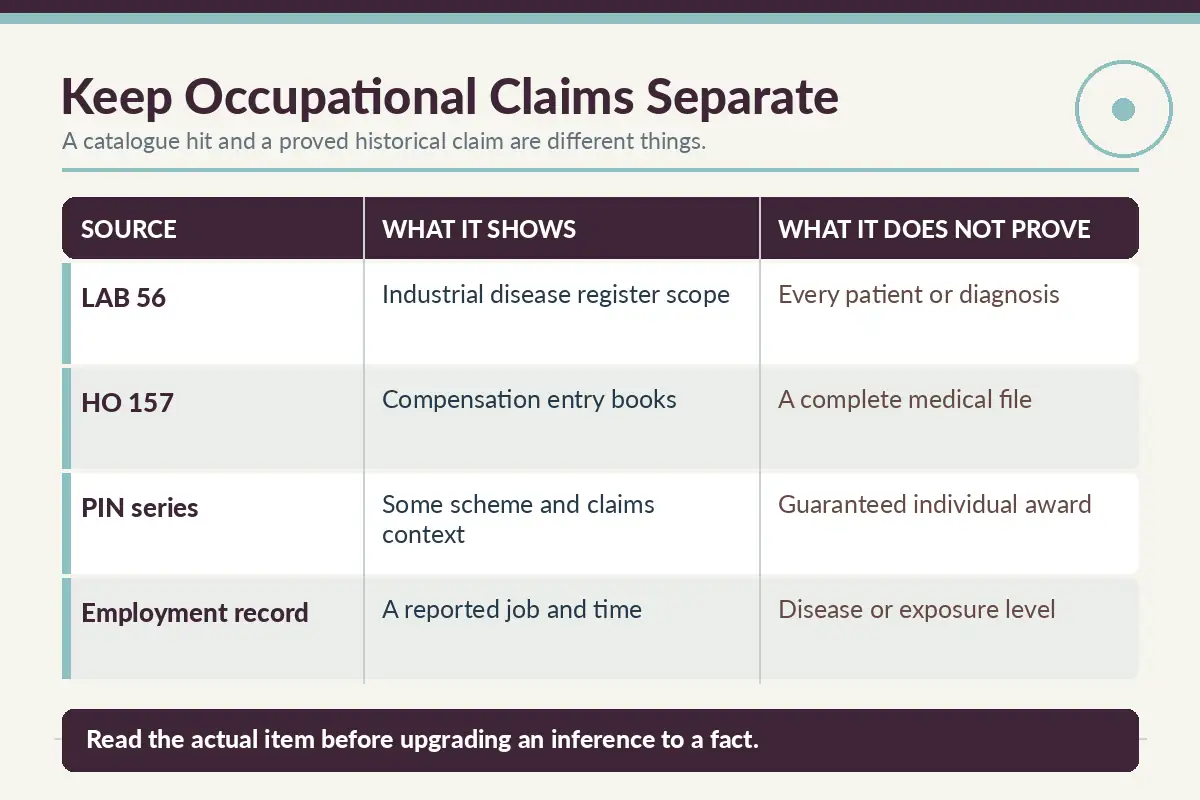
LAB 56 is identified by The National Archives as a series of registers of industrial diseases. It can direct a researcher toward the administrative history of occupational illness, but its title alone does not promise a complete list of named patients, proof of an individual diagnosis or evidence of a successful compensation claim. Start by separating four questions: was a condition recorded by an authority, did a particular person have it, did the person work in an affected occupation, and was any payment awarded?
Separate Disease Reporting From Personal Medical Proof
Industrial disease records exist within administrative systems that changed over time. A register may be organized around categories, notifications, decisions or policy rather than people, depending on the particular volume. Do not write that LAB 56 definitely contains a named miner until the exact document has been consulted. Its presence in the National Archives mining guide confirms it is a relevant research route, not a searchable patient database for every industry and year.
Begin with a plain-language claim and a dated source: for example, a family recollection that a relative “had dust disease” or a local newspaper describing compensation proceedings. Preserve the original words, which may not correspond neatly to a modern medical term. Record the employer, worksite, occupation, dates and the informant. If no specific individual is known, the research objective may be the history of a hazardous trade rather than the medical history of one person.
Be particularly careful with sensitive information. For living or recently deceased people, respect restrictions and consent. Even when a register is open, publication of identifiable medical details should have a legitimate reason. Historical rates or a national policy file can provide useful context without disclosing a family member’s condition or pretending a workplace description establishes causation.

Choose Between Registers, Entry Books and Claims
The National Archives mining guide places LAB 56 alongside related but distinct systems. HO 157 is described as workmen’s compensation entry books. Later compensation and occupational health files appear among PIN 12, PIN 20, PIN 21, PIN 39 and PIN 900. These references answer different questions and may be subject to different survival and access restrictions. A statutory or administrative report about a disease is not the same as a claim submitted by a person.
A report of occupational illness does not necessarily establish a pension or final legal determination. Equally, a payment in a compensation file need not set out the complete clinical reasoning. To reconstruct a specific outcome, look for the decision record, dates, eligibility rules in force and the identity evidence that connects it to the correct person. Separate an employer’s name from proof that a worker was present at a particular location on the relevant date.
Mining records are a useful example of changing government responsibility. The Home Office had a significant oversight role before the twentieth-century ministries responsible for insurance and power took shape. A researcher should not force every case into the newest department. Instead, use the date of the report or award, not merely the date an illness began, to select candidate series. Keep the reporting event and alleged exposure interval on separate lines of the research log.
Inspect the Catalogue Before Guessing Its Fields
Use Discovery to browse LAB 56 by reference and look at its series and piece-level descriptions. Search variations on the disease, industry and geographic term, but recognize that a register can be described only by a title and years. Discovery searches descriptions rather than the full contents of the paper. A failed name search therefore cannot establish that somebody was not recorded. Keep the exact catalogue reference for every item found or ruled out.
When a volume is accessible, transcribe its headings before extracting entries. Note whether it records date received, workplace, authority, condition, decision or simply totals—only if those fields actually appear. Avoid imposing modern columns on a historic form. If the source uses abbreviations or ambiguous diagnoses, quote the original wording and write the interpretation separately. A series-level title does not justify assigning unobserved fields to every piece.
Check the holding archive and access conditions. An item may be undigitized, closed or available only by visiting Kew or ordering a copy. A catalogue description can be relied on to identify a collection but not to assert a person-level detail. The most useful negative search note records the volumes and date ranges physically checked, plus what parts of the name or workplace could not be read.

Corroborate Work, Illness and Compensation Separately
To test employment, seek dated wage records, trade-union material, a company register, census occupations or local industrial records. A census entry saying “collier” shows a reported occupation at that moment, not specific exposure or chronic illness. To test a medical diagnosis, look for a direct medical or administrative document that explicitly states the condition; later death information may be a clue, but the informant and cause fields still require interpretation.
For a compensation claim, locate the relevant administrative process and its final outcome when possible. A newspaper may report an application or appeal but never print a decision. A later benefit record may describe entitlement without explaining an earlier workplace. These are complementary sources rather than a tidy linear chain. The family narrative should say “reported,” “claimed,” “awarded,” or “diagnosed” only when the underlying evidence supports that specific verb.
Imagine a hypothetical worker whose 1930s occupational entry is followed by a later family statement about lung illness. The occupational entry and anecdote can guide a LAB 56 investigation, but they do not prove that the condition was formally recorded or medically attributed to work. Maintain a claim ledger listing exactly which document supports each assertion, where the gap remains and what type of record could resolve it.
More Records and Archives Guides
How We Research Occupational Disease Evidence
Our source selection begins with the National Archives mines and mining guide, which names LAB 56 and distinguishes other compensation and accident files. The Discovery scope guide explains why an archival name search misses unindexed content; result guidance clarifies record hierarchy, custody and access.
This article offers a framework for historical research, not a medical assessment or a representation that a particular patient register contains fields we have not inspected. All example identities are invented and no diagnosis is inferred from an occupation. Our affiliate disclosure explains editorial relationships.
The National Archives identifies LAB 56 as registers of industrial diseases; check the individual piece for actual content.
No. It is not documented as a universal name index, and many catalogue descriptions do not index people inside records.
No. Look for a separate award, decision or final case outcome.
The mining guide describes HO 157 as workmen’s compensation entry books and LAB 56 as industrial disease registers.
No. Work history and medical evidence are separate questions requiring separate support.