
Start With a Narrow Employment Question
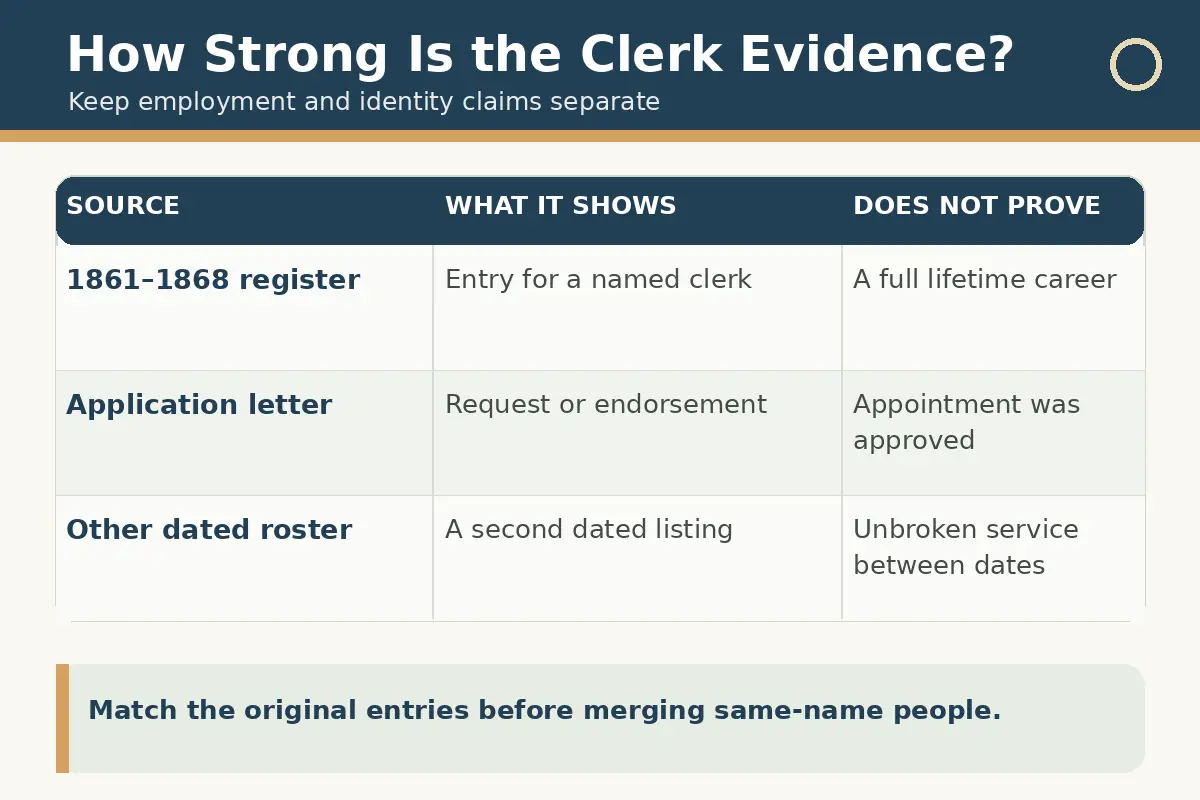
The National Archives lists a register of female clerks for 1861–1868 in Record Group 56, section 56.3.2. For family historians this is a promising administrative lead, not a ready-made biography. A person’s presence on a register can document the wording of a particular entry after the original page is examined, but cannot automatically establish hiring date, length of service, household, marriage, or a lifetime occupation. Begin with a woman’s documented name and one independently estimated year.
Ask exactly what needs proving: a federal appointment, an appearance in a contemporary employee list, a temporary assignment, or continuity of employment across several years. Those are separate questions. A family account that calls someone a “clerk in Washington” may refer to a different department, a contractor, or unofficial work. Keep the department attribution provisional until a contemporary source identifies the Treasury office, and do not use the word “career” merely because the name appears once.
Use the 1861–1868 Window as a Finding Rule
Section 56.3.2 names registers of male clerks, 1835–1890, and female clerks, 1861–1868. These are described as different historical record sets, not as evidence that the department employed no women after 1868. The end year is the span of this particular register. A claim about a woman in 1875 requires a different source path, even if an earlier page might describe the same person. Distinguish the record’s dates from the person’s dates.
The same NARA section describes lists of Treasury Department employees, 1853–1916, and biographies of Treasury employees, 1835–1912. A list may be a useful cross-check if its scope includes the relevant office and year. The guide does not promise that either series supplies a complete roster or that every woman received a biography. Request the arrangement and actual pages before assigning a missing name any historical meaning. A search outside the correct volume is not a negative result.

Separate Register Entries From Applications
The Division of Appointments records in section 56.3.1 include letters of application and recommendation, 1830–1910. An application shows an attempt to obtain consideration; a recommendation expresses someone’s support. Neither proves the office accepted an applicant. When a woman appears in both a letter and a register, compare spelling, dates, office designations, and any addresses actually present. Do not assume a similarly named applicant is the same clerk without an identity bridge.
Other correspondence includes letters about personnel matters and records of people singled out as notable employees. These are alternatives driven by the research question, not required checkpoints for every employee. A subject file might preserve an unusual event while ordinary employment went unrecorded in that file. Conversely, a favorable recommendation can be preserved even when no appointment occurred. Copy the wording of the letter, the recipient, and the archival reference before interpreting its significance.
Transcribe the Page Without Supplying Missing Fields
When a likely register volume is located, record the exact heading and page reference before recording a name. Copy whatever columns the page actually contains, preserving abbreviations, cross-outs, added dates, and unexpected ordering. The federal guide does not set out a standard field list for these volumes, so it would be unsafe to promise that a line includes age, salary, birthplace, department section, or next of kin. Read nearby entries to learn whether the arrangement is chronological or alphabetical.
Make two notes for any ambiguous mark: a literal transcription and a separate interpretation. A faint initial could become decisive only when supported by a second document. Do not silently expand an initial into the first name supplied by a family tree. A late annotation can reflect an administrative correction rather than the original appointment date. If only a typed index is available, retain its citation, but label it as an index until the underlying register has been inspected.
Test Identity Through Independent Records
A name in Washington is seldom unique. Build a candidate table including spelling variants, approximate birth date if known, residence, relatives, and a documented chronology. For 1861–1868, compare independent census households, city directories, letters, or other contemporary records as available. A directory entry for “Miss A. Brown” near a Treasury office is a clue, not a secure match. The person’s name, time, and context must converge; do not use one ambiguous entry to corroborate another.
For an alleged decade-long career, find at least two separately dated employment records and examine the interval between them. A list in 1863 and another in 1870 need not prove uninterrupted service. Similarly, an application in 1862 and a later newspaper tribute cannot fill an otherwise undocumented term. Build a claim ladder: application, appointment or roster, later service, and family identity. State which rungs are directly supported and which remain unverified.
Find the Correct Series and Ask a Reproducible Question
Start with the RG 56 guide, sections 56.3.1–56.3.3. Search the National Archives Catalog for “female clerks,” “Division of Appointments,” and a known surname only after determining the appropriate series. A group-level description is not a person-level search index. Absence of a digitized page does not demonstrate the volume is missing or that a clerk never served.
In a reference request, provide the specific series term, date range, candidate spellings, and reason you suspect Treasury employment. Ask for entry arrangement, registers or indexes, surviving volumes, physical custody, and reproduction options. Avoid asserting the precise page until it has been found. Cite the final entry with record group, series, volume, page, repository, and a dated image or transcript identifier. Preserve your unsuccessful searches as scoped actions, not verdicts about the woman’s life.

More Records and Archives Guides
How We Research Women in Federal Offices
We begin with the distinct RG 56 series as actually described by NARA, and keep an administrative listing separate from an application and from independent proof of identity. The register’s 1861–1868 span, the 1830–1910 application letters, and the later personnel-action registers are not a single uninterrupted dossier. Their different dates and purposes determine how a research claim can be worded. Follow a document’s creating office before interpreting a family recollection.
We preserve exact transcriptions, competing same-name candidates, and negative searches with narrow scopes. The affiliate disclosure explains editorial relationships; this method does not require a paid archive service. When two contemporary sources disagree on a name or date, report the discrepancy rather than rewriting either one. The defensible result is a specific statement about a specific record, followed by the next evidence needed.
A legible original entry may support a particular administrative listing, but its exact wording, date, and context determine the claim. It does not automatically establish every period of employment.
That is the date span NARA gives for this described record set. It is not proof that no women worked for Treasury in other years.
No. A recommendation is evidence of an endorsement. Look for an appointment, roster, pay record, or another dated administrative action.
Preserve every historically documented spelling, and connect them through independent family or civil sources before equating two Treasury entries.
The group-level finding aid does not promise full digitization or an index for every name. Ask about series arrangement and surviving volumes.