
CUST 4 comprises ledgers of imports spanning 1809–1899, listed by The National Archives among its digital microfilm records. The ledgers group data by exporting country and record quantities, official values and gross duties for imported commodities. They are most useful for reconstructing commercial patterns, not for proving that a named relative owned a particular shipment. The archive’s digital microfilm guide describes the series as statistical material organized by country.
Begin With Country, Commodity and Year
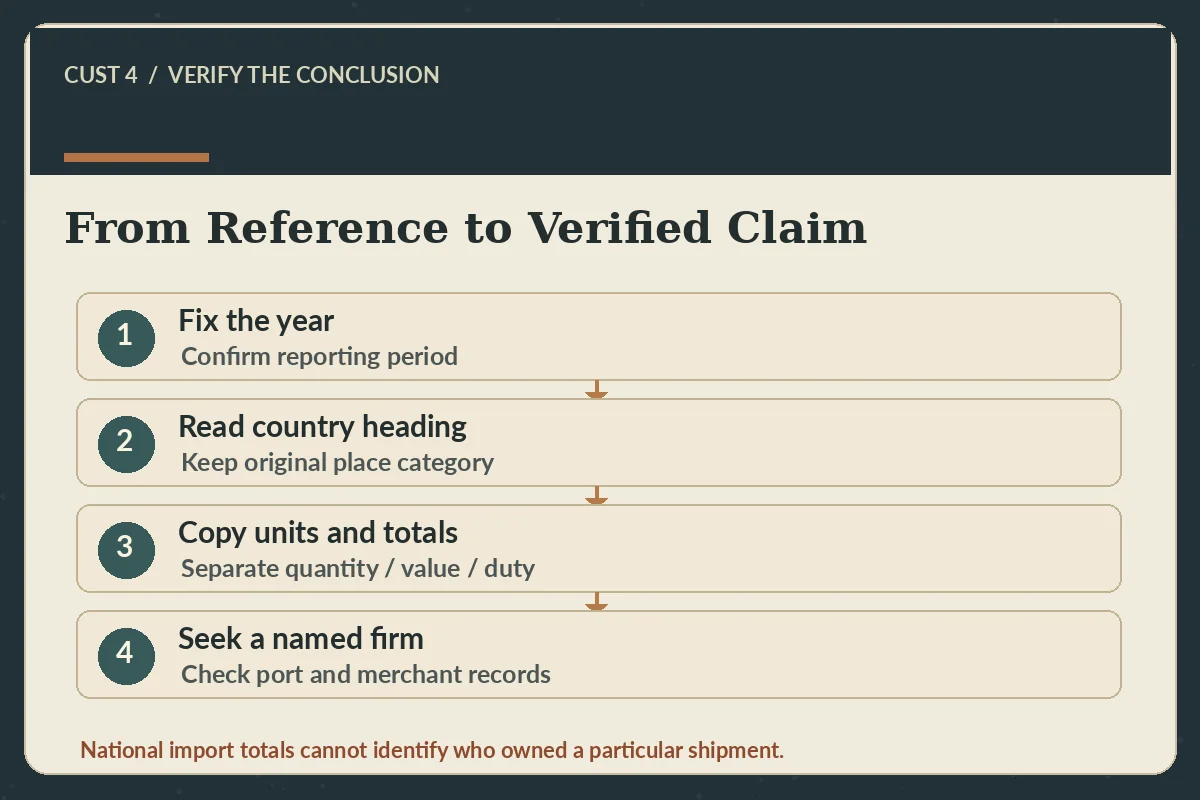
Choose the import year, exporting country and commodity before opening a ledger. A national customs series does not necessarily offer an alphabetical search for individual merchants. Countries may appear under contemporary political names or groupings, and commodity labels may use terms now unfamiliar. Write down the original heading before interpreting it in modern language. A later nation-state name should not be substituted for an earlier customs category without explanation.
Check whether a table represents the calendar year, financial year or another reporting interval shown in the ledger. The existence of an 1809–1899 series span does not prove that every commodity is consistently reported for each year. If the unit of measurement changes, note it. A quantity expressed in pounds cannot be compared directly with another line expressed in packages without independent conversion information.
Identify Quantity, Value and Duty Columns
The National Archives describes CUST 4 as recording quantities, official values and gross duties. Those fields measure different things. An official value is a customs statistical measure and should not automatically be read as an actual sale price or a household’s expenditure. Gross duties also cannot be equated with net government receipts after reliefs or accounting adjustments unless the ledger and related accounts explicitly support that calculation.
Make a transcription sheet with the printed year, exporting country, commodity, unit, quantity, official value, duty heading and page reference. Preserve the original currency notation and thousands separators. If a column is blank or illegible, mark it as such instead of treating it as zero. Do not compare percentages across years until you have confirmed that the column headings and valuation basis remain comparable.

Keep Exporting Country Separate From Port Arrival
A country-of-export grouping may not prove where the goods were produced, which ship carried them, where they first entered Britain or who bought them. Re-export and intermediate trading networks can complicate a simple origin story. Where the ledger uses a broad colonial label, preserve the contemporary term with context rather than inventing a precise modern production address.
If a family history mentions goods from a particular port, CUST 4 can show trade context but may not name that port or merchant. Use port books, customs correspondence, bills of lading, merchant ledgers or vessel records for more granular evidence where such sources survive. Make a clear distinction between a national total for a commodity and a specific shipment. An intriguing coincidence is not a proven personal transaction.
Compare Import and Export Series Without Confusion
The same official digital microfilm guide lists CUST 10 as ledgers of exports of foreign and colonial merchandise under destination countries, and CUST 17 as earlier statistical tables of navigation and commerce. Those series answer different questions. A ledger of goods imported into Britain should not be chained mechanically to an export ledger as if it documented the physical movement of the same consignment.
Select the comparison based on the claim: imports from a country belong in CUST 4, re-exports by destination in CUST 10, and earlier statistical series may offer historical background where date ranges allow. Keep imports and re-exports as separate columns. An apparent fall in imports from one country might reflect reclassification or reporting practice; do not announce a trade collapse without checking contemporaneous definitions and broader context.

Use Trade Tables for Family Research Carefully
Suppose a family firm was said to import timber in the 1850s. CUST 4 can show whether timber from a claimed source country appeared in the national ledgers that year, and whether its reported volume changed. It cannot establish that the firm imported it, owned the vessel or handled a particular parcel. Begin an individual merchant search in directories, firm archives and port-specific records instead.
If a deed or probate inventory mentions imported cloth or sugar, use CUST 4 to describe the wider trading environment without inventing a supply chain for that household. Quote the exact category and ledger year. When quantities do not match the story, consider that the commercial name for a good could differ from a customs heading. Disagreement is a reason to revise the search terms, not to discard the primary source.
Preserve Reproducible Numerical Citations
A useful evidence table includes the archive reference, volume or image identifier if available, page or folio, heading and copied number. Preserve original units and avoid silently rounding historic figures. If you calculate a year-on-year change, show the two exact source values and label the result as your calculation, not a number printed in the ledger.
When historical prices or currencies are involved, do not inflate official values into contemporary money without stating the method and its limitations. A monetary series may represent valuation conventions rather than observed transactions. Photograph or transcribe the heading alongside the numbers so readers can check that the values were not taken from a neighboring commodity or country group.
State What Statistical Survival Cannot Prove
Digital microfilm makes a government ledger accessible, but it does not transform aggregate data into evidence about named people. A missing entry may reflect a category definition or the way the book is organized rather than the absence of trade. A badly scanned page must be checked against a clearer copy where possible before claiming a zero or precise value.
Report conclusions proportionately: ‘The ledger records imports in this category from this exporting country for this year’ is defensible. ‘My ancestor imported this quantity’ needs a merchant-level source. Cite the original series and the exact figures you used, with open questions about origin, route, ownership and final buyer left visible. This protects historical trade research from seductive but unsupported personal claims.
More Records and Archives Guides
How We Research Sources and Boundaries of Proof
Our research method starts with the official subject guide and compares it with a second archival source. We record the holding archive, series, piece, document date, compiler and whether the document itself was inspected. A catalogue description is a lead, never a substitute for reading the original. We distinguish an administrative statement from a later event and a plausible interpretation from independent confirmation. Not every person, date or place can be proved from a surviving record; damaged, missing or unindexed items are noted explicitly. For information about our commercial relationships, review the affiliate disclosure.
No. Its principal purpose is statistical import reporting by country and commodity.
The National Archives lists ledgers of imports for 1809–1899.
Not necessarily; it is a reported statistical value requiring careful interpretation.
No. Trading routes and intermediate exports may complicate provenance.
Seek merchant, port, shipping or business records naming the firm and transaction.