
LS 8 records creditors of the Lord Steward’s Royal Household, including amounts owed to suppliers. The archives describe subgroups extending from 1641 to 1854. An entry can document an administrative obligation or account without proving that a bill was paid or that a similarly named tradesman is an ancestor.
Determine the trade and date first. For an early creditor seek LS 8/1–98; for many later household, food, fuel and incidental creditors examine the LS 8/100–270 range; for 1815–1854 quarterly palace accounts consult LS 8/271–314 where applicable. The archives identify LS 8 creditors from 1641 to 1854, with important subseries in 1641–1760, 1761–1815 and 1815–1854; coverage depends on the particular category and institution.
Work backward from the supplier and expense category
Royal Household finance records are rich in trades and goods but are not simply lists of salaried servants. Begin with the likely occupation, town, time period and type of item supplied. A baker, coal merchant, stationer or laundress can appear in accounts under different spending headings. Search for the administrative department and the relevant date before equating a name with the person sought.
The National Archives places LS 8 under the Lord Steward’s department. The general creditor range LS 8/1–98 covers 1641–1760, but later lists are divided by purpose and by palace. Keep those divisions visible in the search plan; a result in one expense category does not prove absence from another.
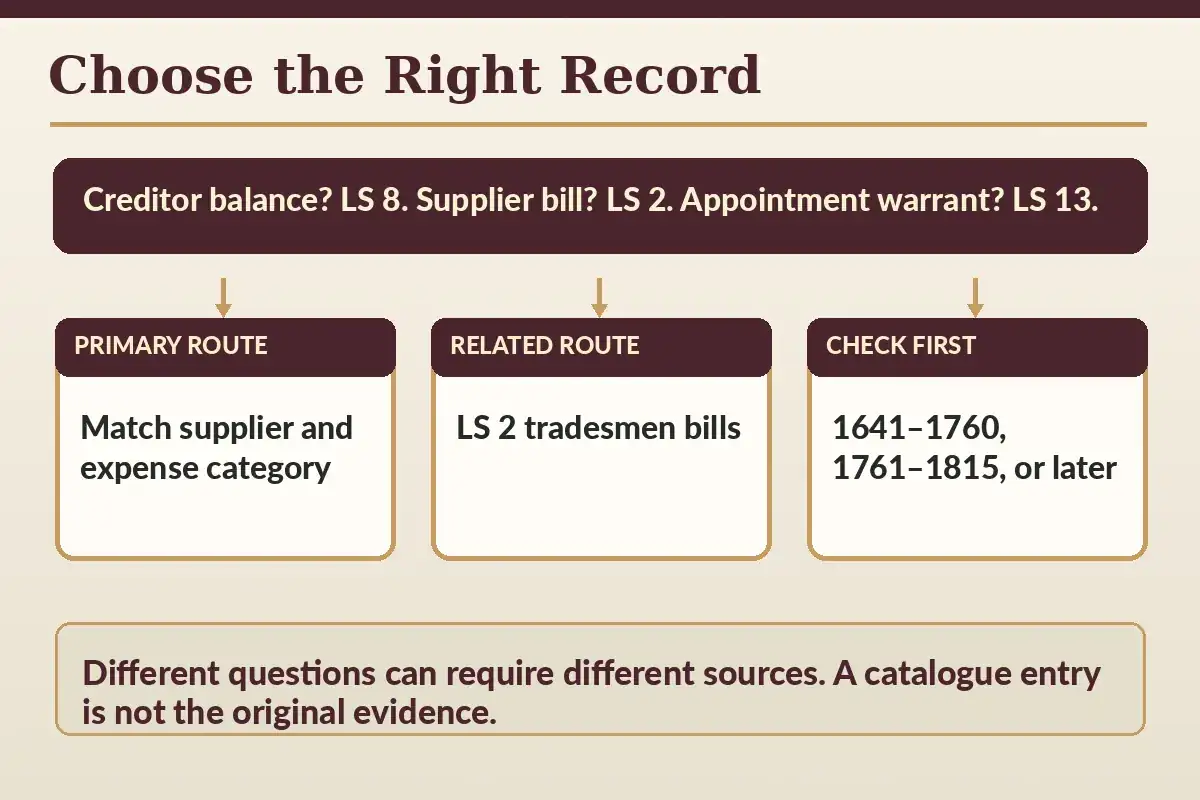
Read the changing LS 8 record groupings
For many 1761–1815 household supplies, the archive cites LS 8/100–270 and distinguishes kitchen, general household and incidental creditors. It also identifies quarterly accounts arranged by palace in LS 8/271–314 for 1815–1854. These ranges are not a universal index of every trade; the catalogue description of the actual volume is essential.
Date labels also matter. A ledger can record an accounting period rather than the moment a loaf, candle or wagon was delivered. Preserve that distinction in a transaction table. When the supplier is named but the trade is not, use the expense heading and other records as clues rather than inventing the trade from context.
Distinguish money owed from money received
The word creditor signals an obligation recorded against the Household, not necessarily a completed payment. A sum carried forward, a claim submitted and a receipt can represent different stages of a financial process. Avoid translating every figure as cash paid to the person named. Note the column heading, currency, date and any marginal marks.
If the original identifies a supplier and an amount, that can support a narrow statement: the administration recorded an obligation in connection with that named supplier. To claim a payment, find a discharge, receipt, settled account or other evidence that explicitly documents the transfer. Distinguish an authorized warrant from a confirmed transaction.
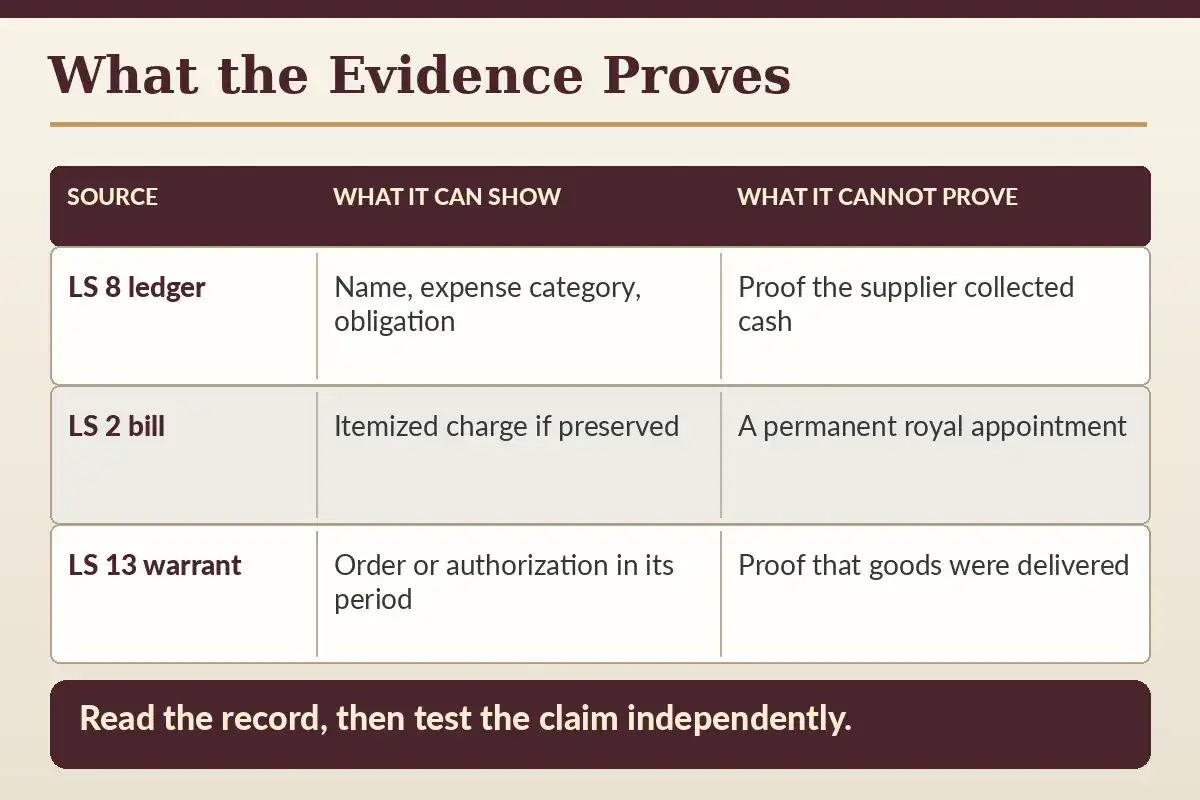
Compare ledger entries with bills and warrants
The archive places tradesmen’s bills in LS 2, with related warrants and orders in parts of LS 13. Use these only when the original account’s date and purpose indicate a plausible link; they are not the next compulsory pages in a single run of records. A bill may show goods in more detail while a warrant may show authority.
Build a reference concordance listing the payee, trade, value, palace, date and source. If two records disagree on spelling or sum, show the difference rather than silently merging them. Different accounting documents may summarize or correct the same business without being duplicates.
Separate a royal contractor from a household employee
A person supplying goods was not automatically a servant on the Royal Household establishment. Check whether the document calls that person a creditor, appointed officer, wage recipient, contractor or merchant. The National Archives distinguishes those kinds of staff and supplier material in different record streams.
For genealogy, compare an LS 8 entry with parish, trade, civic or probate sources that identify the same person in the right period. A common surname and a fashionable trade will rarely be enough. Document a plausible match as provisional until two independent identity anchors support it.

Keep a record of the administrative limits
A finished supplier history should distinguish the recorded amount, the expense purpose, the administration responsible and the unresolved questions about payment and identity. Provide the exact LS 8 piece reference and note whether the entry was viewed directly or located through a catalogue or index.
If a bill or receipt is missing, explain what you attempted to locate and the dates searched. A carefully bounded claim about the royal household’s suppliers is still meaningful evidence of commercial activity even if no personal employment or family connection has been demonstrated.
Build an archive-ready research worksheet
Make a worksheet with columns for the research question, record creator, date covered, original reference, verbatim role or transaction, date of the alleged event, and independent confirmation. Begin with this subject-specific gate: Supplier/creditor account: LS 8; underlying bill: potentially LS 2; purveyor warrant or order: consider relevant LS 13 entries, only if the date and function match. In the first positive entry, record what the document actually establishes. Do not replace uncertainty with a stronger event or identity claim just because the finding aid has an attractive title.
Put LS 8 creditors and LS 2 tradesmen bills on separate lines when comparing sources. The first may show supplier, category and sums recorded as owed, but it does not itself establish automatic proof of receipt of money. If the research requires a firm conclusion, seek a dated receipt, warrant or independent business record. Log negative searches by reference, years and access method; a catalogue search is not a complete examination of undigitized records.
More House and Local History Guides
How We Research and Verify the Evidence
We checked the official National Archives research guidance on 2026-11-03. TNA enumerates LS 8 creditor groupings with ranges and dates and distinguishes bills in LS 2 and warrants in LS 13. The guidance establishes the series route; it does not independently verify an unnamed ancestor or a specific undocumented case.
We checked the official National Archives research guidance on 2026-11-03. TNA places LS 8 within Lord Steward departmental accounts and provides context for related staff and suppliers. The guidance establishes the series route; it does not independently verify an unnamed ancestor or a specific undocumented case.
The practical method in this guide distinguishes archive descriptions, original records and independent confirmation. We do not claim that online Discovery searches inspect every word of undigitized documents. For transparency, read the GenHis affiliate disclosure; our source evaluations do not imply a commercial relationship with an archive or record provider.
No. The ledger may show a debt or account; look for a specific discharge or receipt before claiming payment.
LS 8 includes creditor/account material, while LS 2 contains surviving tradesmen’s bills.
The archive identifies creditors for 1641–1760 in LS 8/1–98, with later groupings arranged differently.
No. A tradesman or contractor can supply goods without holding a staff appointment.
Only after comparing dates, locality, trade and independent biographical records rather than relying on a matching surname.