
WORK 36 is the Office of Works and successor departments’ series of ceremonial plans and drawings, spanning 1685–1936. It can help explain how officials imagined the route, platform, decoration or seating of a state occasion, but a drawing does not establish that the design was approved or used. To research one ceremony, begin with its precise date and venue, identify a document within WORK 36, then seek an independent event-day account before describing what people actually saw.
Identify the Ceremony Before Selecting a Drawing
Begin by defining the occasion as narrowly as possible: coronation, funeral, thanksgiving, state procession or other event, with the date and the specific room, square, street or building. The series covers a long period during which ceremonial practice and the built environment changed radically. A design made for one reign is not a generic picture of how the same location looked in the next. Keep the event date distinct from the date written on a plan and from a later archive cataloging date.
The National Archives architectural-drawings guide identifies WORK 36 as the series for Office of Works ceremonial plans and drawings dated 1685–1936. It does not promise that every occasion has a surviving complete set. Search its catalog using the location and occasion together, then use narrower names for a platform, canopy, route, entrance or seating arrangement. Record the entire reference down to the piece level and read the catalog description before ordering a document.
Ceremonial drawings can belong to a broader administrative process rather than to the final stage. A neat plan may have been prepared for consultation; an annotated copy may record an alteration; a clean drawing may be a later presentation version. List what the paper actually says about author, scale, venue, event and revision. If none of these appears, write “undated or unassigned plan associated with” instead of supplying an attractive but unproved date.

Read the Drafting Conventions Without Overclaiming
A ground plan can show walls, doors, partitions, seating blocks, temporary galleries or the intended direction of movement. An elevation shows a facade or a ceremonial structure from one view. A section can reveal levels that a plan hides. These are different kinds of evidence: a dotted line might denote a proposed feature, an earlier state or a measurement guide. Find a legend, key or accompanying explanation before turning any line style into a historical fact.
Look for revision dates, initials, canceled notes and pasted corrections. A sheet may contain more than one design state. Transcribe short labels exactly and capture each change as a separate observation: “east entrance shown on this revision” is defensible; “the monarch entered through the east entrance” needs a separate witness. Do not infer the number of real spectators from drawn seat outlines unless the plan explicitly specifies a capacity and the built arrangement is corroborated.
If a plan contains a proposed decorative arch, stand or temporary bridge, test whether it was actually erected. Contemporary photographs may exist for later ceremonies; printed programs, official notices, expenditure records and newspapers can help with earlier ones. Treat an image as evidence for what its camera or artist depicts, not automatically as a record of the full route. Different sources may capture rehearsals, dismantling or preparatory work rather than the ceremony.
Compare the Designed Venue With a Real Timeline
Make a four-column ledger for design date, stated approval, construction or installation, and the event itself. A blank entry is an unresolved question, not a negative finding. A design signed two weeks before an event could have been modified again. Conversely, a drawing published decades later might accurately copy an earlier scheme, but its publication date cannot be substituted for a contemporary event date. Track both the source date and the event being represented.
An independent site plan or building history is helpful when a historic location has been altered. The Office of Works maintained other series for royal palaces, public buildings and parks, and The National Archives notes that no single set normally captures every stage of a building project. Use associated series only when a catalog description connects them to the actual venue. Distinguish a surviving permanent wall from a temporary structure depicted for one occasion.
Write the result as a bounded claim. For example, “a ceremonial plan in WORK 36 proposes an enclosed standing area south of the hall” is a plan observation. “A newspaper account describes an enclosed standing area on the day” is a second, independent observation. Only after reviewing both can you discuss consistency. If they disagree, preserve the disagreement; it may identify a revision rather than an erroneous source.
Avoid Inventing Attendees or Official Decisions
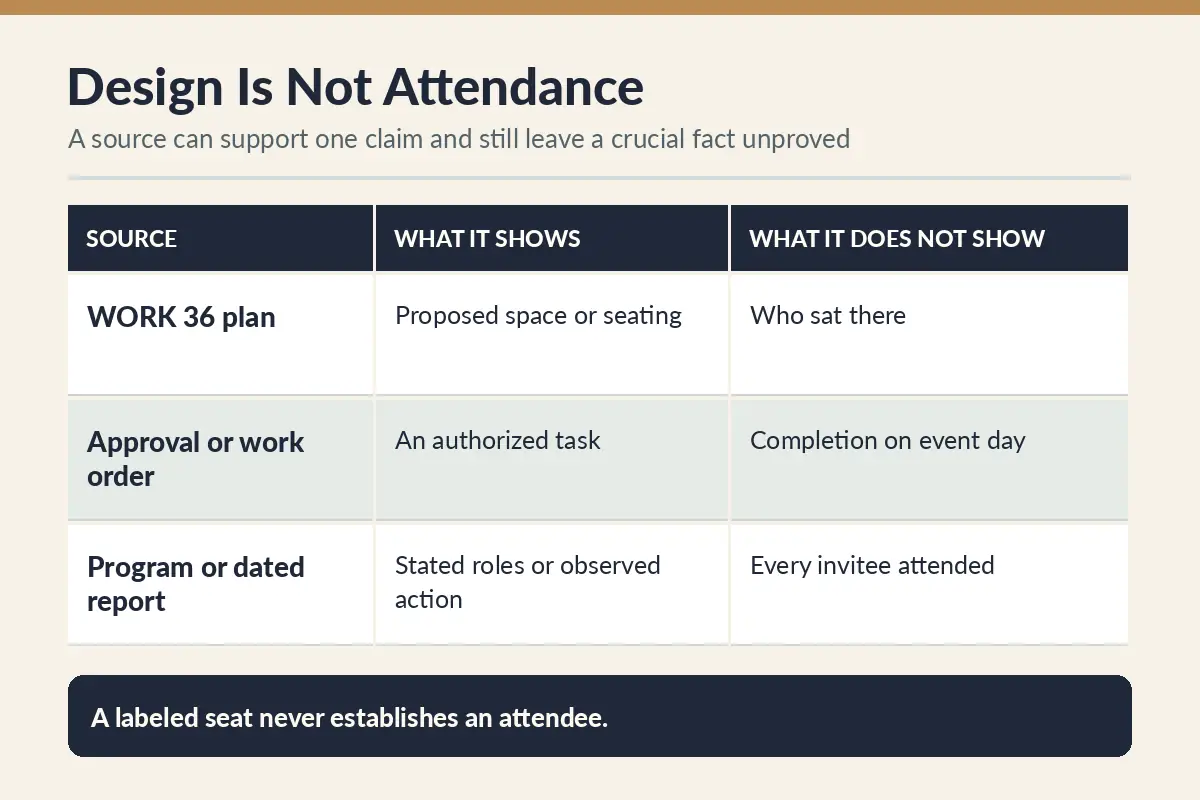
Plans of seating and procession order often name roles such as attendant, guard, herald or ambassador. A role label does not identify which person filled it, and a drawn position does not prove anyone occupied it. To name an individual, find the date-specific invitation, staffing roll, diary, correspondence or attendance register. Even then, distinguish a person invited from a person recorded as present. Use the period’s title for an official only after confirming their tenure.
Similarly, the survival of a plan with a department stamp does not itself prove that the scheme was authorized. Search for dated approvals, work orders, payment accounts and written instructions. The archive may preserve several alternatives in the same collection because administrators reviewed or rejected them. A proposed plan can be valuable even if never used: it reveals expectations and choices, provided the article does not translate intention into completion.
When a drawing is cataloged under a broad label such as “ceremonial,” keep the original description separate from your interpretation. Note uncertain geographic labels, particularly where streets or buildings were renamed. It can be useful to overlay the documented structures on a dated historic map, but do not make an exact modern geolocation claim without scales, control points and a defensible fit.

Build a Citation That Another Reader Can Retrace
Keep the creator, record series WORK 36, specific piece, image or page, physical title and date together in your citation. If you are working from a catalog entry only, cite that as a catalog description and say that the original drawing has not yet been examined. The National Archives explains that Discovery searches descriptions, not the full words inside most documents, so a negative name search means little. Search the occurrence and place first.
Where a copy is obtained, retain the whole drawing, title block and scale instead of publishing only a cropped decorative detail. Record uncertainty in handwriting or dimensions, and do not claim an exact color or material from a monochrome reproduction. Permissions and reproduction conditions may vary; use your own schematic transcription for a worksheet rather than presenting an invented facsimile as an archival original.
A useful final research note states three things: which arrangement WORK 36 demonstrates was contemplated, what independent record confirms or contradicts use of the arrangement, and which person or event claim remains unproved. That separation makes the story more credible than the phrase “the plans show what happened,” which blurs the most important distinction in ceremonial history.
More House and Local History Guides
How We Research This Record Series
We checked The National Archives’ official subject guide for the series name, stated range and record type, and its Discovery research guidance for catalog-search and access limits on November 8, 2026. Our process separates the catalog’s claim, the content of a particular original and any inference requiring another source. We have not treated a suggested example as proof that a named person, ship or building can be found in a given piece.
For every cited item, our audit stores the full reference, the precise wording used by the source, the date of the underlying event and the date the document was produced. We record the scope of missing or unexamined material and compare competing interpretations. Our affiliate disclosure explains editorial and commercial relationships; the links in this guide are informational, not evidence of an affiliate partnership.
Not by itself. It documents a design or arrangement; dated construction, expenditure, event accounts or images are needed to establish what was installed.
A seating role or numbered place is not proof that a named person attended. Check event-specific official lists and independent attendance evidence.
No. It describes the broad series span, not complete coverage. Verify the specific event and surviving piece in Discovery.
Record the undated status and use contextual comparisons to propose a range. Do not quietly replace a probable date with a definite one.
Use the exact Discovery reference and its viewing options. Many drawings require a visit to Kew or a copy order.