
An aviation accident can appear in a newspaper, unit diary, family letter and government inquiry with different levels of detail. The National Archives names AVIA 5 as a series of accident reports involving some civil as well as military aircraft and recommends searches by aircraft and crash location. That is a more dependable starting point than a surname-only search when the research question concerns the accident itself. Not every accident has a surviving report, and no catalogue description should be mistaken for the complete findings. See the official research guide for the archive series and its purpose.
For family historians, the critical distinction is between an event, an inquiry and a conclusion about cause. A squadron log might report that an aircraft was lost, whereas a technical report may review weather or mechanical evidence. A later newspaper story might emphasize one explanation without presenting the evidence that the investigators considered.
Fix the aircraft and incident before searching a surname
Gather the exact incident date, the place name used at the time, the aircraft type and any registration, military serial or unit number documented independently. Record alternate spellings for the location; aerodrome names and county boundaries may have changed. Search Discovery for AVIA 5 alongside the aircraft and/or place. If the family story gives only a year, test a tightly defined range rather than attaching the first crash report for that aircraft model to the ancestor.
When a catalogue entry appears promising, capture its full description and reference. Check whether the accident date is the event date or the date a later enquiry was opened. This matters when comparing a press report printed the next day with a government file assembled months later. A file that mentions the aircraft may concern a related investigation rather than the accident you seek.

Know when AIR 27, AIR 28 or AIR 81 is relevant
The National Archives distinguishes RAF squadron operations record books in AIR 27 from station books in AIR 28. These can record crashes or failure to return, sometimes in only a few words. Their function is to report unit events, not necessarily to reconstruct mechanical causes. Avoid treating a brief operational notice as a final accident finding. Search by unit number if a verified squadron or station is known.
For wartime casualty enquiries from 1939–1945, the guide also points to AIR 81. Its subject is not identical to AVIA 5, and some files are absent or may have access limitations. Follow whichever documentary route matches the actual question: accident circumstances, unit movements or named casualties. Where two files describe the same event, compare dates, named aircraft and the wording of the findings before combining them.

Read findings without inventing certainty
An accident report may contain witness testimony, technical observations, chronology and recommendations. Label each assertion accordingly. ‘A witness stated’ is not the same as ‘the inquiry established’; a recommendation for procedural changes is not proof that the suggested condition caused the accident. If a summary gives no cause, record the uncertainty rather than substituting a popular explanation or a modern guess.
Check if the surviving file represents a draft, an interim note or a final report. A mechanical fault mentioned early may be tested and rejected later. Conversely, a conclusion may be qualified because a wreck was not recovered or a witness was unavailable. A faithful genealogy narrative should preserve those evidential limits even when a confident cause would make a tidier family story.
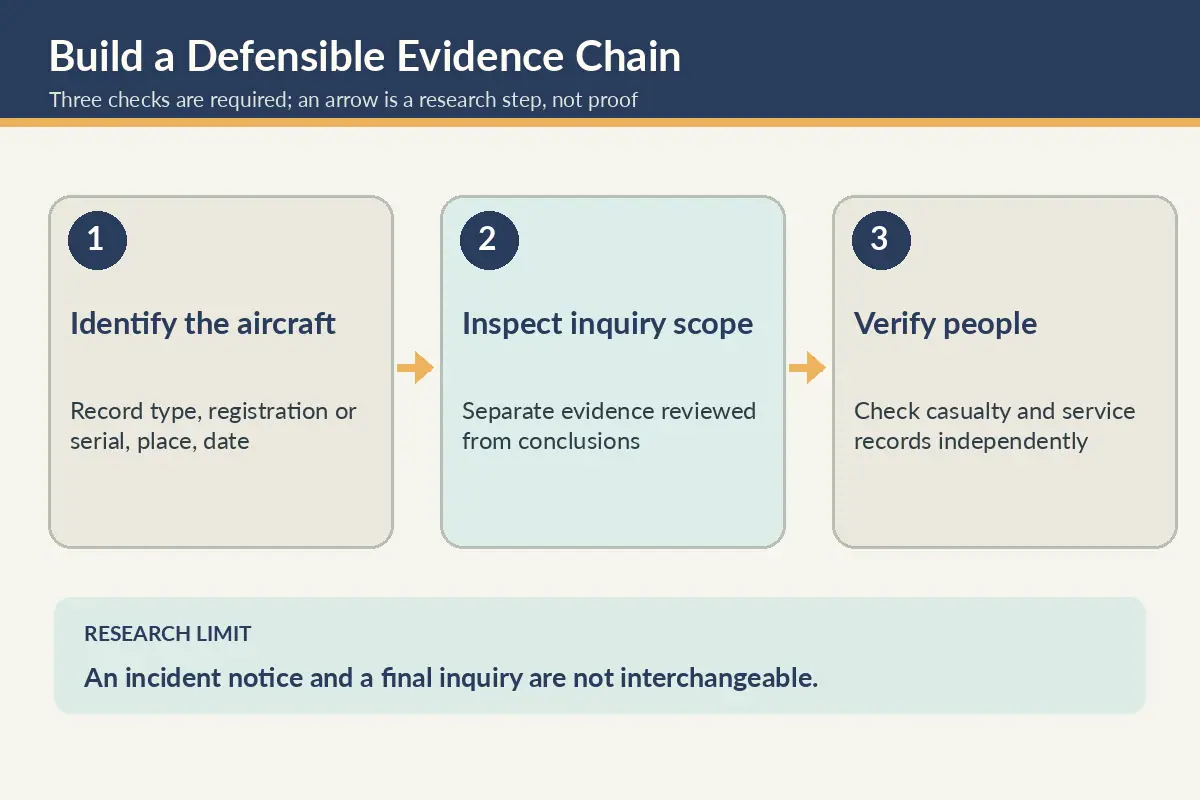
Verify every named individual outside the crash file
A crew name in a report can be compared against service records, casualty notices, contemporary addresses and memorial records, with due regard for privacy. The same surname in an aerodrome community proves little. Record rank, full initials, role, service number where available and the exact aircraft association. Do not count an unnamed person in a photograph as an identified crew member simply because the image appears near the file.
Use a three-column chronology: the flight and accident, the enquiry and publication, and the individual’s separately documented life. Note which statements came from a first-hand report and which from later recollection. A missing AVIA 5 result may reflect cataloguing or survival rather than demonstrate that the incident never occurred. State the unsuccessful search terms for a later researcher to repeat.
Test the story against what investigators could know
Weather, witness position, wreck condition and aircraft identification influence what a report could reasonably establish. If the evidence is partial, a modern retelling should not claim a definite technical failure. A line in a family memoir may still be meaningful, but identify it as recollection rather than official conclusion. Compare the sequence of the accident, early reporting, later enquiry and any revised findings without merging their dates.
For a location-specific search, use both the modern and contemporary place designation, but save the query that produced each record. Aviation records may be held by different departments, and the catalogued ‘held by’ field matters. If an AIR unit diary and an AVIA file conflict, compare their authorship and access to information instead of picking the more vivid wording.
More Records and Archives Guides
How We Research and Verify This Evidence
We begin with the relevant guide from The National Archives to confirm the purpose and limitations of the record series. We then use Discovery to identify the actual series, piece descriptions and holding institution. We record the historical spelling, archive reference and date of each statement; our diagrams are explanatory reconstructions, not facsimiles of archival documents. A catalogue summary is not presented as a transcription of a complete original.
When no item survives, the honest conclusion is that a documented search has not located evidence within the series examined. We do not infer that the person never served, the event never happened or the asserted relationship is necessarily false. For editorial and affiliate policies, read our affiliate disclosure. The research process described here does not depend on a paid partner or a promised download.
No. The guide describes some civil and military accident reports; coverage is not universal.
Start with aircraft and crash location, adding a verified date or unit when possible.
Not necessarily. It is primarily a squadron operational record.
No. Separate recommendations, testimony and the inquiry’s qualified conclusions.
Try related unit and casualty series and document the limits of survival.