
SP 5 includes miscellaneous Tudor state papers relating to the dissolution of monasteries and the General Surveyors, described by The National Archives as spanning 1517–1560. Some relevant correspondence concerns visitations or the Oath of Supremacy. Such material can reveal what royal officials asked, reported or alleged during a period of coercive religious change. It does not mean that every named monk committed an offense, that an entire community consented to surrender, or that a particular lay family later acquired the land.
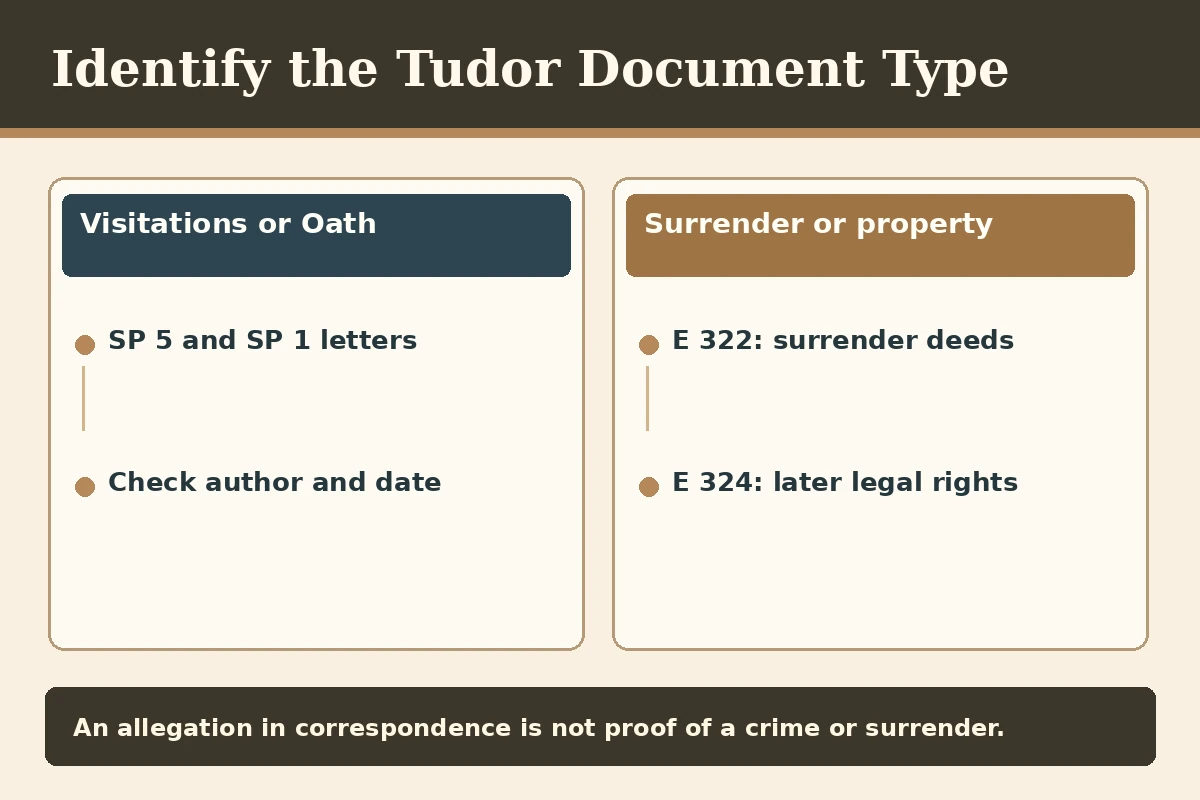
The safest route is to identify the kind of surviving document before writing a biographical conclusion. Correspondence in SP 5 and SP 1, a visitation report, a formal surrender in E 322 and later legal title evidence are separate stages with different writers and purposes. A calendared summary may make a complex political allegation look simpler than the original wording. Treat the date, author, recipient and documentary function as essential evidence, not background decoration.
Find the report in its political and archival setting
Search The National Archives’ Henry VIII state-paper guide alongside its dissolution guide before selecting a record. SP 5 is a miscellaneous series, not a uniform register of monks arranged by surname. Start with the religious house, county, approximate year and known royal official or commissioner. The published Letters and Papers of Henry VIII can identify a relevant calendared item, but the catalogue reference to an original may require a separate lookup.
The National Archives notes that British History Online includes calendars that sometimes summarize a document and sometimes provide near-complete transcripts. It warns that the British History Online calendared presentation does not give the original document reference. Accordingly, capture the calendar citation as a finding aid, then use the relevant archive catalogue or edition to establish the precise SP 5 piece. Do not cite a calendar reference as though it were an inspected parchment.
The record’s role determines the claim. A correspondent warning that an abbey resisted a commissioner is evidence that the writer made that report. It need not prove what the community actually did. Check if the author was an investigator, royal official, interested petitioner or later compiler. Several people with the same monastic name may appear across different houses; preserve the institution and office when recording a person.
Separate an alleged offense from a finding
The 1536 Compendium Compertorum reported alleged offenses identified during scrutiny of monasteries; The National Archives locates it in SP 1/102, folios 91–114. That reference should not be silently relabeled SP 5. If a SP 5 letter mentions accusations or describes supposed behavior, preserve the author’s words and the fact that the account belongs to the reforming government’s administrative process. Allegations, even when officially repeated, do not automatically constitute independently verified guilt.
The Oath of Supremacy also generated correspondence. A named religious person’s presence in an oath-related record may indicate a request, interrogation or administrative report; it is not by itself proof of voluntary consent or an executed surrender. Read for a signature, date, official recipient and recorded response, and distinguish a quotation from the clerk’s summary. If the item survives only as a calendar abstract, make the limitation prominent.
Resist sensational storytelling. The dissolution affected communities with different local circumstances, economic interests and political pressures. A single critical statement may be partisan, indirect or incomplete. Where a later history repeats a Tudor accusation without citing the actual record, it cannot be treated as independent corroboration. Prefer narrow language such as “the report alleged” and describe the archival basis clearly.

Trace a surrender or land transfer only with its own source
Formal surrenders of religious houses are separately identified in E 322. If a letter announces that a house will be surrendered, test whether the relevant formal act survives rather than treating the announcement as an executed legal instrument. Record its parties, seals or signatures if visible, and the date as written. A surrender document describes a legal act, but it does not provide a roll of every person who later occupied the buildings.
Later land documents answer different questions. The National Archives identifies E 324 as records ratifying new owners’ rights to former monastic properties, while other fiscal and legal series cover grants, accounts and disputes. A SP 5 reference to a property, steward or commissioner does not give that person a freehold title. To support family-property research, match the same estate description in a grant, lease or account and keep later changes separate.
Pay attention to place names. A religious house might have dependent lands in other counties, and a commissioner may mention several institutions in one letter. Do not automatically attach all place names to the main monastery or all named laypeople to one household. Keep a table of person, role, institution, date, property, document creator and whether the record contains direct testimony, reported opinion or legal action.
Create a source trail that others can audit
For each SP 5 item note the original archival piece if established, calendared reference, writer and recipient, documentary purpose, precise date and key claim. Quote only a short decisive phrase in a published family note. If you inspected the calendar but not the original, state that explicitly; abbreviated summaries may omit uncertainty, reservations or context.
A missing letter does not prove a visitation never occurred. SP 5 is miscellaneous and surviving documents are distributed among SP 1 and other governmental series. A negative search must specify the name variants, houses, years and indexes tried. Do not impose one modern spelling of an abbey or monk’s name on sixteenth-century records and then infer silence from an empty digital result.
Finish with three statements rather than one dramatic conclusion: what an official reported, what a surviving legal act shows, and what later independent evidence says about the people and property. If only the first survives, publish only the first. This preserves the value of SP 5 as a source for Tudor administration while resisting the temptation to turn accusations into certainties.

More Records and Archives Guides
How We Research SP 5 Records
We use The National Archives’ Henry VIII letters and papers guide for SP 5, original-versus-calendar cautions and related manuscripts, and its dissolution guide for SP 1/102, visitations and E 322 surrenders.
We keep reported allegations, actual legal acts and later possession in separate evidence columns. Our affiliate disclosure explains editorial transparency, without implying endorsement of a paid research platform.
A miscellaneous Tudor State Papers series relating to the dissolution and General Surveyors, covering 1517–1560.
No. It proves an allegation was recorded; independent verification is a separate question.
The National Archives identifies SP 1/102, folios 91–114, for the 1536 reported findings.
Not automatically. Formal surrender deeds are a separate research route in E 322.
Treat it as a finding aid and label its level of transcription; trace the original where possible.