
CAB 24 is the key series for memoranda circulated to the British War Cabinet and Cabinet between 1915 and 1939. It can tell you which question a minister or department brought forward, what options were put on paper and when that paper circulated. It does not by itself tell you that Cabinet accepted the recommendation. The National Archives distinguishes these memoranda from CAB 23, where the formal minutes and conclusions for 1916–1939 are held. Treat that distinction as the starting point, not a footnote.
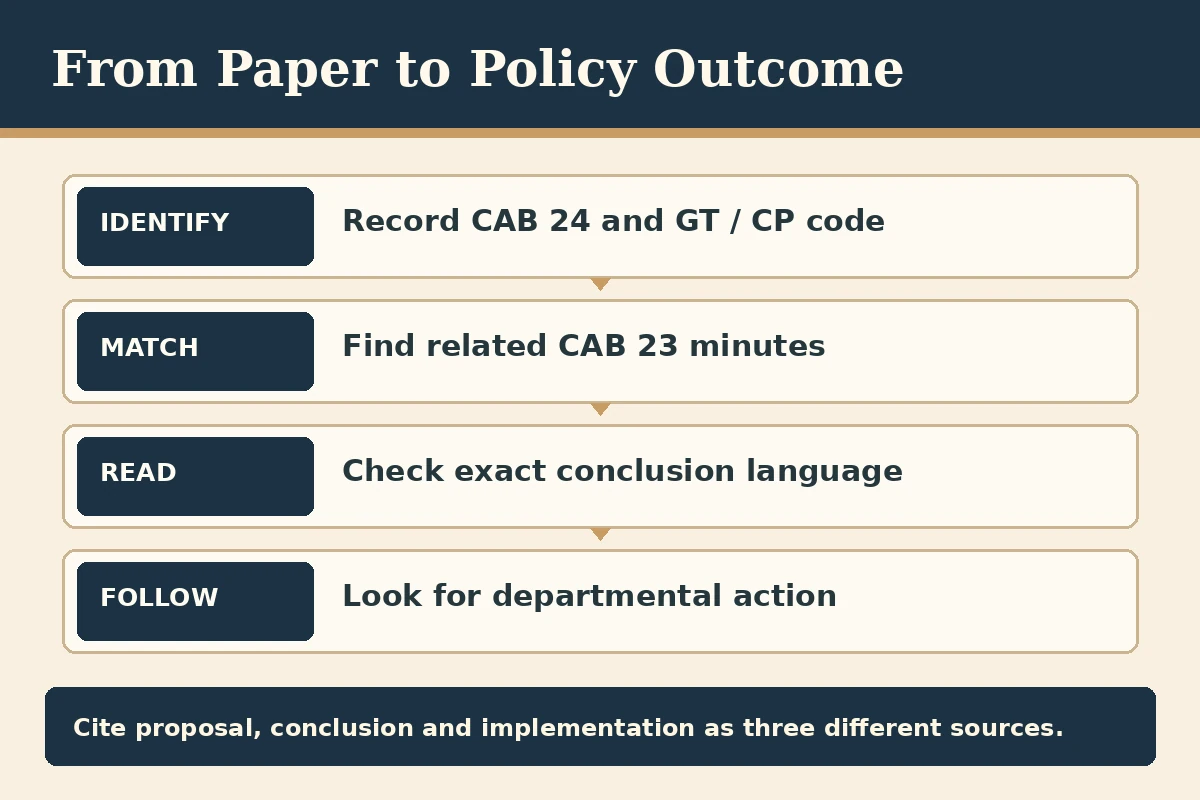
An effective inquiry follows a numbered memorandum to the relevant meeting and then, where possible, to action in the responsible department. This is useful for local historians investigating a school, port, housing scheme or labor regulation as well as for political history. A policy statement about a locality may explain an administrative climate, but cannot substitute for the local authority’s record of what happened in a particular street or household.
Find the right paper series and chronological window
Begin with a subject, an approximate date and the government department likely to have sponsored the measure. The National Archives identifies CAB 24 as the War Cabinet and Cabinet memorandum series for 1915–1939; CAB 37 holds earlier Cabinet papers from 1880–1916, while CAB 66 is the principal War Cabinet memorandum series for 1939–1945. This period gate saves time and prevents a modern citation from being attached to a paper created in a different administrative system.
The paper code is an essential part of the trail. Early War Cabinet papers may carry GT identifiers; later interwar Cabinet papers frequently use CP and other contemporary reference systems. Retain the letter prefix, number, year and any suffix exactly as written on the document. Do not assume a paper number is a meeting number. A catalogue title may summarize the document, and a PDF or catalogue image should be opened before claiming to quote its contents.
Search The National Archives Discovery catalogue for the policy topic, a distinctive phrase and the reference CAB 24. The guide notes that many memoranda are digitized and that catalogue descriptions often reproduce their titles, which makes some keyword searching practical. Cataloguing depth varies, however, so a failed keyword query is not evidence that no minister considered the subject. Browse surrounding dates and paper lists when a specific number is not found.

Match a proposal to formal Cabinet conclusions
Next search CAB 23 by the probable meeting date and the exact subject of the CAB 24 paper. A memorandum might be circulated in advance, deferred, revised or considered alongside other documents. Create a two-column log recording the proposal wording and the minute’s actual decision language. Words such as “noted,” “approved,” “deferred” and “referred” have different implications; preserve the contemporary wording instead of paraphrasing all of them as “adopted.”
The minutes are formal conclusions, not a verbatim transcript of every intervention in the room. Where the minute refers to a committee or another paper, capture that reference and investigate the relevant committee series if necessary. Cabinet business could progress in several stages. An ambiguous minute may show only that ministers asked a department to review a matter, not that every element of an earlier proposal was accepted.
Some policy subjects span the boundary between wartime and interwar cabinets. Build a timeline rather than matching documents solely because the names look alike. Note the paper’s authorship, date of circulation, meeting date and resolution number independently. A second memorandum with a similar title may represent an amended recommendation. Never merge two different versions into one supposedly final policy text.

Test what happened after ministers discussed it
If the family or local-history question concerns an actual factory closure, school building or compensation program, go beyond CAB 23. Search records of the responsible ministry, statutory instruments, parliamentary papers or local council minutes. A Cabinet conclusion can authorize further work without proving the program operated uniformly. Documents from the implementing body are better suited to a claim about a particular place or beneficiary.
Identify the practical unit of the claim: national proposal, ministerial decision, regulation issued, funds authorized or local implementation. Create a citation for each stage, with the creator and date. The apparent chronology may include delays or reversals. A later departmental report may show a policy was narrowed or suspended, even if the original memorandum recommended broader action.
Avoid person-level leaps. A Cabinet discussion about veterans’ pensions does not identify a particular ancestor as a pensioner; an education memorandum does not establish that a named child attended a school. Pair the national evidence with a service file, household record or local administrative document. If that second source is absent, explain the policy context while leaving the individual outcome unresolved.
Write a claim that the archive can defend
A defensible statement might be: “A memorandum circulated to Cabinet on this date proposed this measure; a later recorded conclusion directed additional consideration.” Give the CAB 24 piece and paper identifier, the CAB 23 reference if located and the relevant text. Do not collapse a written proposal, a minute and implementation into the word “decision” without saying which source supports it.
Record whether you consulted a catalogue description, a digitized original or a transcription. A descriptive abstract can omit caveats in the memorandum’s annexes. Check whether statistical tables are estimates, official counts or forecasts, and attribute them accordingly. The existence of a Cabinet paper does not validate every factual assertion its author made at the time.
A negative result should state the period searched, the variant terms used and whether meeting minutes were actually inspected. It should not declare a policy nonexistent on the basis of one empty keyword result. The value of CAB 24 research lies in reconstructing the stages of discussion carefully enough that later readers can retrace them.
More Records and Archives Guides
How We Research CAB 24 Records
We use The National Archives Cabinet research guide to establish the CAB 24/CAB 23 distinction, dates and paper identifiers before making any policy claim. We treat the meeting conclusion as a separate source from the circulated memorandum.
This guide explains the limits of a government-policy document, not a personal enrollment register. See our affiliate disclosure; references to archival repositories are provided for research, not as paid endorsements.
No. It proves a proposal was circulated; use CAB 23 conclusions and subsequent records to investigate the outcome.
CAB 23 holds formal minutes and conclusions for that period.
Many digitized papers have searchable catalogue titles, but browse by date and paper identifier if keyword searching fails.
No. They summarize formal business and conclusions rather than every statement in a meeting.
Not alone. A named benefit requires implementing records or person-specific evidence.