
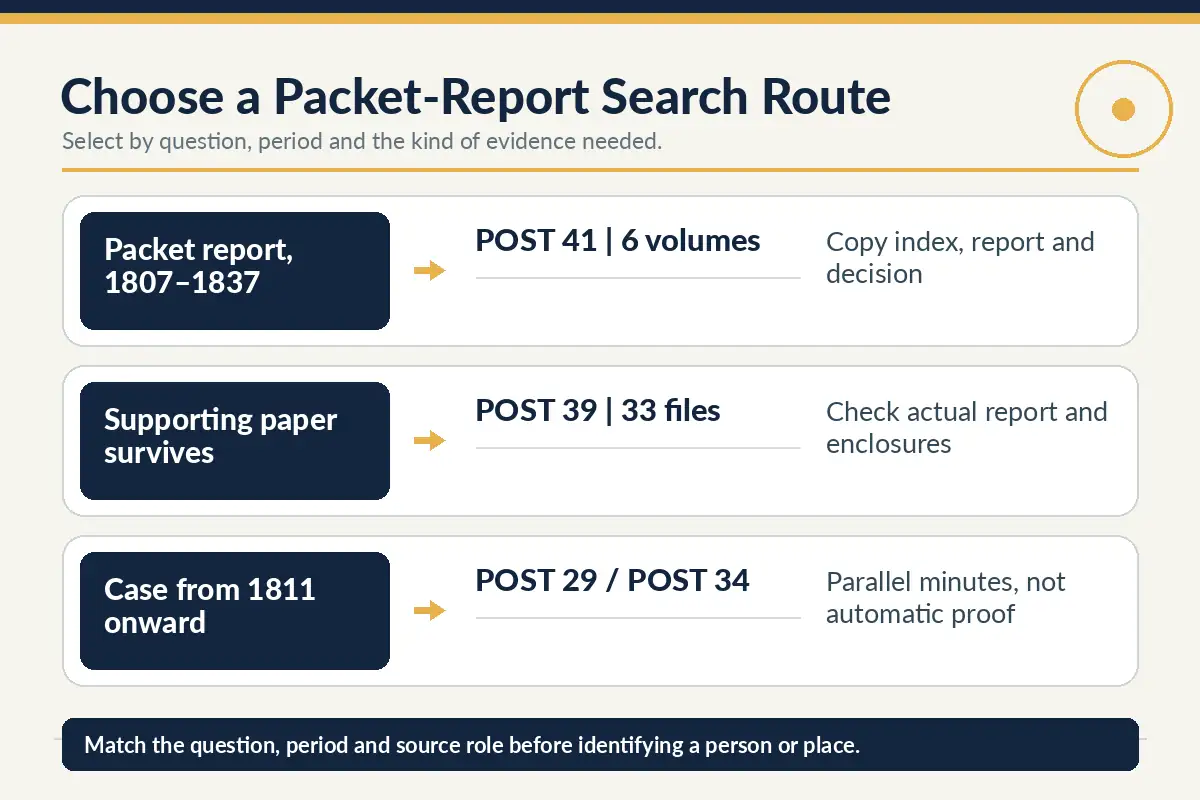
POST 41 is a set of six indexed volumes of Packet Reports, covering 1807–1837, held by The Postal Museum’s Royal Mail Archive. They record reports on packet-boat services and overseas mail arrangements sent to the Postmaster General, together with decisions. The best route starts with a specific mail route, incident, report or approximate date, then checks whether supporting papers survive in POST 39. A proposed alteration to a route is not proof that a named vessel made a voyage, and a report about a crew is not a surviving crew list.
Find the Administrative Question Before a Ship
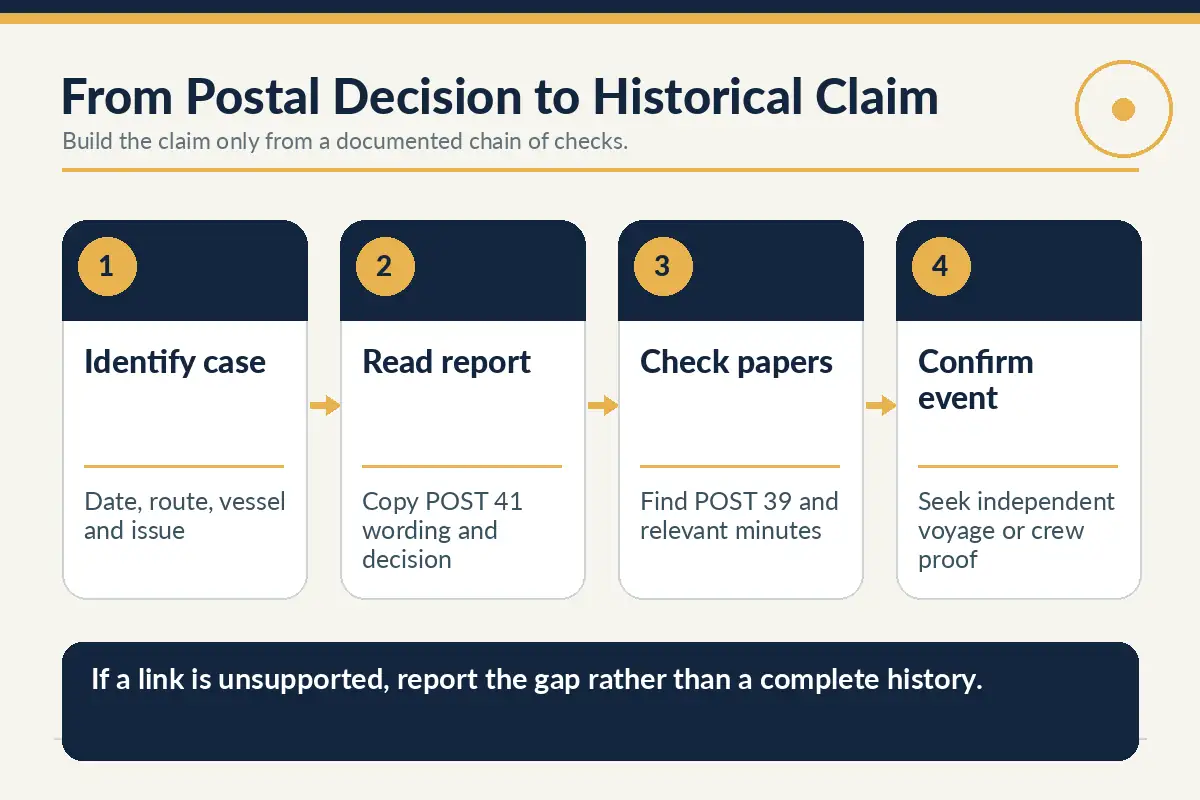
Begin with the event that actually needs testing. A family letter might say a mail packet was delayed, an ancestor worked aboard a government-contracted vessel, or a coastal port lost its overseas service. Those are three different questions. Date the statement, identify the relevant port and destination as closely as the evidence permits, and note which words come from the original family source. Avoid searching for a familiar ship name alone: the same name could appear in different services or over many years.
The Royal Mail Archive description identifies POST 41 as six volumes of indexed Packet Reports dating from 1807 through 1837. It is not an all-purpose register of every packet boat or individual seaman. The reports were submitted by the Secretary to the Post Office for the Postmaster General’s consideration. Their administrative purpose means a document may concern proposed charges, a service dispute, provisioning, route schedules or a reported incident without naming each person who sailed.
Use the archive catalogue to confirm the volume and date span, then examine the index or the relevant part of the volume. Record the heading, report date, index term, report number if supplied, decision text and exact volume or page. An index entry may point to a topic rather than name an individual. If a catalogue search returns no ship or surname, that may mean the name was never indexed; it is not evidence that the voyage or person never existed.
Link POST 41 to Surviving POST 39 Papers
POST 41 and POST 39 are associated but not interchangeable. POST 41 preserves indexed copies of reports, including some for which the separate papers no longer survive. POST 39 holds the surviving report documents and any accompanying enclosures. Build a cross-reference using dates and report identifiers rather than assuming that the thirty-three files of POST 39 match the six POST 41 volumes one for one. The archive arrangement itself is a useful clue about possible loss.
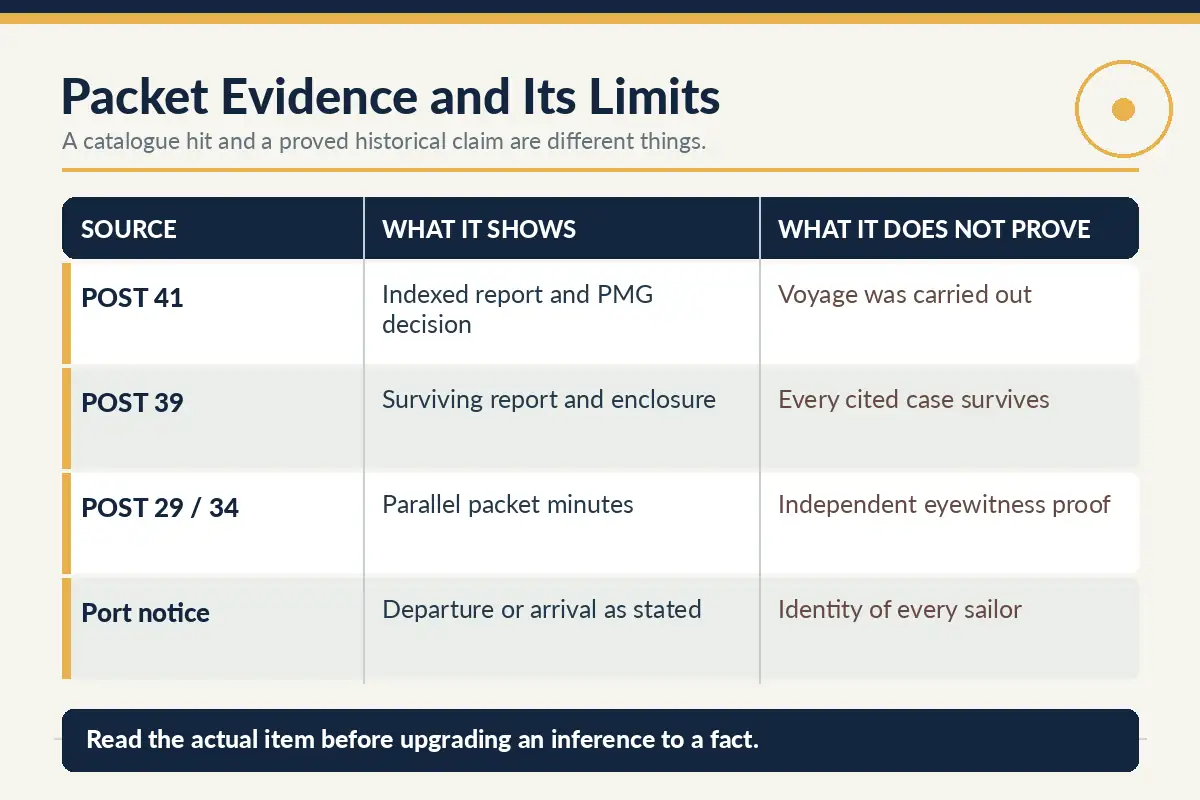
When a POST 41 entry contains a decision, transcribe its actual language before interpreting it. Consider the difference between a Postmaster General agreeing to consider a revised schedule, approving a proposed contract, and confirming that the service operated. A recorded approval is evidence of an administrative action; whether it was implemented may require later correspondence, contracts, shipping notices or local port records. In some cases even the apparently final decision may have been superseded.
POST 39, where a relevant file survives, can add petitions, letters or enclosures that explain the report’s background. Preserve the filing relationship: a complaint is an allegation, an enclosure can be older than the report, and an official minute is not eyewitness proof of an occurrence at sea. Cite both series independently. If a report is visible only in POST 41, explicitly note that you did not inspect any missing supporting papers and do not describe them as if their contents were known.
Choose the Separate Minutes Route After 1811
A second route begins in 1811. The Royal Mail Archive notes parallel Packet Minutes kept in POST 29 and POST 34. Some cases appear in both the reports and minutes, others in only one. This is a conditional search, not the next mandatory stage for every item. Start by determining whether the question dates to 1811 or later; otherwise do not project the later minutes system backward into 1807.
If a POST 41 entry points to a continuing dispute or an ongoing route arrangement, inspect the relevant minutes where the catalogue and access arrangements allow. Record exact changes in wording between report, decision and minute. Repetition does not create three independent eyewitness accounts; an administrative summary copied into another register may simply repeat the original source. A contradictory entry can be evidence of a changed decision rather than evidence that one record is wrong.
The report series ends in 1837, whereas the parallel minutes continue. A question from 1840 should therefore be routed to the appropriate continuing minute and report systems instead of forcing a POST 41 match. For earlier context the archive describes other Postmaster General reports and records. Date gates matter: record survival, cataloguing and official practices changed, and the closest-sounding series is not always the correct series for a later event.
Test a Voyage, a Loss, and a Family Claim Separately
Mail administration records can address incidents such as capture, loss of crew, smuggling allegations, hire terms and alterations of a route. Each requires a different evidentiary test. An incident report might identify a ship or captain, but that is not a full passenger list; it might discuss missing crew without naming them; and a reference to a proposed sailing is not proof of its departure or arrival. Copy each claim into a separate evidence row with its own wording and date.
A useful historical shipping check can combine a dated packet report with contemporary sailing notices, port arrival information or merchant-marine documentation when available and relevant. Do not assume two mentions of the same vessel identify the same captain or crew. Search alternate ship spellings and distinguish the scheduled sailing date, date of a reported incident, date the letter reached London, and date of the Postmaster General’s decision. They can be weeks apart.
For family history, a surname named as a petitioner, contractor or witness must not be silently upgraded to a seaman aboard the packet. If a family tradition names a crew member, look for an independent person-level document that connects that individual to the vessel and period. If no independent document survives, the sound conclusion may be that official correspondence discusses a ship connected to the family story, not that it proves the ancestor’s voyage.
More Records and Archives Guides
How We Research Packet Service Reports
Our starting point is the archival description of POST 41, which identifies the six volumes and their 1807–1837 coverage. We check the POST 39 description separately to distinguish copied reports from surviving original report papers and the parallel minutes. The Postal Museum catalogue is the practical repository lookup; titles alone are not a guarantee that records are digitized.
We do not fabricate packet-boat itineraries, indexed crew names or access privileges. The illustrated diagrams are newly drawn explanations, not reproductions of original reports. A missing item is marked as an archival gap rather than proof that no event took place. See the affiliate disclosure for editorial relationships.
POST 41 comprises six indexed volumes for 1807–1837, according to the Royal Mail Archive description.
No. A report or approval is an administrative record; a voyage requires dated shipping or other independent operational evidence.
POST 39 contains the surviving report documents and enclosures, which can add context. Some reported cases no longer have those supporting papers.
POST 29 and POST 34 offer parallel packet-minute records; cases can appear there, in the reports, or in both.
Only a person-level record that actually establishes service can do that. A complaint, petition or vessel mention alone is insufficient.