
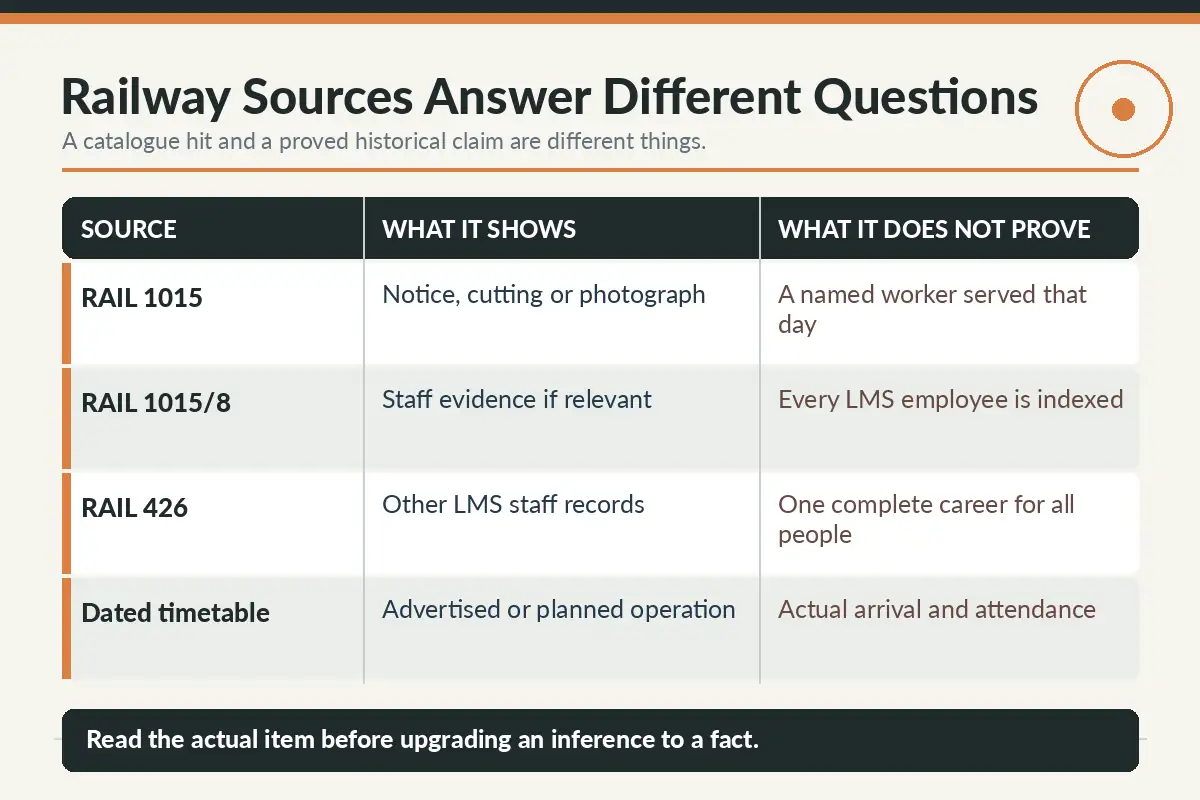
RAIL 1015 is a London, Midland and Scottish Railway (LMS) collection at The National Archives containing historical material such as notices, cuttings, photographs and related documents; its overall 1825–1970 date range is much wider than the LMS company’s own 1923–1947 operating era. A piece of railway ephemera can document a published instruction or scene, but it cannot by itself prove that a named ancestor was employed, rode a particular train or witnessed an incident. Begin by dating the specific item and identifying its original railway company.
Fix the Original Railway Company and Date First
The date range of a collection can mislead researchers who assume every item was produced by the London, Midland and Scottish Railway. The LMS was formed in the 1923 grouping of companies, but RAIL 1015 contains records inherited from predecessor railways and later material as well. The National Archives photography guide gives the collection span as 1825–1970. Treat it as a range of stored material, not the operating dates of one company or proof that one employee served across the whole period.
Start with the original document rather than the collection title. Note whether it is a staff notice, newspaper clipping, promotional handbill, photograph, correspondence or later historical note. Transcribe the issuing company, header, station, document date, revision information and any explicit personal names. The date of an old document reproduced in a later scrapbook may differ from the scrapbook’s assembly date. Do not give one event two dates without explaining which is which.
Search RAIL 1015 by reference and, where descriptions allow, by the predecessor company, place or subject. A broad LMS name search is only an entry point. Company mergers changed ownership and record creation, and several railways could serve the same town. Record the railway company operating a particular station on the date being studied rather than projecting the LMS name backward onto a nineteenth-century notice.

Read Staff Notices as Orders, Not Attendance Registers
Railway notices are often precise about rules, services or responsibilities. A notice instructing personnel to change a working practice documents an instruction being issued, not proof that every worker saw or obeyed it. A temporary timetable may specify a planned train movement without recording that the train ran. Keep a clear distinction among instruction, reported operation and independently confirmed occurrence in your notes.
When a notice names an official, read the exact role. The signatory might be a manager issuing an instruction, the person to receive reports or an officer responsible for a division; that does not make them the driver or guard on every affected service. Similarly, a staff photograph may document a group at a railway location but not supply its membership or duties. Look for a caption with names before attempting individual identification.
The railway-workers guide identifies several LMS personnel record routes for 1923–1947, including RAIL 1015/8 and other record series such as RAIL 426. Those are separate research paths selected for the employee and period in question. A note in RAIL 1015 about a depot does not automatically establish that an ancestor appears in its staff records. If a person-level record is found, record its appointment and departure details exactly and check whether the identity fits place and age.
Distinguish a Picture, a Cutting, and an Original Record
Collections accumulated for historical or company purposes may contain copied newspaper reports and photographs alongside documents created by railway offices. These sources are not equally close to an event. A contemporary official notice can state a policy, a newspaper clipping can report an accident with uncertain facts, and a later caption can identify a locomotive based on information added years afterward. Label each source by creator, type, date and reason for inclusion.
The TNA photo guide describes railway photographs as widely distributed throughout collections and warns that many catalogues do not identify every individual image. Search by site, locomotive, railway and period, but be prepared to inspect a volume or file when item-level descriptions are sparse. An uncatalogued photograph cannot be assumed absent from a collection. Equally, a photograph labeled only ‘workshop’ should not be given a precise depot without independent visual and documentary checks.
Use a source-to-claim table. A photograph may support that a particular building, machine or uniform was visible at an uncertain date. A timetable or public notice may support an intended service. A named staff register, if extant, can support an employment period. Avoid stacking multiple derived copies of the same newspaper report as if they were independent corroboration. Cross-check the same claim with a genuinely different document and record where accounts disagree.

Connect a Family Member to the Right Railway Evidence
A family story such as ‘worked for the LMS at Carlisle’ should be divided into identity, employer, role, place and dates. Match the person first using full name, age, home address and independent family documentation. A company title mentioned in family memory may be a convenient later shorthand for a predecessor railway, or it may refer to employment after the 1923 grouping. Do not alter the claimed dates to make them fit the archive collection title.
For a possible employee, start with surviving railway staff records specific to that company and branch, then compare entries with census, civil registration, trade directories or other dated personal evidence. The National Archives railway-workers guide warns through its company-by-company series listing that there is no single universal roster. An occupational label such as ‘railway servant’ does not necessarily distinguish a clerk from a porter, guard, driver or maintenance worker.
If a RAIL 1015 image or notice mentions a person with the right surname, check namesakes and context. Two railwaymen might share initials and work in the same area. Employment dates, birthplace and a documented move may distinguish them. If the link remains uncertain, cite the useful railway context and state that the person-level identification was not proved. Historical collections are valuable without being turned into invented family biographies.
More Records and Archives Guides
How We Research LMS Collection Records
We use the TNA photography guide for the collection’s broad date range and mixed photographic holdings, the railway-workers guide for staff record routes, and the RAIL 1015 Discovery entry for collection identification. These sources do not promise that every employee has a surviving personnel file.
We distinguish document date, original creating railway, later collection custody, and independent person-level proof. Every scene in our graphics is an original explanatory illustration; none is presented as an actual LMS photograph or notice. The affiliate disclosure describes editorial relationships.
No. Its collection range is 1825–1970 and includes older predecessor-company and later materials.
No. Instructions and schedules establish intentions or rules, not attendance or completion.
The National Archives lists RAIL 1015/8 and RAIL 426 among relevant sources; applicability depends on person, company and period.
Usually not reliably without a caption and independent person-level evidence.
Record the exact piece, issuing company if shown, document type, dates and any later annotations separately.