
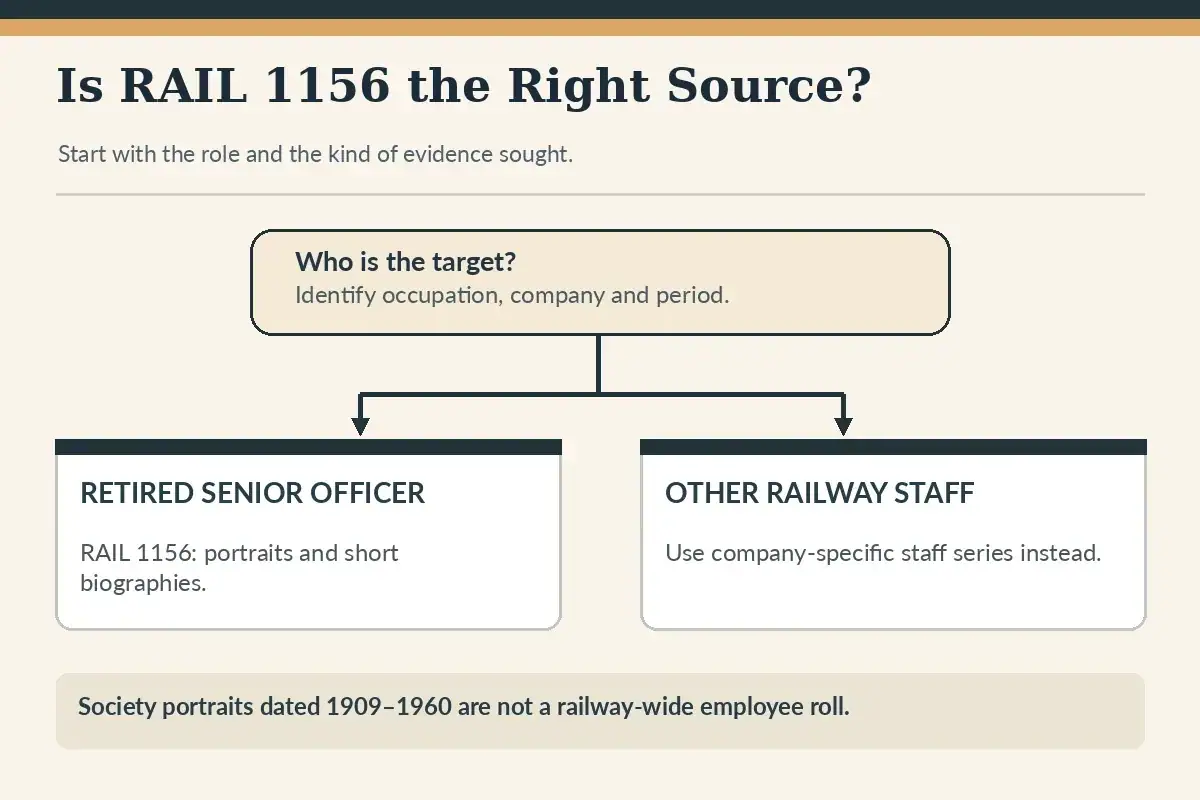
RAIL 1156 is a targeted source for photographs and short biographies of senior railway officials, not a name index for every railway worker. The National Archives identifies it with the Retired Railway Officers’ Society; its photographs in fifteen volumes date from 1909 to 1960. A person’s appearance in a volume is valuable identification evidence, but the image date and the dates of employment may be different things.
The first step is to establish whether your question concerns an identified officer, a particular railway company or a supposed family portrait. A fireman, porter or track laborer should not be expected to appear merely because he worked on the railways. Where ordinary employment is the issue, the separate company staff records described in the railway-workers guide are more appropriate. RAIL 1156 is selective by role and collection provenance.
Identify the Society Collection Before Searching a Name
The photographs guide describes the Retired Railway Officers’ Society series as fifteen volumes of members’ portraits dating from 1909 to 1960. The railway-workers guide describes small biographies and pictures of senior officials whose service extended around the late nineteenth and early twentieth centuries. These are descriptions of a collection, not evidence that every subject retired during the photographic date range or worked continuously for one company.
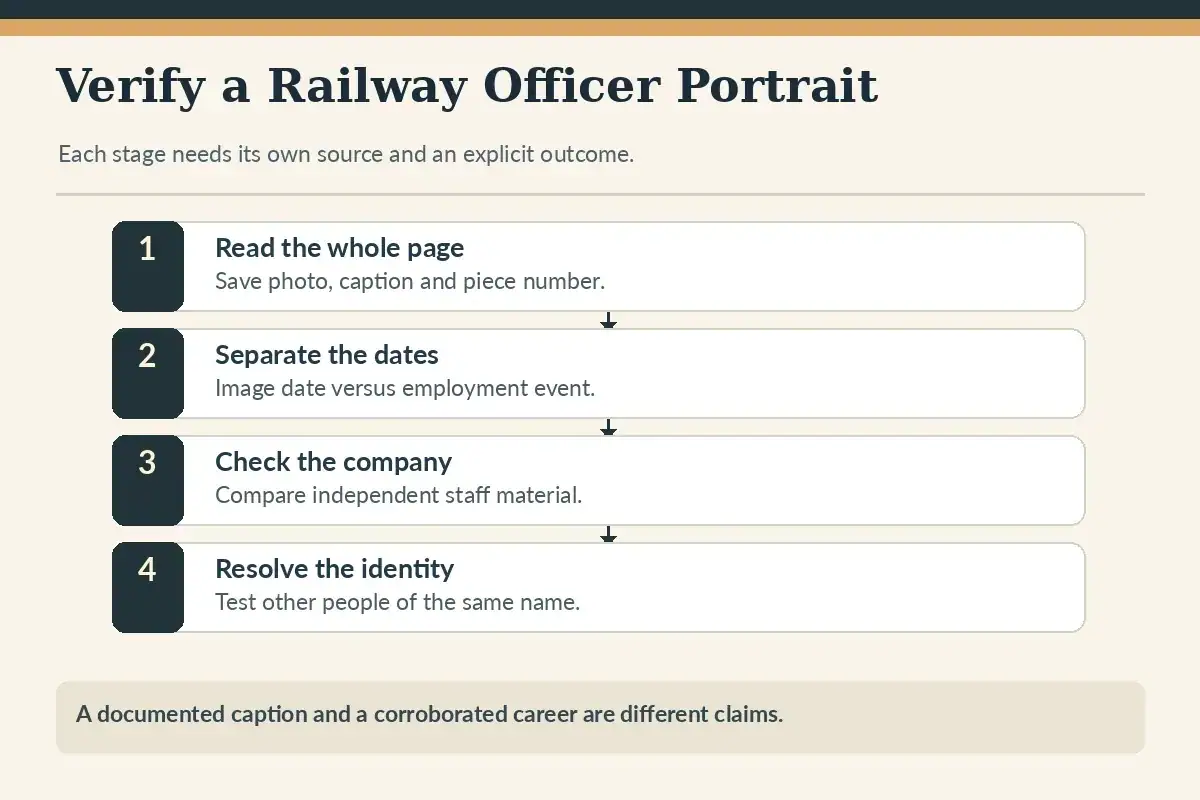
Begin with the exact variant of the officer’s name and a candidate employer. Search Discovery for RAIL 1156, then inspect the catalogued arrangement and relevant volume rather than assuming all subjects are individually indexed online. Record the page, caption and piece number if found. Identify whether the information came from a contemporary caption, a biographical entry or an editor’s later summary. These layers can make the same name appear deceptively certain.
Keep the Portrait Date Apart from Employment Dates
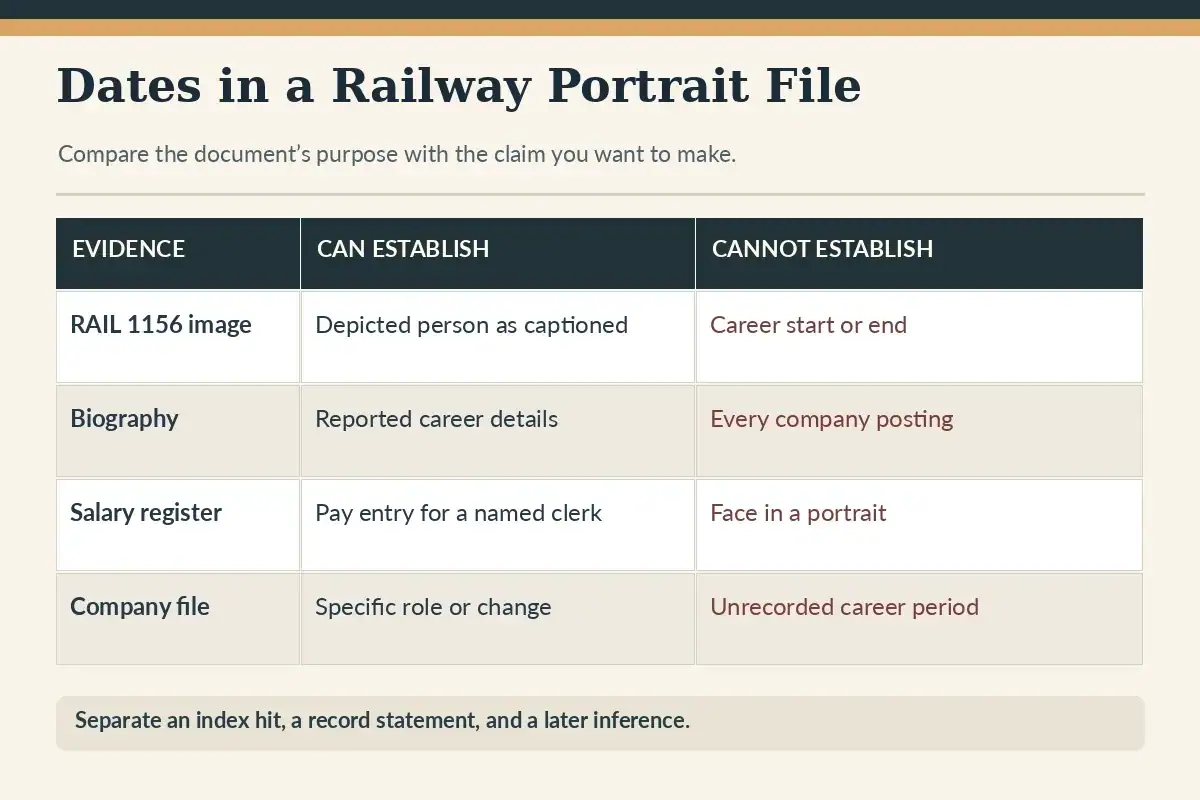
A photograph may be taken well after the office or job named in its caption. Use two timeline columns: one for the image’s estimated or stated date and one for the dates of company service explicitly given by a biographical source. If a caption says “former superintendent,” do not convert that into a promotion on the date the image was printed. Likewise, a society membership date is not automatically a retirement date.
A portrait can show a face and perhaps a uniform or insignia, but clothing alone does not reliably establish a precise office. Ranks, corporate titles and regional divisions changed as railways amalgamated. Transcribe the exact employer named, then check the chronology of that firm rather than updating it to a successor company in your record citation. Separate factual caption text from visual interpretations, especially for undated photographs.
Use Company-Specific Staff Records as an Identity Check
The archive guide lists company record groups such as RAIL 264 for Great Western Railway, RAIL 397 for London and North Eastern Railway, and RAIL 410 for London and North Western Railway. It also explains that staff registers, salary registers and personnel files record different employment details. These series are possible independent comparators when the subject and firm match, not a required chronological chain through every group.
Check company, location, occupation and approximate years before linking the photograph to a staff entry. The same officer may appear under an abbreviated forename, title or job description. A salary rise does not prove that the portrait depicts the recipient. When two candidates share a surname, compare location and posts, then seek a second document that links the full name to a specific role. Preserve both candidates until that connection is supported.
Audit Photographic Copies, Captions and Reproduction Claims
Determine whether the image is an original photograph, a printed reproduction or a digital copy of a bound page. Record the source volume and any caption in quotation marks, keeping editorial additions visibly separate. Cropping may remove the contextual caption that makes the photograph useful. If you save a working copy, retain the full page as well as a detail view so another researcher can check the association.
A historic collection being accessible for research does not automatically make every image free for commercial publication. Check The National Archives’ copying and reuse instructions for the specific image before republishing. Family resemblance is never sufficient to identify a namesake. If you cannot verify the officer by company, role or independent biographical facts, mark the portrait as a candidate and avoid publishing an unsourced identification.
Write a Career Statement That Reflects Surviving Evidence
Imagine a fictional officer named Arthur Dixon whose 1935 portrait caption names an earlier railway post. Your first statement can cite the portrait and the caption; a later statement about a promotion needs an independent dated staff record. It would be wrong to write that Dixon held the post until 1935 merely because that is the date of a society volume. Put each date beside the document that reports it.
The archive warns that company employment records are uneven, and most post-1947 personnel records were not retained centrally. Avoid treating gaps in a former employer’s archive as proof of resignation. A rigorous research log should distinguish absence from the consulted book from absence from company service. Search successor companies and local holdings only when there is a documented historical reason to do so.
More Records and Archives Guides
How We Research Railway Officer Portraits
The account of RAIL 1156 is drawn from The National Archives’ railway workers guide and its photographs guide. The latter specifies the fifteen volumes and 1909–1960 portrait dates. Discovery provides the detailed reference route. These guides distinguish a picture collection from comprehensive staff employment registers.
Arthur Dixon is fictional. The diagrams deliberately separate image date, service description, independent staff evidence and an unresolved identification. For research copies and external services consult our affiliate disclosure; this article does not presume a license to reuse a photograph.
A collection containing photographs and short biographical information about retired senior railway officers.
The National Archives describes the fifteen society portrait volumes as dating from 1909 to 1960.
No. It focuses on retired officers and is not a complete staff census.
No. The image and the career event require separate chronological evidence.
Check the appropriate railway company staff and salary records, using the company reference in the railway workers guide.