
A name in a Secretary of State’s pass book is evidence that an official pass was entered, not proof that the traveler reached a port or completed a voyage. The National Archives identifies two partly overlapping groups of passes for people travelling into and out of Britain: SP 44/334–413, covering 1674–1784, and FO 366/544, covering 1748–1794. Both require a date-aware search before any family narrative can be attached to a name.
The distinction matters because passports were not generally compulsory for overseas travel before the First World War. A person could travel without appearing in a surviving pass book; conversely, a person who obtained a pass might not have used it. Begin with a specific name, an independently attested place and a proposed decade. Record why you think a pass is relevant instead of treating an empty search as evidence against migration.
Choose SP 44 or FO 366 by Date and Provenance
For a date between 1674 and 1747, start with the surviving SP 44/334–413 pass entries; FO 366/544 does not cover that earlier interval. For 1748–1784, consider both record groups, rather than pretending the second is a direct continuation without overlap. For 1785–1794 the cited guide directs attention to FO 366/544. These ranges tell you what books can be sought; they do not promise continuous entries for every date or individual.
The archives describe these as entry books of passes issued by Secretaries of State. They are not a single list of everybody crossing a frontier. A case may be difficult to locate if the name spelling, decade or office of origin is uncertain. In your research log, write the search period and series examined, including negative results, and explain if an overlapping series remains unchecked. This simple boundary audit prevents false claims of exhaustive coverage.

Read a Pass Entry Without Inventing a Port or Voyage
Transcribe the wording of the actual entry before paraphrasing it. Note the date of entry, named party, office or authorizing official when stated, and any stated destination, companion or purpose. An early modern pass could use abbreviated personal names or a social title. The exact fields must come from the consulted volume, not a modern form imagined from a twentieth-century passport application. Mark uncertain readings with a visible question mark.
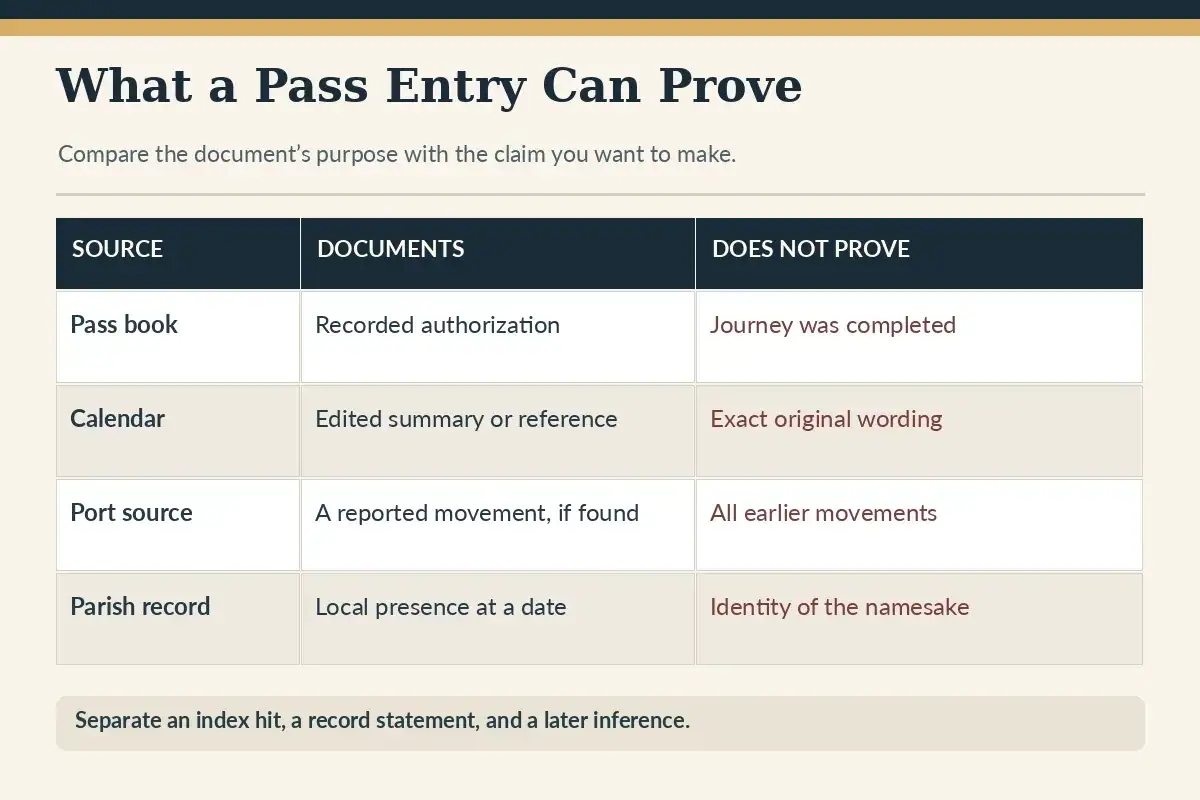
Separate three possible propositions: a pass was issued, a person attempted a journey and a journey took place. Only the first follows directly from an issued-pass entry. An intended route, if specified, is a statement about proposed movement, not independent proof of disembarkation. A related port ledger, contemporary correspondence or foreign local record may demonstrate arrival. Without that corroboration, write “issued a pass for” rather than “sailed to” or “emigrated.”
Use Printed Calendars as Finding Aids, Not Originals
The National Archives notes that some information from these pass books appears in the Calendar of State Papers Domestic and Calendar of Home Office Papers. A calendar can identify a date or abstract a name that helps target a volume, but abstracts may reduce the detail and spellings of the underlying record. Make two citations if you use both. One citation belongs to the calendar’s volume and page; the other identifies the surviving archival entry.
If a calendar entry appears to conflict with a record image, recheck the reference, dating conventions and transcription rather than silently choosing the familiar spelling. Old-style and new-style year boundaries may affect context in early periods; confirm the calendar’s editorial conventions before converting any date. Do not extrapolate one traveler’s identity from an abstract containing only a name. Look for independent evidence of residence, occupation or associates.
Distinguish a Namesake from the Person You Seek
Imagine a fictional merchant named Thomas Hale named in a pass index around 1760, while a parish register lists another Thomas Hale living in the same decade. That overlap alone does not establish an identity. Assemble a comparison grid of exact name form, status or occupation, chronology, associated travelers, intended destination and any linked correspondence. Give greater weight to a combination of independent identifiers than to a single matching surname.
An entry for a named servant or companion must not automatically be converted into a parent-child relationship. Likewise, a foreign-sounding surname does not prove birthplace or nationality. Where the pass book has no relevant descriptive field, say so. A solid genealogy result can be a bounded conclusion: “This entry may refer to the target, but the surviving details do not distinguish the candidates.” That is more useful than an unsupported migration story.
Plan an Independent Test of Movement and Record Survival
Once you have a pass entry, construct a two-date timeline: authorization date and the earliest independently documented location after that date. Search the candidate’s local or overseas context for a letter, trade record, estate instrument or other named source that could bridge the gap. Do not presume that a printed port list exists for every eighteenth-century crossing. Your next search should be chosen by the individual’s destination and circumstance, not by a general promise of passenger registers.
The broad passport guide explains why historical documents were selective and surviving collections patchy. State clearly which groups you searched, the coverage dates and whether the original or only a calendar was examined. Avoid saying that a relative “had no passport” simply because no pass entry was found. Instead preserve the exact no-result search and specify what new evidence, such as a changed surname spelling or corrected travel year, would justify reopening it.

More Records and Archives Guides
How We Research Secretary of State Passes
Our series ranges and the warning about travel documentation come from The National Archives’ passports research guide. It identifies the two ranges and points to printed calendars as additional finding aids. For a document-level reference we use Discovery advanced search, which helps separate a series description from a particular original volume. Neither a catalogue description nor this example replaces examining the record.
Thomas Hale is invented solely to demonstrate identity testing. We do not claim that a historical pass proves nationality, kinship or arrival. Readers using paid outside services can review our affiliate disclosure. Preserve uncertainties alongside transcriptions so a later researcher can repeat the search.
The National Archives places these pass books in 1748–1794.
Yes. SP 44/334–413 covers 1674–1784, overlapping FO 366/544 in 1748–1784.
No. It documents the authorization or pass entry, not an independently verified journey.
No. The National Archives says passports were not compulsory for overseas travel before World War I.
Use its date and wording to locate the relevant original pass-book entry and cite both separately.