
Search FO 611 for a named historical British passport applicant only in a year with a surviving index, then use the date or passport number to consult FO 610 registers. The National Archives lists uneven index coverage from 1851 to 1916 and a longer FO 610 register run from 1795 to 1948. A passport application or issue entry is not a surviving travel document and does not prove that the bearer crossed a frontier. Start with the official passport research guide and consult our affiliate disclosure.
Select the Exact FO 611 Index Year
Write a precise research question before typing a surname: Did the Foreign Office record an issue on a specific day, or did this ancestor actually travel abroad? A passport register can assist the first question. For the second, you will usually need passenger, port, residence or correspondence evidence. Assemble a birth decade, full name including married-name changes, known address, destination hypothesis and narrow trip window. Distinguish a British passport issued to a person from proof that the person was born British, remained British throughout life or used that passport for one alleged journey.
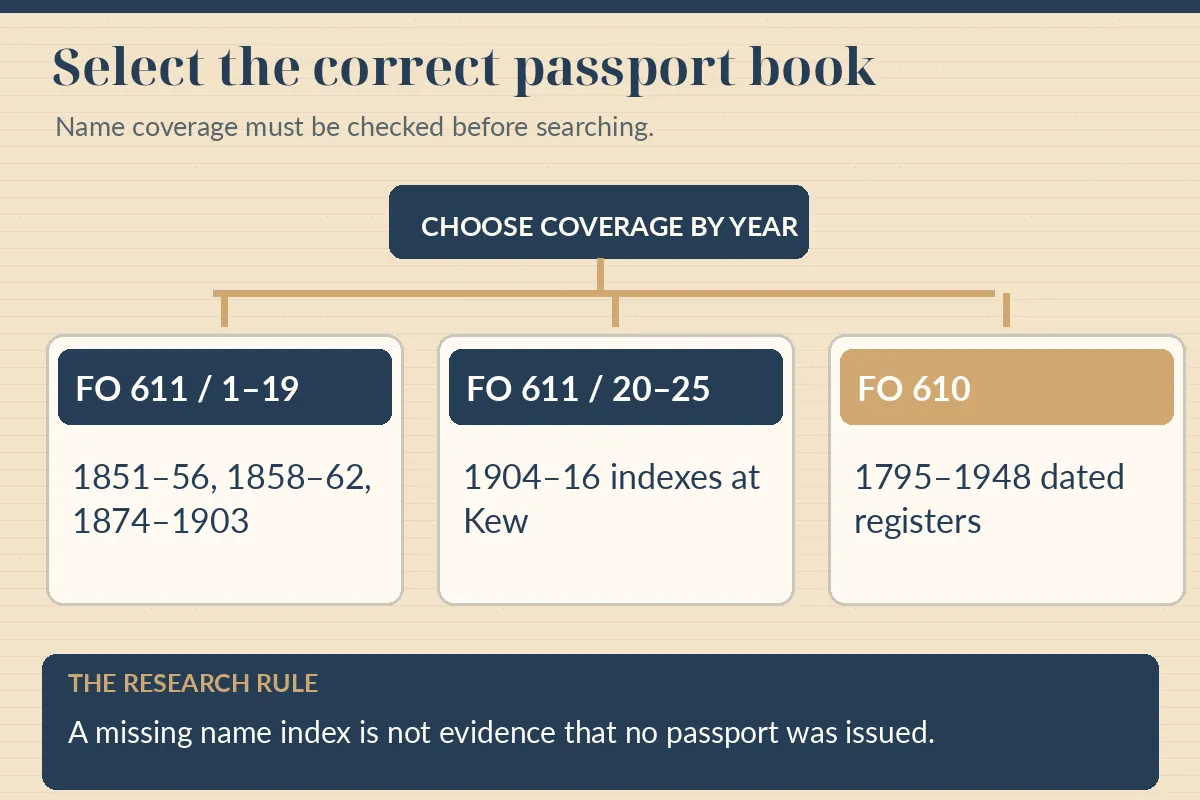
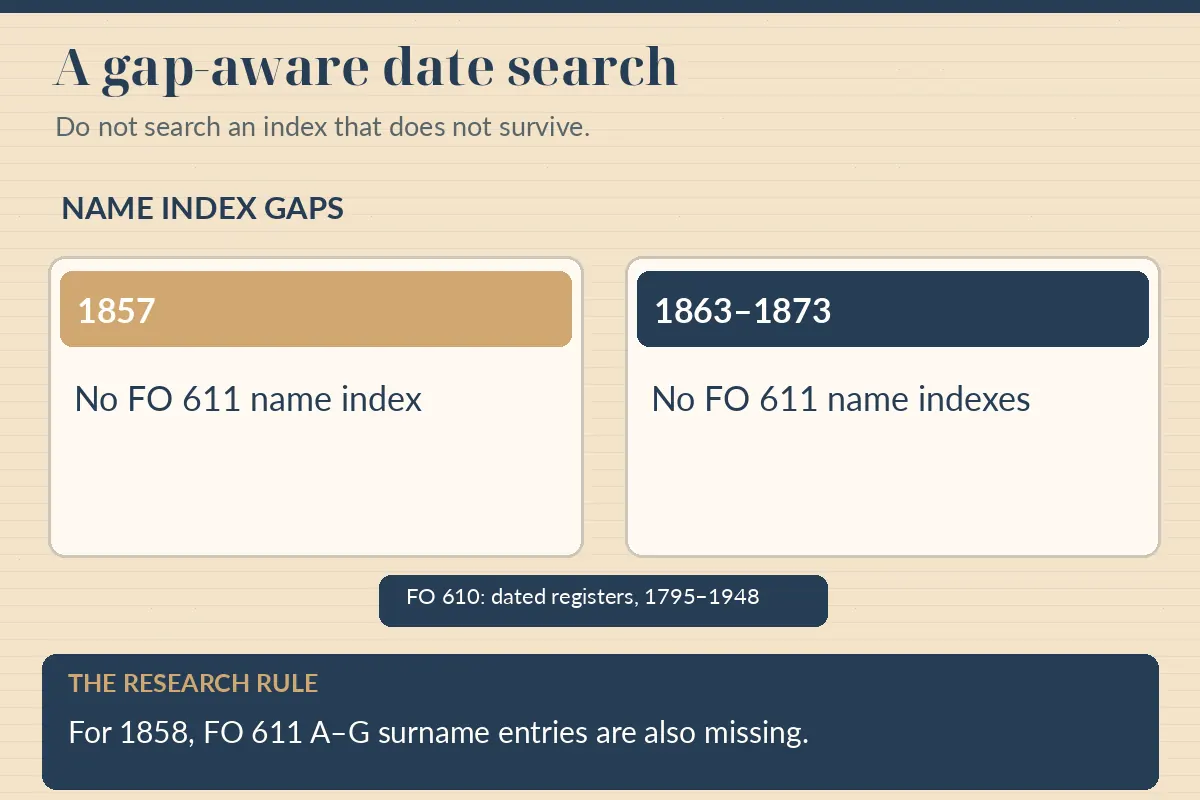
The National Archives identifies downloadable or partner-accessible FO 611/1–19 name indexes for 1851–1856, 1858–1862 and 1874–1903. There is no FO 611 name index for 1857 or for 1863–1873, and the 1858 index lacks surnames beginning A–G. The search failure of an Anna Cooper in 1858 therefore means something different from no hit in a fully indexed 1890 volume. Write the coverage test in your log before the search outcome. Treat small spelling variations, initials and adopted surnames as possible index variants, not proven identity changes.
Use FO 610 When the Index Is Missing
The later FO 611/20–25 indexes cover 1904–1916 at Kew. The National Archives warns that they are arranged chronologically within initial letters, not in strict alphabetical order. A name search or quick browse of a single initial page can miss a late-year entry. Record the surname initial, chronological sequence and volume actually checked. From these and earlier name indexes, transcribe the passport number and date of issue if written, noting that later entries may contain little besides name and issue date. An “observation” in one index must be recorded as a notation, not embellished into an event.
Decode Passport Number and Issue Date
FO 610 is the administrative register series for passport applications from 1795–1948, arranged by date and passport number. It offers a search path when the name index is absent, but chronological browsing needs a reasonably narrow date. FO 610 often repeats only a few particulars from the index and sometimes has fewer. Do not promise an applicant’s photograph, physical description, detailed birthplace or exact journey without confirming that field in the original register. Record the volume, number, entry date and wording from the page. There can be separate steps between an application, a register entry and physical document delivery.
Treat dates and numbers as retrieval keys, not as person-identifying proof by themselves. An issue date may be later than a letter requesting permission or earlier than a subsequent journey. A common name in the register should be compared with a separately known residence, occupation or dated communication when possible. If an index gives no distinguishing details, do not force it onto an ancestor on the strength of surname and travel tradition. Search a broad date band only when the archival series is actually indexed for those years; otherwise prioritize a narrower event window from independent family evidence.

Separate Registers From Preserved Passports
The Archives holds a small illustrative collection of surviving passport documents in FO 655, from 1802–1961. It is not the ordinary passport for every FO 610 registrant; fewer than a dozen examples survive for most years. Other later Passport Office case-paper samples also exist, with photograph practices evolving during the twentieth century. Those preserved specimens can explain how a form looked but cannot be paired automatically with a named index result. In particular, do not claim that an FO 611 entry proves a photographed identity or that an original passport is available to download.
A traveler might appear in inward or outward passenger lists, shipping-company records, letters, embassy correspondence and naturalization papers. Each has a different creation date and scope. A passenger list names a reported traveler on a particular movement but a passport register records an administrative issue. One cannot establish the other unless a distinctive number, date or identity clue joins them. Some journeys have no surviving named list; others were not covered by British border registers. Write “passport issued,” “passenger listed” and “journey corroborated” on separate lines, with a citation supporting each sentence.
| ARCHIVAL SOURCE | WHAT IT SHOWS | WHAT IT DOES NOT PROVE |
|---|---|---|
| FO 611 name index | Name and issue date or number | Not a journey |
| FO 610 register | Dated passport application entry | Not a passenger list |
| FO 655 specimens | Rare physical passport examples | Not an applicant collection |
Test Travelers Against Independent Arrivals
For two people named Eleanor Price, suppose a newspaper notice suggests that one visited France in 1895 and the other resided in London. An FO 611 result for Eleanor Price in that year is still ambiguous. Compare the index date and number with FO 610, then seek a passport-related address or an independent family letter; neither may exist. A later manifest listing a matching age and address could strengthen a link, but should be read in its own context. If an index provides name and date alone, do not treat it as a biometric match or a substitute for the person’s birth record.
A good negative search is explicitly bounded. State “FO 611 indexes searched for 1889–1891 under Price and Pryce; no credible entry identified” rather than “never held a passport.” If your target year is 1868, say the FO 611 name index is missing for that year and identify any FO 610 dates actually browsed. A register is not a complete account of every foreign trip or every person crossing British ports. Researchers should also verify whether an archive catalogue item is digitized, viewable only at Kew, or accessible through a fee-charging partner before promising an image.
Cite a Positive Hit and an Empty Search
Cite The National Archives, FO 611 specific piece and page or entry, year, name, and any passport number as printed. For a FO 610 match, separately cite the relevant volume, date, number and page. Include the portal or reading-room context and date consulted. When a record is in a partner’s transcription rather than a direct image, say so and seek the actual index page where possible. Keep the transcription beside the scan, and do not turn a catalog label into an assertion that you read a particular passport.
More Records and Archives Guides
How We Research Passport Applicants
We verify the FO 611 year and initial-letter coverage before interpreting a no-match, move to the FO 610 chronological register only with an appropriate date window, and keep surviving specimen passports in FO 655 conceptually separate. Our identity comparison uses independent addresses, family documents or dated travel evidence when they exist. The most defensible result may be “a person of this name obtained a passport on this date”; journey, destination, current nationality and family relationship require evidence from other records.
The 1857 and 1863–1873 name indexes are absent, and 1858 lacks A–G; check the official year coverage first.
No. FO 610 is a register of applications, not a complete collection of issued physical passports.
FO 611/20–25 indexes cover 1904–1916 at Kew, arranged chronologically within surname initials.
No. Use a separate travel or residence record to support an actual journey.
The surviving passport and case-paper specimens are selective, and older registers usually contain limited details.