
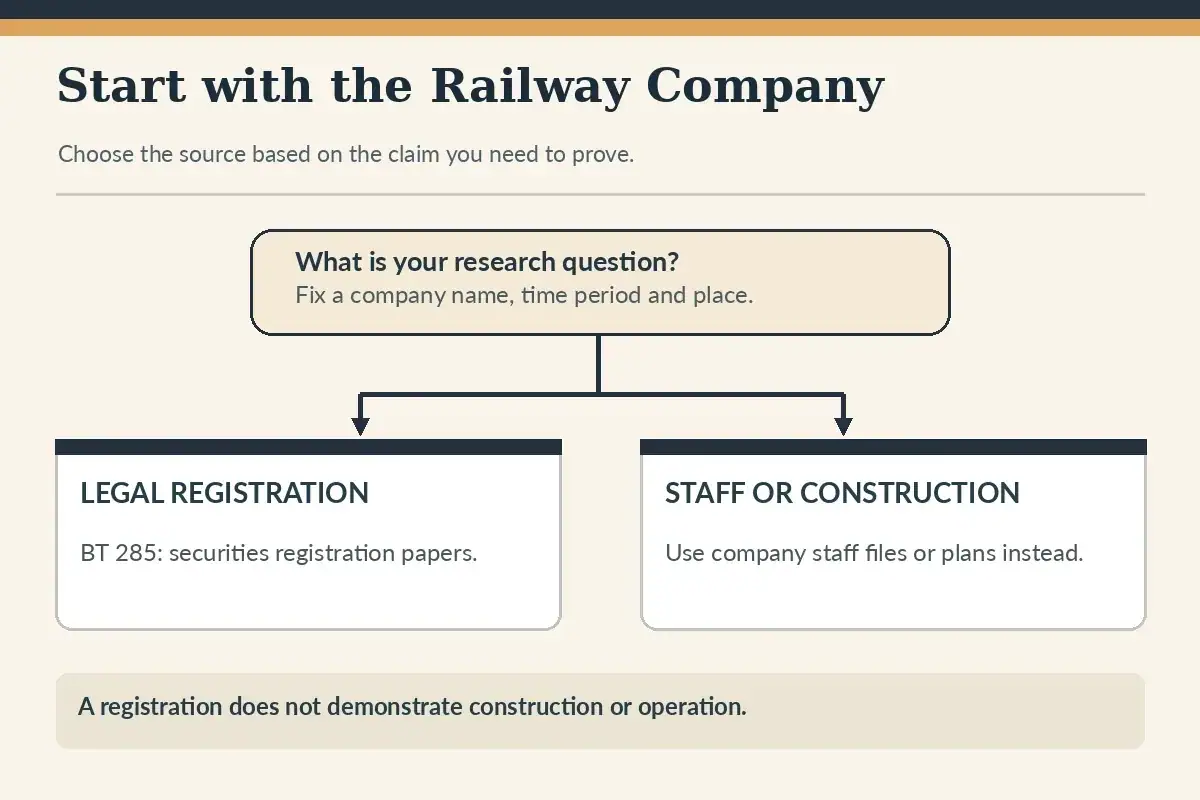
BT 285 contains registration papers compiled under the Railway Companies Securities Act 1866, according to The National Archives’ railway guide. These records may help identify a railway company’s legal and financing context. They do not by themselves show that every proposed line was completed, that a specific station opened, or that an ancestor worked for the company.
This is primarily a company-first research route. Start with a company name and a dated document in which it appears, such as a local notice, family business paper or railway plan. Identify the relevant historical company rather than assuming that the current operating brand is the same legal entity. Changes in corporate ownership and the major 1923 regrouping can easily obscure the name under which filings were made.
Identify the Historical Railway Company Before Opening BT 285
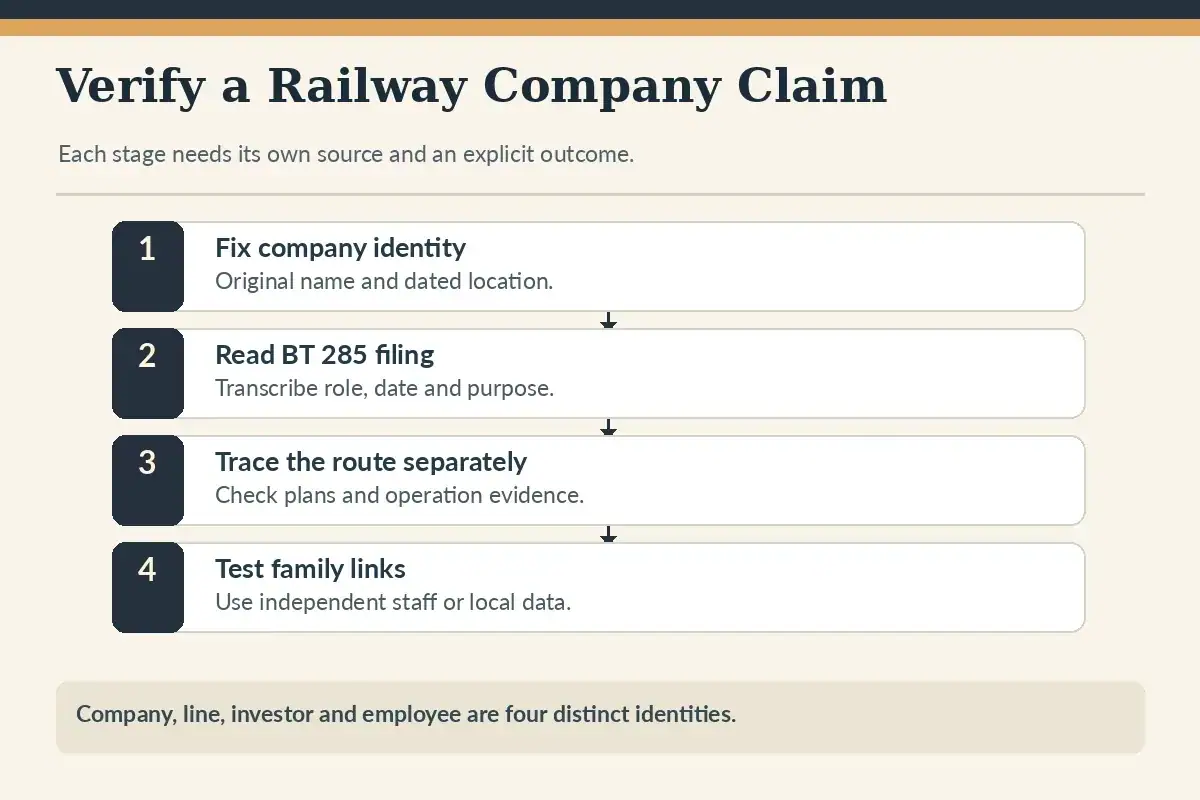
The National Archives advises railway researchers to establish the company associated with a railway before searching. Historic gazetteers and pre-grouping railway atlases can help, but a station used by several companies does not automatically identify its owner. Write down the full corporate name as used at the chosen date, known spelling variants, region and any successor companies. This step is crucial where a proposed route was promoted under a title later altered or absorbed by a different firm.
Check Discovery for the company name within BT 285. Do not assume the reference will be indexed under a family surname, station nickname or modern franchise. If the company is absent, record the years and variants tried. Search for related company records in other series only after establishing whether the firm was registered under the relevant securities law. A no-result search can reflect company history, terminology or incomplete cataloguing.
Understand the 1866 Securities Registration Purpose
The railway guide places BT 285 among the Board of Trade’s records for railway companies, specifically registration papers compiled under the 1866 Act. This indicates a statutory corporate record function. It does not convert the file into a directory of shareholders, payroll staff or passengers. When reading a paper, identify what information is actually declared, the party making the declaration, its administrative date and any accompanying amendment or reference.
Do not assume that an amount mentioned in a securities filing was fully raised, spent locally or received by a named relative. Corporate authorizations, registered officers, financing arrangements and construction spending are separate evidentiary propositions. If a document names an individual, copy the exact recorded capacity, which might involve a registered role rather than employment. To prove that the person was paid wages, seek a suitable company staff or salary record.
Separate a Registered Company from a Constructed Railway
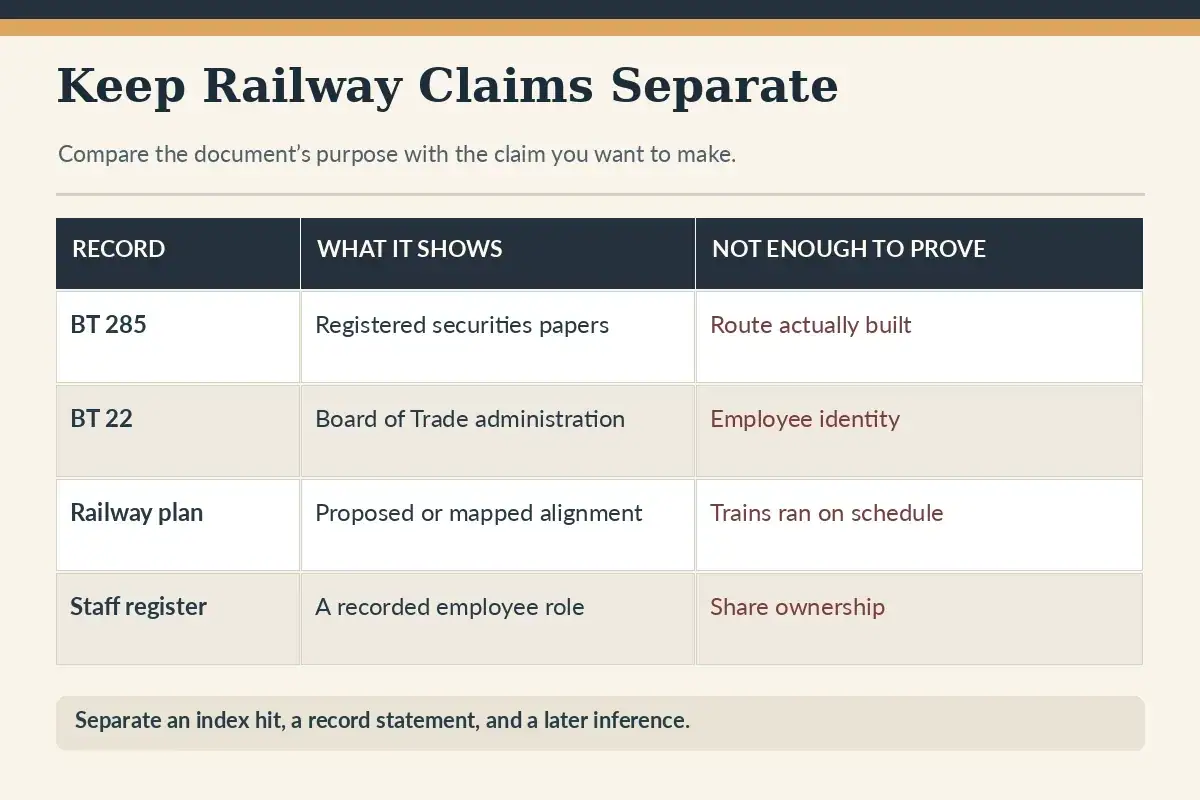
A proposed railway can leave financial or legal records without the intended track ever entering service. If the question concerns construction, compare the registration material with dated engineering plans, government inspection reports or company minute books where preserved. The National Archives railways guide points researchers to separate sources for maps, railway inspection and accident reporting. Each document was made for a different purpose and has different limits.
Avoid drawing a route on a modern map solely from a corporate name. A line called “Western and Northern” may be a proposal, a truncated section or a merged system. Use a dated deposited plan or contemporary map to establish what was proposed, then corroborate with evidence of opening or operation. Never infer local property acquisition or employee residence just because the registered company intended to serve a town.
Find the Correct Companion Records Without Mixing Series
The same guide lists BT 41 for railway company material registered under joint stock legislation and BT 22 for the Board of Trade Railway Department’s administrative papers. These may offer alternative context but are not stages that every BT 285 filing must pass through. It also identifies MT 6 and MT 11 as later Ministry of Transport correspondence series with separate indexes. Choose related records for a specific question, not because a code looks adjacent.
Where you are investigating an officer or clerk rather than the company, turn to the railway-workers guide and its company-specific RAIL references. There is no central universal register of all railway employees. A statutory securities filing should be cited as corporate evidence even if the family story concerns railway work. That distinction avoids mistakenly claiming a railway ancestor simply because the family invested in, promoted or lived near a railway.
Build a Chronology of Corporate Claims and Local Evidence
Imagine a fictional Blackwater Railway Company listed in an 1868 local newspaper. In your ledger, create separate rows for a named company, a securities filing, a planned route, an opening report and any employment claim. Label each row by source and date. The registration would support the legal-paperwork row; only an independent operating record could support an opening claim. Do not fill missing dates with the earliest printed proposal.
If a company was renamed or absorbed, keep a link table with each legal name, dates used and source proving the change. A successor company’s later map does not establish that the predecessor built every segment. Shareholder or officer identity must be checked by contemporary address and role. A strong local history may conclude that the company was registered while the proposed line’s completion remains unresolved.
More House and Local History Guides
How We Research BT 285 Railway Filings
The series attribution comes from The National Archives’ railways guide, which explicitly assigns registration under the 1866 securities legislation to BT 285. Its companies and businesses guide explains the distinction between legal registration files and internal daily business records. Search Discovery by the historic corporate name and record reference to obtain the exact piece before citing it.
Blackwater Railway Company is invented for the workflow. The article does not assume actual amounts, completion or survival of every relevant file. For paid copying or external services see our affiliate disclosure.
Registration papers for railway companies under the Railway Companies Securities Act 1866.
No. A filing and a completed, operating railway are different kinds of evidence.
Start with the historical company name and use person-level records to test an individual role.
No. BT 41 concerns other company registration material; the archive lists BT 285 separately for the securities legislation.
Document each company and successor name against dated sources before combining catalogue results.