
BT 34 is a National Archives series of liquidators’ accounts for companies dissolved between 1890 and 1932. This guide identifies the original record path, shows exactly which claims the source supports, and explains which separate evidence is still needed.
Identify the Legal Company Before Its Liquidator
BT 34 is a National Archives series of liquidators’ accounts for companies dissolved between 1890 and 1932. The Archives’ guide to company records identifies the series but also explains that company records are not uniform, and that official registration and winding-up papers often differ from the company’s own day-to-day business books. An accounting entry cannot stand in for the entire financial, employment or family story of a business.
Begin with the legal company name at the date in question, its registration number if known, a registered office and the time of dissolution. A shop’s trading name, a partnership and an incorporated limited company can look similar in local directories. Do not assume an ancestor ran the company merely because their name appears on a sign, invoice or local advertisement. Establish which registered legal entity is the subject of the account before looking for a family link.
Separate Winding Up, Insolvency, and Dissolution
The National Archives distinguishes voluntary winding-up of a solvent company from insolvent business proceedings. It also distinguishes company liquidation from bankruptcy of firms and individuals. These are different legal and accounting pathways, with different evidence. A dissolved company was removed from its legal register, but dissolution by itself does not reveal whether every creditor was paid or whether a named investor lost money.
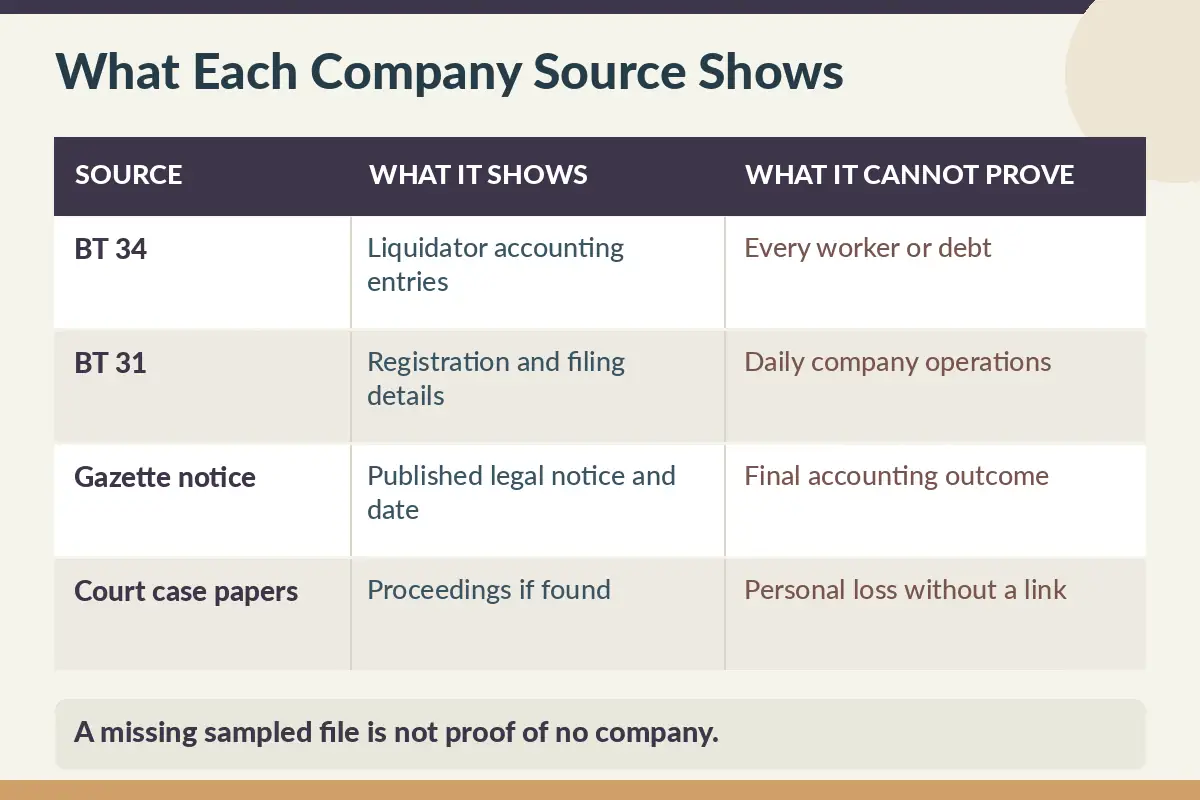
For formal business identity, compare the company with BT 31 registration or dissolution files where a suitable file survives. For liquidation proceedings, the Archives identifies Chancery and Companies Court records such as J 13, J 14 and J 137, depending on date and kind of case. Do not represent that all these series apply to every company. Search The Gazette for a dated notice, remembering that publication of a notice is a documentary event and not a final audit of the underlying debts.

Transcribe the Account at Transaction Level
A liquidator’s account may record receipts, payments, balances and named parties according to its form and period. Examine the actual headings before interpreting a money figure: a sum entered as an asset realized, a fee, a dividend or a pending amount has a different meaning. Preserve monetary units and dates. Never sum two periods as if they were independent transactions without checking for carried balances or repeated entries.
Make a table with the company identity, exact BT 34 piece, account interval, accountant or liquidator, transaction description, amount, and documentary status. Where a figure is uncertain or abbreviated, transcribe it as seen and explain the uncertainty. A settlement shown against a category of creditor does not prove that a particular named relative received cash, unless the original item actually identifies them and the transaction. Equally, one fee does not document the company’s full operating expenditure.
Find the Original Company and Court Trail
The Archives advises that BT 31 registration and dissolution files preserve a sample of companies and are not complete. A missing company file does not mean the company did not exist. A registration number may be recoverable from historical company indexes, directories or Companies House records where appropriate. The Archives also points to liquidators’ accounts in BT 34 and court records as distinct collections. Each needs its own search and its own citation.
An accounting file can refer to an estate, a debtor, a legal claim or a sale, but the context of the transaction may be explained in court or winding-up papers. A notice in The Gazette may help establish petition, appointment or resolution dates. If a family business passed to a successor after winding up, test that using dated trade directories, company filings and property documents. Reuse of a trading name is not proof the original company continued under the same legal ownership.
Test Shareholders and Employees as Separate People
Shareholders, directors, creditors, contractors and employees stand in different legal relationships to an incorporated company. A liquidation account may mention a name without proving which relationship existed, unless the entry states it. The company’s register of directors or shareholder lists, when preserved, provide better direct context for those roles. Even then a recorded share does not automatically prove how much money the holder ultimately received or lost.
For an ancestor said to have worked at the business, search wage records, pension files, union sources or local newspapers. A company in liquidation may continue limited trading while assets are realized; the legal dates and a worker’s actual final day can differ. Treat an address in a filing as a registered office unless independent evidence locates the workshop or residence. Put the question about a specific person in its own evidence column.

State Exactly What the Account Establishes
A useful family-history conclusion is narrow: “A liquidator’s account in BT 34 records this dated payment or receipt during the winding up of the named company.” A broader claim that the firm was bankrupt, that a shareholder lost an inheritance, or that every employee was dismissed needs different records. The National Archives’ custody and sampling guidance makes it important to state which files were actually examined and which remain unlocated.
Preserve both the catalogue finding aid and the precise original account reference, including page or entry where available. Note search failures separately from actual negative evidence. This permits the next researcher to compare company identity, legal proceedings and personal claims without mistaking a ledger transaction for a fully reconstructed corporate collapse.
More Records and Archives Guides
How We Research, Cite Sources, and Test Limits
The record families, dates, historical jurisdiction, index methods, and evidence limitations above were checked against these source pages: The National Archives guide; The National Archives citation guidance; Discovery catalogue guidance. A series description explains what a collection is and where to begin; it does not establish that a particular unseen item contains a given person or that a reported event occurred. We distinguish source transcription from reasonable historical inference, with no invented sample cases presented as real discoveries.
For every claimed match, retain the archive series, precise piece and item where available, the date as written, an access note and the independent source used for identification. Do not interpret a failed name search as proof that an event did not occur when records may be unindexed, missing or organized by place. See our affiliate disclosure; this method requires no paid relationship or endorsement.
No. It contains liquidators’ accounts; different types of winding up and bankruptcy require separate legal evidence.
The National Archives describes liquidators’ accounts for companies dissolved between 1890 and 1932.
Do not assume this. Check company filings, shareholder documentation and separate staff records as relevant.
Check a surviving BT 31 file, historical indexes, company registration number and dated Gazette notices as appropriate.
Only if the original names the relevant party and the transaction, and the person’s identity is supported independently.