
The National Archives directs searches for post-1906 Coastguard and Lifeboat Services correspondence to BT 166. This administrative trail can reveal how a station or service was discussed, but it does not by itself prove a particular lifeboat was launched or name the participants in an incident. Choose the record by date, place and question. This guide gives a precise source route, identifies what the archive can and cannot show, and names the independent documents needed before a personal or geographic conclusion becomes defensible.
Use the 1906 Date Gate Before Searching Names
Coastguard administration moved between different government departments, so the place and date of a question determine where the evidence might be held. The National Archives places Coastguard and Lifeboat Services correspondence dated after 1906 in BT 166, while it points researchers toward MT 9 for records before 1906 and ADM 120 for certain policy papers between 1875 and 1940. These are alternative administrative paths, not a chronological chain every individual event must pass through. Begin by recording the historic station name, coast, jurisdiction and a date window.
Search a station both with and without the word “coastguard,” and look for alternate spellings of its harbour or locality. If you only have the name of a boat, discover its home station independently first. The National Archives warns that Coastguard records are widely scattered because of changes in responsibility. A missing BT 166 catalogue result may indicate a different file arrangement or custodian, not that the boat, station or officer did not exist. Preserve each unsuccessful search with its reference limits.

Understand Administrative Letters and Their Status
A BT 166 file may be found through its subject heading rather than the name of a person mentioned inside. Before interpreting it, describe the document precisely: request, reply, minute, memorandum, draft instruction or report. Capture dates and parties for every item, especially where a letter was forwarded between agencies. A request for a new boat, station building or operational change is not proof that a purchase was made or that an order was put into effect. The corresponding reply may qualify, decline or change what was asked.
Keep one ledger row per action. Useful columns are date, author, receiving office, station, subject, claimed event, formal decision, follow-up and independent source. Where the wording is ambiguous, quote a short exact phrase and explain the uncertainty rather than summarizing it as a definite event. Administrative documents can be valuable evidence of policy or concern, including a reported hazard, but they may not be firsthand witness accounts. If a file says “rescue reported,” seek contemporaneous logs or newspapers before reconstructing the incident.
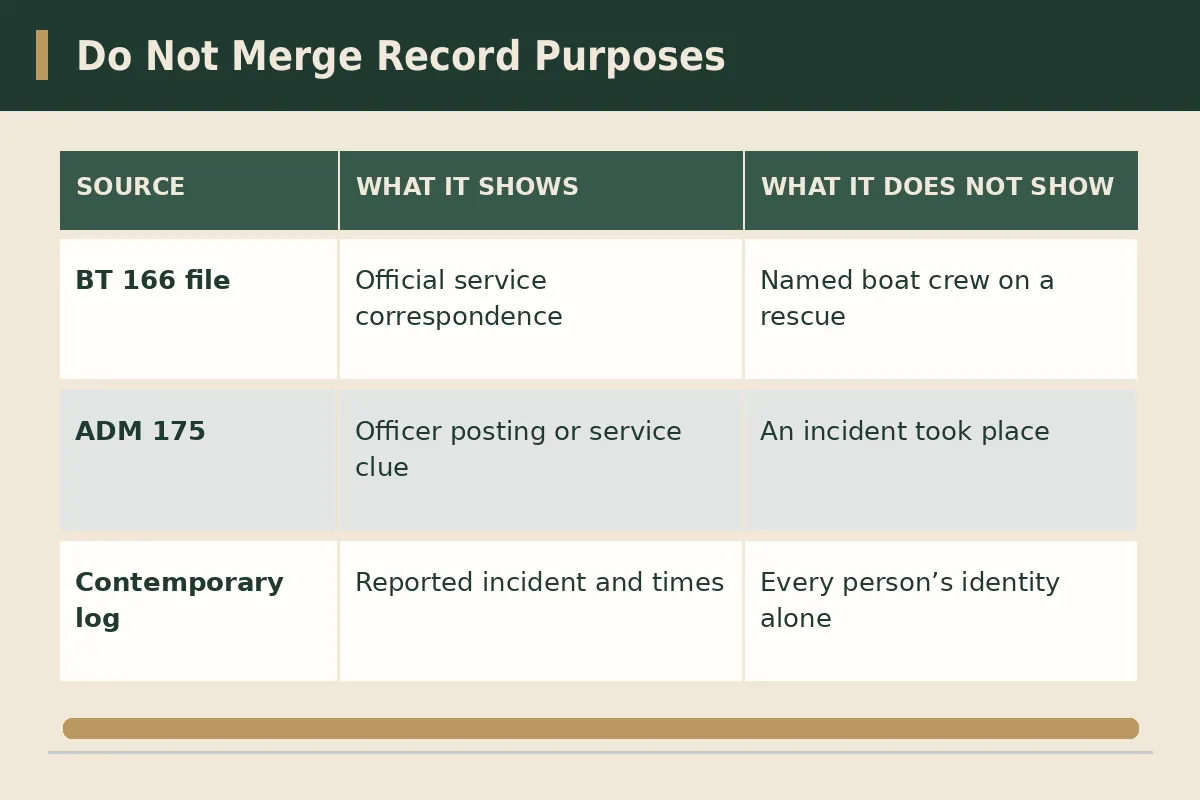
Hypothetical example: a family story credits a relative with a rescue near a named station in 1912. BT 166 correspondence about lifeboat provision may show officials discussing equipment that year. ADM 175 may independently show the relative as a coastguard. Neither is yet proof of participation in the alleged launch. Search an operation log, local report or contemporary account with an exact date before linking the person to the event.
Distinguish a Station File from an Officer’s Career
For an individual coastguard, the National Archives recommends ADM 175 establishment books, appointment registers, service cards and discharge records. The coverage is not comprehensive and arrangements vary by time and geography. ADM 175 may help place a named officer at a station; it is not automatically a list of lifeboat crew for a particular operation. Likewise BT 166 may discuss a station without naming all staff. Link records through explicit dates, ranks, service numbers or postings, not just a shared surname and coastal town.
Remember that a man stationed locally in one year may have moved by the time a reported incident occurred. Build a posting timeline and keep the incident date separate. A service entry supports a particular appointment when the source says so; a later discharge or pension record may support the career interval. Neither proves attendance at every rescue. Local lifeboat institution archives, station minute books or independent press accounts may contain operation-level detail. Those sources must be identified and dated before including individual roles in a family history.
Check Whether an Alleged Rescue Actually Happened
A useful rescue audit has three different questions: was danger reported, was a response authorized or attempted, and did a particular rescue occur? The documents required can differ. A BT 166 letter might be written after an allegation, or before a planned measure. A contemporary log or a dated account may establish an action, but should still be checked against its informant and purpose. Do not fill missing details from a similar incident on the same coast or assume a proposed lifeboat is the one eventually used.
For each supposed event, try a narrow date and location search in local newspapers, harbour authority records, ship logs or records kept by the lifesaving organization. Record a vessel’s correct name and registry where known. If one source claims three people were landed and another says four, preserve both claims before choosing an explanation. A rescue account might not list every rescuer; an absence of names does not disprove participation. The safest conclusion distinguishes the independently corroborated event from the still-unproven identity of an individual.

Record Access and Custody Before Drawing Conclusions
The National Archives advises that Coastguard administrative records covered by its guide are not generally viewable online and may require a visit to Kew or an ordered copy. Use the full BT 166 piece reference and check the “Held by” field for each catalogue result. Other repositories may have local station or lifeboat evidence not duplicated in central government papers. Avoid promising free image access merely because a series description can be found online. A search result is a document locator, not a searchable transcript of all its contents.
If the file cannot be obtained, leave the claim at “identified correspondence” rather than “confirmed rescue.” For an eventual citation record the administrative creator, place, dates, piece reference, document type and the exact words relied upon. Then cite any independent officer, ship or incident source in its own right. This maintains a defensible boundary between the history of a coastal service and the biography of someone believed to have worked there.
Record the result as three separate citations: BT 166 for the administrative correspondence, ADM 175 for the person’s service or posting, and an independently identified contemporaneous incident source for what actually happened. If any link is missing, mark it as unresolved rather than silently bridging it with the family story.
More Records and Archives Guides
How We Research This Archive Series
This guide starts with the documented evidence in an authoritative source, not a claim that we have inspected a particular person’s private file or a specific original piece. The archival statements here concern the series or research method. A hypothetical example is labelled as such; it is not a newly discovered historical event. We use the Discovery search guidance to distinguish keyword matches from archive holdings and document contents, because catalogue descriptions do not transcribe every word of an original.
For every real candidate, record its historical place or person’s name, the creator, document type, date, full BT 166 piece or item reference, access restrictions, and the exact claim being tested. The official citation guide explains how to document those references so another researcher can retrace them. An unread document remains a catalogue lead, never proof of imagined details. If a record is missing, preserve the searched terms and dates and examine survival and alternate custodians before interpreting the gap.
Before sharing a conclusion, audit the difference between original source wording and your interpretation. Require independent evidence for any further claim about an individual, property owner, legal effect, or completed action. Respect archival access limits and living people’s privacy. This website also provides an affiliate disclosure; no paid partnership or commercial access is implied by these archival references.
It contains correspondence and papers relating to Coastguard and Lifeboat Services after 1906.
No. The series is administrative correspondence; find crew evidence independently if needed.
ADM 175 contains various establishment, appointment and service records with incomplete coverage.
No. Check the response and subsequent operational or procurement evidence.
The National Archives warns that the administrative records in its coastguard guide generally require consultation or ordered copies.