
The Royal African Company records in T 70 can provide evidence about ships, voyages, colonial forts, company finances and some people enslaved by the company. They are not a complete nominal register of Africans forced into the Atlantic trade. The collection was created by an organization that profited from enslavement; its accounting language must never be treated as a neutral or complete description of the people whose lives it affected.
The National Archives specifically identifies T 70/1209 (1695–1749) for voyage summaries and people enslaved by the company itself, and T 70/1515–1606 (approximately 1750–1820) among detached papers relating to people enslaved at its West African forts. The broad ranges describe groups of records, not continuous individual histories. Search by date, ship, fort, location and source type before trying to assert a specific person’s identity.
Name the record creator and the ethical limitation first
The Royal African Company was a British trading enterprise whose operations included the trafficking and enslavement of African people. Its books preserve the language and interests of administrators, not a balanced account of those coerced into labor or transportation. When a historical ledger uses a dehumanizing commercial label, quote it only where necessary to explain how the source was organized, and make clear that it refers to people, not to property in any legitimate moral sense.
Before collecting a family claim, write what is known about the source creator, the intended purpose of the document and why a particular person might appear or be omitted. An account could enumerate people collectively yet name a factor or captain individually. Absence of a personal name reflects the record-keeping choices of those in power, not the absence of individual lives, families or resistance.

Use a date-and-purpose gate to select T 70 material
If you are looking for a voyage summary within 1695–1749, the official guidance points to T 70/1209. For detached papers concerning people enslaved at company forts in West Africa around 1750–1820, it identifies T 70/1515–1606. Other T 70 pieces concern accounts, cargoes, correspondence and administrative business. These are different pathways into surviving material, and the dates must not be extended beyond the records without evidence.
A ship can be mentioned in correspondence but absent from an expected register, just as a fort may appear in an expense account without individual names. Work from a dated record reference rather than a generalized story about the whole company. Note the geographical location, the period covered by the piece and the type of information expected before beginning a search for a person.
Read voyage summaries as partial company reporting
A voyage summary can anchor a vessel or commercial operation in a particular interval. It should not be converted into a manifest of everyone aboard or everyone forcibly transported. Ship names may be reused; captains can change; a reported voyage could combine documents created at different stages. Record the exact terminology for each number and avoid converting accounting totals into a fabricated list of named individuals.
Build a row for original reference, vessel, date range, ports or coasts actually named, narrator and entry type. Do not claim an arrival, embarkation or death for a particular person unless a source says so. Other ship, customs or judicial records may preserve a different fragment of the activity; evaluate whether those records are independent or derived from the same company statement.
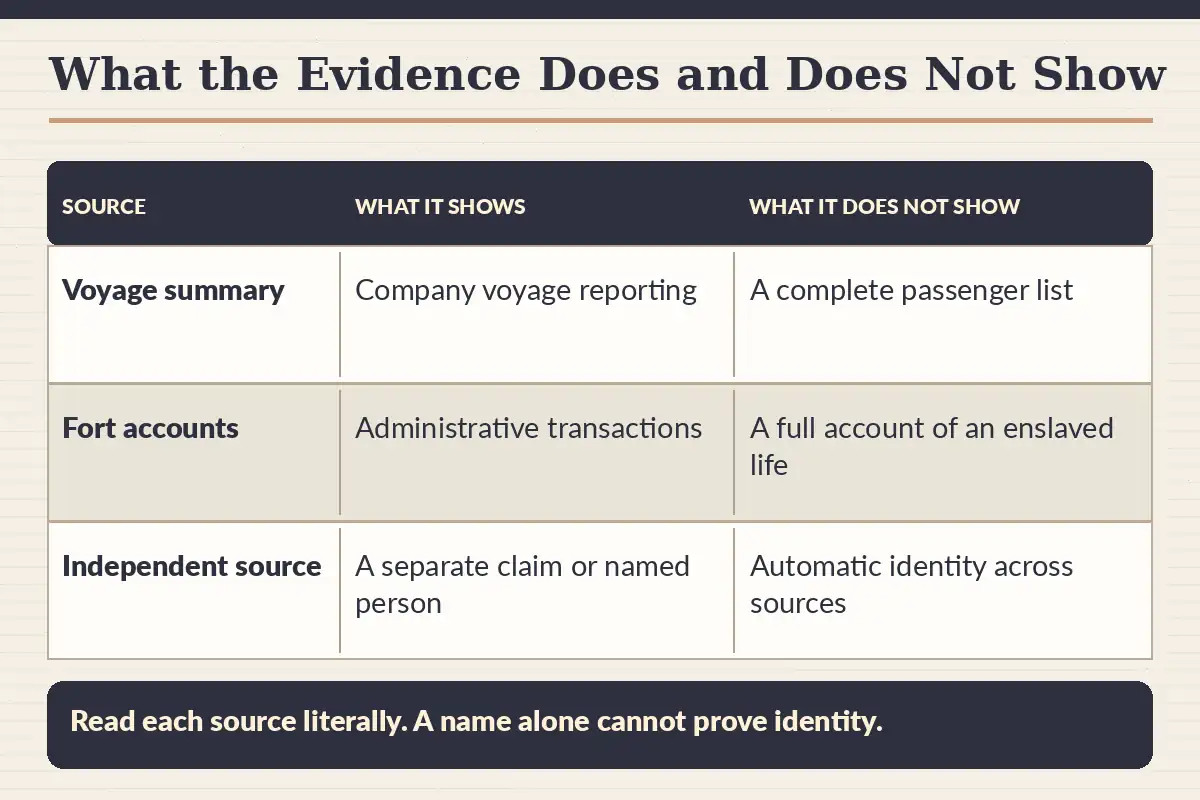
Interpret fort records without constructing an invented biography
Detached fort papers may include correspondence or accounts relating to people enslaved and compelled to work in company settlements. Some entries may include individual identifiers, but surviving names, spellings and relationships can be fragmentary. Avoid assuming that two people identified with similar abbreviated names in different years are one person, or that an administrative designation accurately represents a person’s own identity.
Record the fort, date, author, exact wording and relationship of an entry to any later annotation. A movement between locations or a reported status change requires its own evidence. Where only a collective accounting category survives, the responsible conclusion is that the source reports an institution’s action, not the personal history of each affected individual. Leave uncertainty visible instead of supplying missing names.
Compare outside records while tracking colonial bias
The TNA guides note related records such as customs accounts, port books and legal papers that can illuminate trade routes and administrative decisions. Surviving materials are uneven. An outside ledger that repeats company figures may not corroborate them independently; a contemporary court testimony or locally preserved community source may provide a different perspective, although each also has its own limitations.
Build a source-dependency column. Record whether a figure came from a company account, a governmental return that copied it or a separately generated report. Use identifiable places and time windows to formulate precise next searches. If investigating an ancestor, do not connect a modern surname to an unnamed person in a voyage aggregate. The relevant question is what identifying evidence survives, not whether the story seems plausible.

Write a result that preserves names and absences accurately
A strong finding separates an archive description, a transcription of an original account and an inference. You might state that a specific T 70 piece records a voyage or fort transaction, while no surviving record yet identifies an individual affected by it. That conclusion is not a research failure; it marks the historical limits of the material and the archival silences created by exploitation.
Cite every piece, folio or page viewed; distinguish catalogue summaries from documents actually consulted. Keep original terms within quotation marks when the language matters and provide explanatory context. Share information about identifiable descendants or living families with appropriate care. A sensitive research account does not claim certainty where violence, displacement and asymmetric survival have made the evidence incomplete.
Build a claim-by-claim source ledger
A useful research ledger records the full repository and piece reference, original document creator, item date, reported event date, precise place, name and documentary role of every relevant person, actual quotation, scope of the source, access method and search terms tried. Include a column for the claim not proved. Choose the voyage-summary material, detached fort papers or other T 70 records by the question and document date; these are alternative groups, not a single person-level timeline. If a piece does not cover the relevant interval, a failed search is only a failed search of that portion of the archive, not evidence that the event did not occur.
Once you have a likely entry, connect it to a separately created record that actually speaks to your question. Commercial categories and gaps in names must not erase the humanity of enslaved people. If two sources repeat the same statement, note that they may not be independent. Do not substitute a catalogue result for an inspected original, and never turn a missing name into an invented identity. Record disagreements and competing hypotheses with a concrete next document that might resolve them.
More Records and Archives Guides
How We Research and Verify the Sources
We consulted the official archival research guidance on 2026-11-03. The National Archives identifies T 70/1209 and T 70/1515–1606, their dates and differences, and cautions that these archives cannot be searched online by the names of enslaved people. This establishes the documented route and limitations, not proof that a particular ancestor appears in the collection.
We consulted the official archival research guidance on 2026-11-03. The National Archives describes T 70 as records of the Royal African Company, its voyage and fort accounts and their creation from the perspective of people managing the trade. This establishes the documented route and limitations, not proof that a particular ancestor appears in the collection.
Our original illustrations are explanatory artworks, not reproductions of an archival item. We do not imply any paid affiliation or access arrangement. See the affiliate disclosure.
The National Archives says these Royal African Company records cannot generally be searched online by those names.
The guide identifies voyage summaries and some information concerning people enslaved by the company, dated 1695–1749.
They are described as detached papers, approximately 1750–1820, including material concerning enslaved people at West African forts.
No. Its purpose and preservation differ from a complete person-level passenger manifest.
Quote only when evidentially necessary, identify their colonial origin, and describe enslaved people as people.