
Treasury T 64 Shipping Returns: Trace a Port Entry Without Inventing a Voyage is an evidence-first guide to Treasury T 64 shipping returns, not a promise that one archival item can reconstruct a complete biography. Start with the archive’s stated scope, record the exact entry and date, and separate the administrative act from the larger historical conclusion. The National Archives series guidance establishes the first search route; a related official research guide explains the next evidentiary checks. Use the route below to find what a record actually says before inferring a person, voyage, estate, or event.
Recognize What a Treasury Shipping Return Is
T 64 is described by The National Archives as miscellaneous Treasury records containing ships entered and cleared, plantation shipping returns, and miscellaneous returns from Scotland. The label does not designate a single, uniformly structured ship register. A return might be a count or summary prepared for financial administration; another might list vessels. The first task is therefore to read the item description and decide whether it can answer a named-ship question at all.
Start with the place, approximate year, and the action you are researching: entry into a port, clearance out of it, a plantation return, or a Scottish summary. Do not substitute a modern national border or port authority for the administration that produced the historical return. The geographical scope may be narrower or differently organized than the name on a later map suggests.
Separate Entered Ships From Cleared Ships
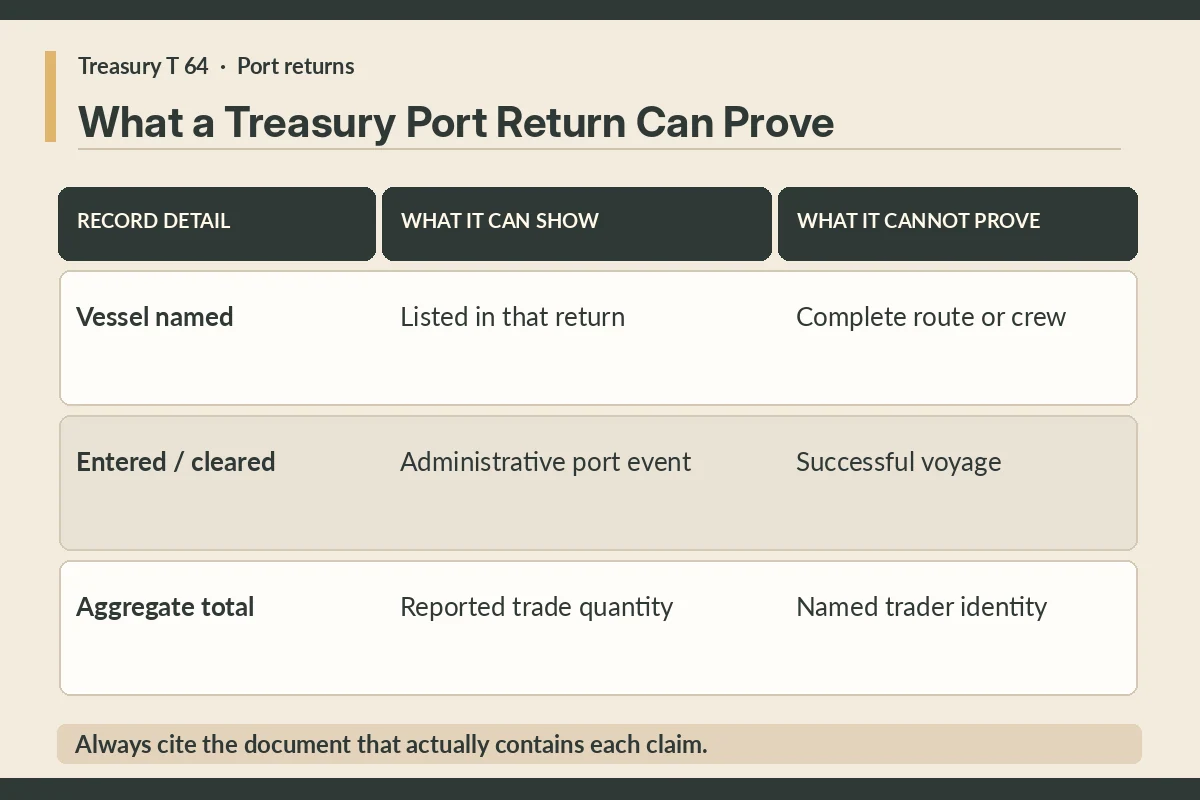
A ship entered in a port list has been recorded in that administrative category. A ship cleared has been processed for departure. Neither item proves uninterrupted movement to a distant destination. A clearance may precede delay, diversion, loss, or a change of voyage. Record the return’s exact verb, date, port and unit of account rather than paraphrasing all entries as successful voyages.
If both arrival and clearance appear, do not assume two lines describe the same journey without comparing ship name, master, tonnage and date. A port might have successive vessels of the same name. Similarly, an arrival from one named place may identify a prior reporting point but not every earlier stop. The safest reconstruction preserves what each port authority actually reported.

Choose Plantation and Scottish Returns Carefully
The archive guide names plantation shipping and Scottish returns among T 64 holdings. Those categories matter because the forms, years and administrative purpose can vary. A plantation shipping list may have been created for trade oversight; a Scottish return may use another reporting route. Do not project fields from a London port book onto a return created elsewhere.
Inspect the relevant piece description before ordering or copying records. Identify any quoted series title, port, accounting period, and original author. If you cannot establish the exact jurisdiction, write a place-name question in your notes instead of silently choosing a colony or county. That uncertainty can guide the next catalogue search.
Keep Aggregate Trade Figures Distinct From People
Some returns summarize shipping quantities, tonnage or traffic rather than individual names. An aggregate does not identify a master, merchant, crew member or enslaved person. Even a named master should not be treated automatically as the ship’s owner. Ownership, command, trading partnership and employment are different legal or practical relationships, documented in different sources.
When interpreting colonial returns, consider whose movement the administration counted and whose presence it omitted. Administrative shipping statistics can obscure forced labor, passengers and maritime workers. Avoid converting counts of vessels or cargo into unsupported personal narratives. Describe what the record captures and acknowledge populations it does not directly name.
Cross-Identify the Vessel in Registration Records
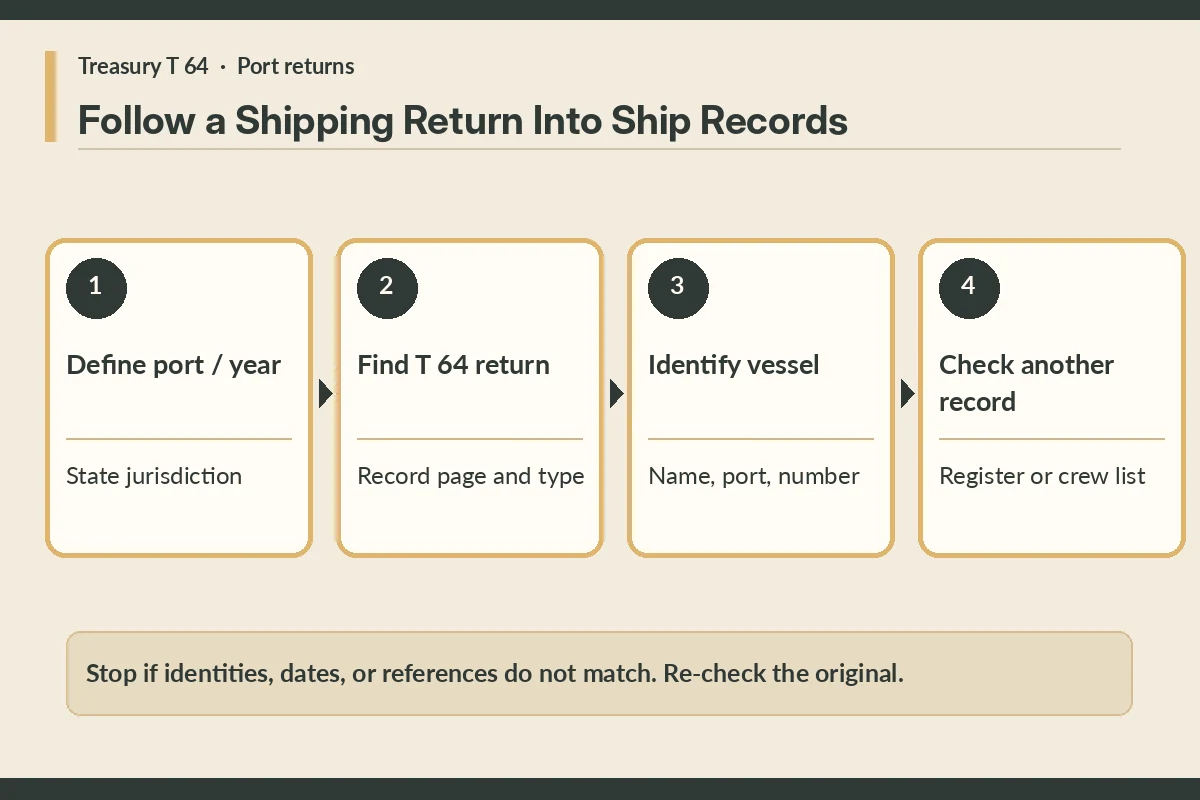
To connect a T 64 entry to a particular hull, search merchant-ship registration or contemporary port records. Use the vessel name with port, approximate year, master and any official number available in the later period. A name alone can be shared, changed, or mistranscribed. A ship’s measured tonnage can help but may have been calculated differently over time.
Keep a separate column for each evidence layer: T 64 return, ship register, crew agreement and other port evidence. Cite each reference exactly. Only after identifiers align should you write that a ship found in one source is likely the same vessel as the ship in another; even then, explain contradictory particulars rather than concealing them.
Use Treasury Papers for Administrative Context
T 1 contains Treasury correspondence, including some colonial and customs shipping material. The National Archives warns that finding early Treasury correspondence may require calendars or registers rather than a simple keyword search. A letter about a return might explain why a statistic was requested, changed, disputed or submitted late, but it does not automatically validate every figure in a separate T 64 schedule.
Search the correspondence by sender, period and administrative subject when a return raises questions. Compare reported dates: document creation, Treasury receipt and the period measured by the return are not necessarily the same. If the figures were later corrected, note both versions and the evidence for the revision.
Work Through a Port Clearance Example
Imagine a return that lists a vessel as cleared from a Caribbean port in a given month. A defensible finding is the named clearance in that return. It does not show that the ship reached Britain, carried a named worker, or followed the same route described in a later newspaper. Match the name and master to registration records before linking the clearance to another departure or arrival.
If the original return reports only a count of vessels, the evidence is still narrower. Keep the total and its reporting period; do not invent a list of individual ships from that aggregate. A second return may change the number without implying fraud or disappearance: altered accounting rules, delayed reports or clerical corrections all require checking.
More Records and Archives Guides
How We Research Port History from Returns
We preserve the descriptive chain: catalogue record, original T 64 return, precise port event, and any independent ship evidence. A ship’s appearance in a list justifies a narrow finding such as “reported as cleared at this port on this date.” It does not justify claims about the crew, full voyage or later fate without further material.
For complex colonial research, we also note contemporary terminology and the administrative viewpoint that produced the return, rather than endorsing it. Research-source links are not proof of a commercial relationship. See the site’s affiliate disclosure for how reader-facing recommendations are handled.
The National Archives identifies miscellaneous Treasury material including lists of ships entered and cleared, plantation shipping returns, and returns from Scotland.
It is not a reliable person-level register. Begin with port, period, vessel, and return type, then search independent crew records if you need a sailor.
No. A port clearance is an administrative departure record. Later arrival and completed route require independent documentation.
No. Some are totals or summary lists and others name vessels. Inspect the specific item rather than assuming every volume has the same fields.
Use the port, time period, master if listed, registry and official number where available; distinguish contemporaneous vessels rather than merging them.